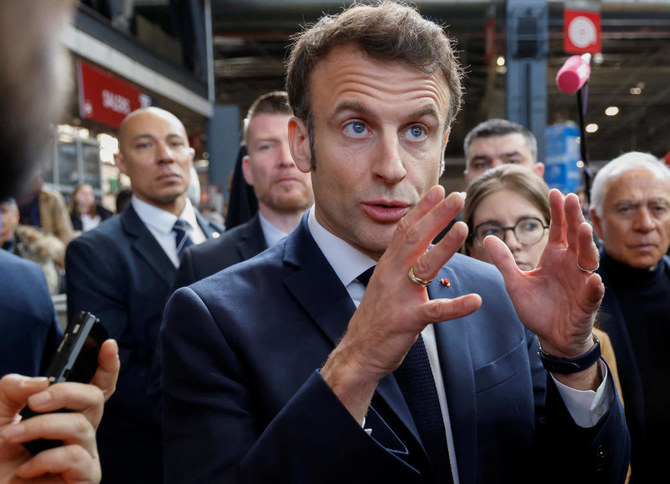
PARIS: French President Emmanuel Macron on Saturday said he would visit China in early April and called on Beijing to “help us pressure Russia” to end the war in Ukraine.
Speaking a day after China called for urgent peace talks as it released its plan to end the war in Ukraine, Macron said peace was only possible if “the Russian aggression was halted, troops withdrawn and territorial sovereignty of Ukraine and its people was respected.”

Macron says will visit China in ‘early April’
https://arab.news/mqkx3
Macron says will visit China in ‘early April’
NATO wants ‘automated’ defenses along borders with Russia: German general
- That zone would act as a defensive buffer before any enemy forces advanced into “a sort of hot zone,” said Lowin
- The AI-guided system would reinforce existing NATO weapons and deployed forces, the general said
FRANKFURT: NATO is moving to boost its defenses along European borders with Russia by creating an AI-assisted “automated zone” not reliant on human ground forces, a German general said in comments published Saturday.
That zone would act as a defensive buffer before any enemy forces advanced into “a sort of hot zone” where traditional combat could happen, said General Thomas Lowin, NATO’s deputy chief of staff for operations.
He was speaking to the German Sunday newspaper Welt am Sonntag.
The automated area would have sensors to detect enemy forces and activate defenses such as drones, semi-autonomous combat vehicles, land-based robots, as well as automatic air defenses and anti-missile systems, Lowin said.
He added, however, that any decision to use lethal weapons would “always be under human responsibility.”
The sensors — located “on the ground, in space, in cyberspace and in the air” — would cover an area of several thousand kilometers (miles) and detect enemy movements or deployment of weapons, and inform “all NATO countries in real time,” he said.
The AI-guided system would reinforce existing NATO weapons and deployed forces, the general said.
The German newspaper reported that there were test programs in Poland and Romania trying out the proposed capabilities, and all of NATO should be working to make the system operational by the end of 2027.
NATO’s European members are stepping up preparedness out of concern that Russia — whose economy is on a war footing because of its conflict in Ukraine — could seek to further expand, into EU territory.
Poland is about to sign a contract for “the biggest anti-drone system in Europe,” its defense minister, Wladyslaw Kosiniak-Kamysz, told the Gazeta Wyborcza daily.
Kosiniak-Kamysz did not say how much the deal, involving “different types of weaponry,” would cost, nor which consortium would ink the contract at the end of January.
He said it was being made to respond to “an urgent operational demand.”


