

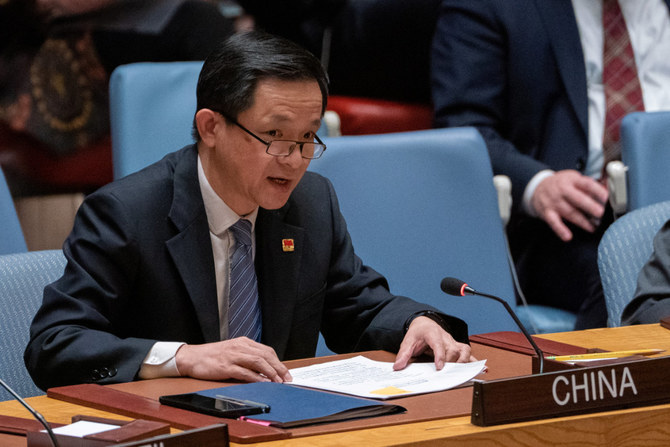

BEIJING: China called Friday for urgent peace talks as it released its plan to end the war in Ukraine, but several Western powers rebuffed the proposals while warning against Beijing’s closening ties to Moscow.
The United Nations expressed cautious optimism over the Chinese proposals, particularly over the document’s call to avoid using nuclear weapons.
Russia reacted positively to Beijing’s efforts and Ukrainian President Volodymyr Zelensky offered a muted response, saying Kyiv needed to “work with China” on approaches to put an end to the year-old war.
Zelensky told reporters he was planning to meet with Xi Jinping after the Chinese leader’s government called for the peace talks, saying it would “be important for world security.”
China’s 12-point paper calling for a “political settlement” of the crisis follows accusations from the West that China is considering arming Russia, a claim Beijing has dismissed as false.
Timed to coincide with the first anniversary of Russia’s invasion of Ukraine, the paper urges all parties to “support Russia and Ukraine in working in the same direction and resuming direct dialogue as quickly as possible.”
It also makes clear its opposition to not only the use of nuclear weapons, but the threat of deploying them, after Russian President Vladimir Putin threatened to use Moscow’s atomic arsenal in the conflict.
Russia said Friday it appreciated Beijing’s efforts to settle the conflict but insisted any solution should recognize Kremlin control over four Ukrainian regions.
“We highly value the sincere desire of our Chinese friends to contribute to the settlement of the conflict in Ukraine through peaceful means,” the foreign ministry said, but added any settlement must recognize “the new territorial realities.”
China’s document was immediately met by skepticism from Ukraine’s allies, with NATO chief Jens Stoltenberg saying Beijing “doesn’t have much credibility because they have not been able to condemn the illegal invasion of Ukraine.”
“Putin is applauding it, so how could it be any good?” US President Joe Biden told ABC in an interview broadcast Friday.
And German President Frank-Walter Steinmeier said that while “every constructive suggestion that brings us closer on the path to a just peace is highly welcome... whether global power China wants to play such a constructive role is still doubtful.”
At a press conference in Beijing, Ukrainian and EU diplomats urged China to do more to press Russia to end the conflict.
Jorge Toledo, the EU ambassador to China, said Beijing has a “special responsibility” as a permanent member of the UN Security Council to uphold peace.
At the United Nations, Secretary-General Antonio Guterres’s spokesman said “I think the call on the need to avoid the use of nuclear weapons is particularly important.”
China has sought to position itself as a neutral party in the conflict while maintaining close ties with strategic ally Russia.
Top Chinese diplomat Wang Yi on Wednesday met with Putin and Russia’s foreign minister, Sergei Lavrov, in Moscow.
A meeting readout published by Chinese state news agency Xinhua quoted Wang as saying China was willing to “deepen political trust” and “strengthen strategic coordination” with Russia.
Since Russian tanks rolled into Ukraine, China has offered Putin diplomatic and financial support, but refrained from overt military involvement or sending lethal arms.
“I don’t anticipate a major initiative on the part of China providing weaponry to Russia,” Biden told ABC. “We’d impose severe sanctions on anyone who has done that.”
Leaders at a virtual Group of Seven summit Friday also warned countries they will face “severe costs” if they continue helping Russia evade international sanctions imposed over its invasion.


