Palestinian nurse spots own father among dying casualties from Israel raid

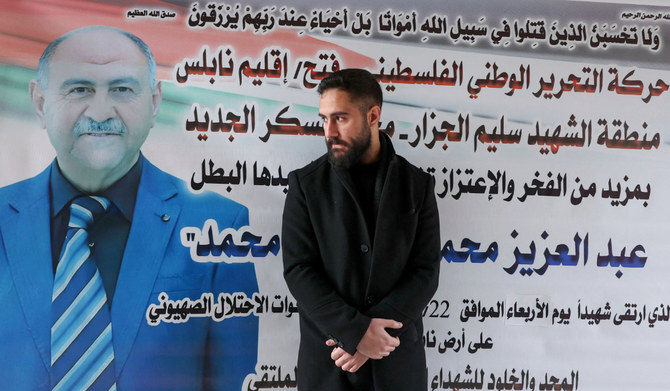
Palestinian nurse Elias al-Ashqar stands by a billboard bearing an obituary for his father Abdel Aziz, on February 24, 2023, who died during an Israeli raid in Nablus in the occupied West Bank two days earlier. (AFP)
Short Url
Updated 25 February 2023
Follow

Palestinian nurse spots own father among dying casualties from Israel raid

  • Ashqar said his father Abdel Aziz, 65, had been returning from prayers in the Old City when he was caught up in the Israeli incursion

NABLUS, Palestinian Territories: When Israel conducted its deadliest raid in the occupied West Bank in almost two decades this week, a young Palestinian nurse rushed to help.
As critical case after critical case succumbed to their wounds, Elias Al-Ashqar, 25, let out a blood-curdling roar.
“My father! My father,” he screamed, as he realized his dad was among the 11 people killed in the raid on the flashpoint city of Nablus.
“I was on my regular shift in the hospital on Wednesday morning. I was busy with a group of medical students from An-Najah University,” Ashqar told AFP.
It was then that the emergency department alarm bell sounded, warning of multiple incoming casualties, an increasingly frequent occurrence amid the growing violence of recent months.
As he entered, he saw two people on opposite beds. “The doctors were trying to resuscitate them,” he told AFP, tears welling in his eyes.
“I helped the doctors with the first patient. He was young but soon died, so I tried to help save the life of the second man without looking at his face.
“The doctors were trying to resuscitate him, so I left them to help other cases... but I had a strange feeling the second wounded man belonged to me.
“I ran back and asked about him, and they told me that he had been martyred, so I subconsciously pulled back the curtain, and discovered that the martyr was my father.”
Ashqar said his father Abdel Aziz, 65, had been returning from prayers in the Old City when he was caught up in the Israeli incursion. He said his father was unarmed.
Recent clashes in Nablus are at least partly the result of the emergence of a new militant group in the city dubbed the Lions’ Den, that claims to rise above traditional factional loyalties and has been blamed for a number of attacks on Israeli targets.
Israel said Wednesday’s raid targeted two Lions’ Den members, as well as a member of the Islamic Jihad militant group.
As young men lined up to offer their condolences on Friday, Ashqar said his father had simply been going about his everyday life and lamented the prospects of ever winning justice for him.
“I don’t know whether the Palestinian person is different to the European or American person,” he said.
“We just wish we could have a life, we just want a life.”


Gaza’s Rafah border crossing has reopened but few people get through

Updated 11 sec ago
Follow

Gaza’s Rafah border crossing has reopened but few people get through

  • Restrictions negotiated by Israeli, Egyptian, Palestinian and international officials meant that only 50 people would be allowed to return to Gaza each day
  • Amid confusion around the reopening, the Rafah crossing was closed Friday and Saturday

KHAN YOUNIS, Gaza Strip: When the Rafah border crossing between Gaza and Egypt finally reopened this week, Palestinian officials heralded it as a “window of hope” after two years of war as a fragile ceasefire deal moves forward.
But that hope has been sidetracked by disagreements over who should be allowed through, hourslong delays and Palestinian travelers’ reports of being handcuffed and interrogated by Israeli soldiers.
Far fewer people than expected have crossed in both directions. Restrictions negotiated by Israeli, Egyptian, Palestinian and international officials meant that only 50 people would be allowed to return to Gaza each day and 50 medical patients — along with two companions for each — would be allowed to leave.
But over the first four days of operations, just 36 Palestinians requiring medical care were allowed to leave for Egypt, plus 62 companions, according to United Nations data. Palestinian officials say nearly 20,000 people in Gaza are seeking to leave for medical care that they say is not available in the war-shattered territory.
Amid confusion around the reopening, the Rafah crossing was closed Friday and Saturday.
Hours of questioning
The Rafah crossing is a lifeline for Gaza, providing the only link to the outside world not controlled by Israel. Israel seized it in May 2024, though traffic through the crossing was heavily restricted even before that.
Several women who managed to return to Gaza after its reopening recounted to The Associated Press harsh treatment by Israeli authorities and an Israeli-backed Palestinian armed group, Abu Shabab. A European Union mission and Palestinian officials run the border crossing, and Israel has its screening facility some distance away.
Rana Al-Louh, anxious to return two years after fleeing to Egypt with her wounded sister, said Israeli screeners asked multiple times why she wanted to go back to Gaza during questioning that lasted more than six hours. She said she was blindfolded and handcuffed, an allegation made by others.
“I told them I returned to Palestine because my husband and kids are there,” Al-Louh said. Interrogators told her Gaza belonged to Israel and that “the war would return, that Hamas won’t give up its weapons. I told him I didn’t care, I wanted to return.”
Asked about such reports, Israel’s military replied that “no incidents of inappropriate conduct, mistreatment, apprehensions or confiscation of property by the Israeli security establishment are known.”
The Shin Bet intelligence agency and COGAT, the Israeli military body that handles Palestinian civilian affairs and coordinates the crossings, did not respond to questions about the allegations.
The long questioning Wednesday delayed the return to Gaza of Al-Louh and others until nearly 2 a.m. Thursday.
Later that day, UN human rights officials noted a “consistent pattern of ill-treatment, abuse and humiliation by Israeli military forces.”
“After two years of utter devastation, being able to return to their families and what remains of their homes in safety and dignity is the bare minimum,” Ajith Sunghay, the agency’s human rights chief for the occupied Palestinian territories, said in a statement.
Numbers below targets

Officials who negotiated the Rafah reopening were clear that the early days of operation would be a pilot. If successful, the number of people crossing could increase.
Challenges quickly emerged. On the first day, Monday, Israeli officials said 71 patients and companions were approved to leave Gaza, with 46 Palestinians approved to enter. Inside Gaza, however, organizers with the World Health Organization were able to arrange transportation for only 12 people that day, so other patients stayed behind, according to a person briefed on the operations who spoke on condition of anonymity because they were not authorized to speak to the media.
Israeli officials insisted that no Palestinians would be allowed to enter Gaza until all the departures were complete. Then they said that since only 12 people had left Gaza, only 12 could enter, leaving the rest to wait on the Egyptian side of the border overnight, according to the person briefed on the operations.
Crossings picked up on the second day, when 40 people were allowed to leave Gaza and 40 to enter. But delays mounted as many returning travelers had more luggage than set out in the agreement reached by negotiators and items that were forbidden, including cigarettes and water and other liquids like perfume. Each traveler is allowed to carry one mobile phone and a small amount of money if they submit a declaration 24 hours ahead of travel.
Each time a Palestinian was admitted to Egypt, Israeli authorities allowed one more into Gaza, drawing out the process.
The problems continued Wednesday and Thursday, with the numbers allowed to cross declining. The bus carrying Wednesday’s returnees from the crossing did not reach its drop-off location in Gaza until 1:40 a.m. Thursday.
Still, some Palestinians said they were grateful to have made the journey.
As Siham Omran’s return to Gaza stretched into early Thursday, she steadied herself with thoughts of her children and husband, whom she had not seen for 20 months. She said she was exhausted, and stunned by Gaza’s devastation.
“This is a journey of suffering. Being away from home is difficult,” she said. “Thank God we have returned to our country, our homes, and our homeland.”
Now she shares a tent with 15 family members, using her blouse for a pillow.