ANKARA: The death toll from the earthquakes in Turkiye and Syria that struck on Feb. 6 surpassed 50,000 on Friday after Turkiye declared more than 44,000 people died.
The Disaster and Emergency Management Authority (AFAD) said the death toll in Turkiye due to earthquakes rose to 44,218 on Friday night.
With Syria’s latest announced death toll of 5,914, the combined death toll in the two countries rose to above 50,000.
This comes as Turkiye has begun work to rebuild homes following this month’s devastating earthquakes, a government official said on Friday.
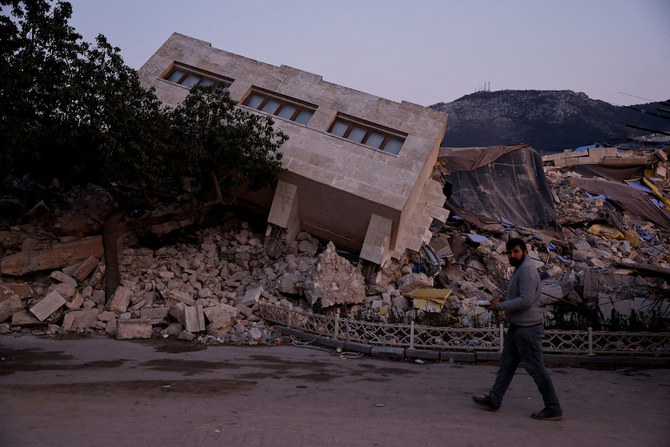
More than 160,000 buildings containing 520,000 apartments collapsed or were severely damaged in the Feb. 6 earthquakes that killed tens of thousands in Turkiye and neighboring Syria.
President Tayyip Erdogan has pledged to rebuild homes within a year, although experts have said the authorities should put safety before speed. Some buildings that were meant to withstand tremors crumbled in the latest earthquakes.
“For several projects, tenders and contracts have been done. The process is moving very fast,” the official said, speaking on condition of anonymity, adding there would be no compromise on safety.
Authorities say tents have been dispatched for the many who are homeless, but people have reported trouble accessing them.
“I have eight children. We are living in a tent. There is water on top (of the tent) and the ground is damp. We are asking for more tents and they don’t give them to us,” Melek, 67, who was waiting in a line to collect aid outside a high school in the town of Hassa.
The school was being used as an aid distribution center by a group of volunteers called Interrail Turkiye. One volunteer, Sumeyye Karabocek, said the shortage of tents remained the biggest problem.
Erdogan’s government has endured a wave of criticism over both its response to the devastation and what many Turks say were years of non-enforcement of construction quality control.
The Turkish government’s initial plan now is to build 200,000 apartments and 70,000 village houses at a cost of at least $15 billion, he said. US bank JPMorgan had estimated rebuilding houses and infrastructure will cost $25 billion.
The UNDP said it estimated that the destruction has left 1.5 million people homeless, with 500,000 new homes needed.
It said it had requested $113.5 million from the $1 billion in funds appealed for by the United Nations last week, adding that it would focus this money on clearing away mountains of rubble.
The UNDP estimates that the disaster had produced between 116 million and 210 million tons of rubble, compared with 13 million tons of rubble after the earthquake in northwest Turkiye in 1999.
Turkiye also issued new regulations under which companies and charities can build homes and workplaces to donate to the urbanization ministry for people in need.
Many survivors have left the region of southern Turkiye that was hit by the quake or have been settled in tents, container homes and other government-sponsored accommodation.
In Antakya, Saeed Sleiman Ertoglu, 56, loaded up what remained of his stock from his waterpipe shop that was not damaged.
“The glassware was very beautiful, more than usual, but then we had this (earthquake), and it all got ruined,” he said, after his home and shop survived the first tremors but not the later one. He estimated that just 5 percent of his merchandise survived.
“What can we do?,” he said. “This is an act of God, and God’s will always bears gifts.”
(With Reuters)


![]()
Earthquake death toll surpasses 50,000 in Turkiye and Syria

Short Url
https://arab.news/cy6za
Earthquake death toll surpasses 50,000 in Turkiye and Syria

Latest updates


© 2026 SAUDI RESEARCH & PUBLISHING COMPANY, All Rights Reserved And subject to Terms of Use Agreement.