Court issues arrest warrants against Pakistani interior minister in ‘terrorism’ case

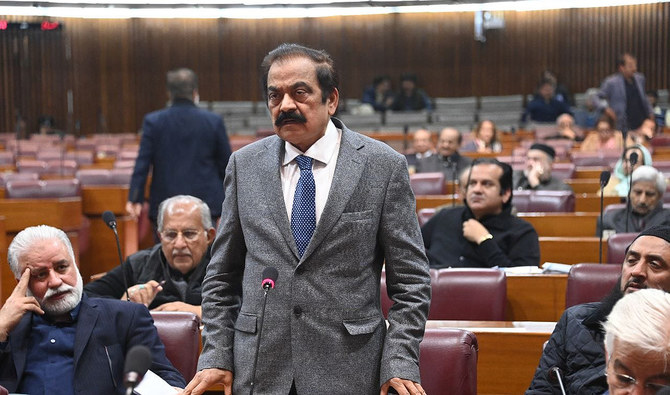
Pakistan's Interior Minister Rana Sanaullah addresses on the floor of the National Assembly of Pakistan in the federal capital Islamabad on January 31, 2023. (Photo courtesy: Twitter/NAofPakistan)
Short Url
Updated 24 February 2023
Follow

Court issues arrest warrants against Pakistani interior minister in ‘terrorism’ case

  • In Pakistan, court cases against politicians are commonly used as a tool of intimidation
  • Rana Sanaullah was last year acquitted in narcotics case filed during tenure of last government

ISLAMABAD: A Pakistani anti-terrorism court on Friday issued bailable arrest warrants against Interior Minister Rana Sanaullah in a terrorism case filed over allegations he had threatened judges and government officials during public comments.

In December last year, a special court in Lahore acquitted Sanaullah in a narcotics case filed against him during the previous government of former Prime Minister Imran Khan. Sanaullah says the case was filed by opponents to politically victimize him.

The terrorism case was filed against Sanaullah in August last year.

The first information report (FIR) stated that "the interior minister had threatened to stop the judiciary from doing its job and kill the children of the Punjab police officials,” Dawn reported.

An antiterrorism court in Gujrat took up the case today, Friday, and directed law enforcers to arrest and produce the minister before the ATC on March 7.

The case was registered on the complaint of a citizen, Sheikh Shekaz Aslam, under Section 7 of the Anti-Terrorism Act (punishment for acts of terrorism), and sections 353 (assault or criminal force to deter public servant from discharge of his duty), 186 (obstructing public servant in discharge of public functions), 189 (threat of injury to public servant) and 506 (punishment for criminal intimidation) of the Pakistan Penal Code.

The FIR reproduced Sanaullah’s remarks aired on Geo News programme ‘Naya Pakistan.’

“The purpose of Sanaullah’s statements was to terrorise the judiciary, chief secretary, commissioner and people of the country,” the FIR said. “His aim was to stop the officials from working and prevent them from fulfilling their lawful responsibilities.”

It added that the minister’s speeches had created fear among the judiciary, bureaucracy, police, administration and the public, adding that Sanaullah should be probed for his comments and punished “to create an example for other citizens speaking against government officials.”

In Pakistan, court cases against politicians are commonly used as a tool of intimidation.


Pakistan, seven Muslim countries condemn new Israeli measures aimed at annexing West Bank

Updated 11 sec ago
Follow

Pakistan, seven Muslim countries condemn new Israeli measures aimed at annexing West Bank

  • Israel approves steps to make it easier for settlers to buy land in West Bank, grant Israeli authorities more enforcement powers over Palestinians
  • Foreign ministries of Pakistan, Egypt, Jordan, United Arab Emirates, Indonesia, Türkiye, Saudi Arabia and Qatar issue joint condemnation 

ISLAMABAD: Pakistan and seven Arab and Muslim states on Monday jointly condemned recent Israeli decisions to impose new legal and administrative measures in the occupied West Bank, saying they amount to an attempt to enforce unlawful sovereignty and accelerate annexation of Palestinian territory.

The West Bank is among the territories that the Palestinians seek for a future independent state. Much of it is under Israeli military control, with limited Palestinian self-rule in some areas run by the Western-backed Palestinian Authority (PA).

Israel’s security cabinet approved a series of steps on Sunday that would make it easier for settlers in the occupied West Bank to buy land while granting Israeli authorities more enforcement powers over Palestinians. The measures reportedly include scrapping decades-old regulations that prevent Jewish private citizens buying land in the West Bank. They are also reported to include allowing Israeli authorities to administer some religious sites, and expand supervision and enforcement in areas under PA administration in matters of environmental hazards, water offenses and damage to archaeological sites.

In a joint statement issued in Islamabad, the foreign ministries of Pakistan, Egypt, Jordan, the United Arab Emirates, Indonesia, Türkiye, Saudi Arabia and Qatar said Israel had no sovereignty over the occupied Palestinian territory and accused it of pursuing measures aimed at entrenching settlement activity and imposing a new legal and administrative reality on the ground.

“The foreign ministers condemned in the strongest terms the illegal Israeli decisions and measures aimed at imposing unlawful Israeli sovereignty, entrenching settlement activity, and enforcing a new legal and administrative reality in the occupied West Bank,” the statement said, adding that such actions were accelerating attempts at “illegal annexation and the displacement of the Palestinian people.”

The ministers warned that continued Israeli expansionist policies and “illegal measures” in the West Bank were fueling violence and instability across the region.

They said the actions constituted “a blatant violation of international law,” undermined the two-state solution and infringed on the Palestinian people’s right to establish an independent and sovereign state along the pre-1967 borders, with East Jerusalem as its capital.

The statement said these measures were “null and void” and in clear violation of United Nations Security Council Resolution 2334, which condemns Israeli actions aimed at altering the demographic and legal status of territory occupied since 1967, including East Jerusalem.

Calling on the international community to act, the foreign ministers urged states to fulfill their “legal and moral responsibilities” and to compel Israel to halt what they described as dangerous escalation in the West Bank and inflammatory statements by Israeli officials.

They reiterated that fulfilling the Palestinian people’s right to self-determination and statehood through a two-state solution, in line with international resolutions and the Arab Peace Initiative, remained “the only path” to achieving lasting peace, security and stability in the region.

Prime Minister Benjamin Netanyahu’s ruling coalition includes many pro-settler members who want Israel to annex the West Bank, land captured in the 1967 Middle East war to which Israel cites biblical and historical ties.

The United Nations’ highest court said in a non-binding advisory opinion in 2024 that Israel’s occupation of Palestinian territories and settlements there is illegal and should be ended as soon as possible. Israel disputes this view.