

Pakistani brothers released from Guantanamo and sent home

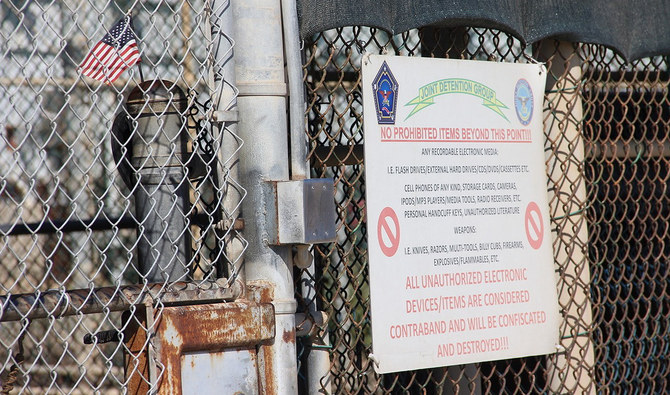
In this file photo taken on January 26, 2017, a US national flag is placed in the fencing of Camp 5 at the US Military's Prison in Guantanamo Bay, Cuba. (Photo courtesy: AFP/File)
Short Url
Updated 24 February 2023
Follow

Pakistani brothers released from Guantanamo and sent home

  • Abdul Rabbani, born in 1967, is believed to have been one of the oldest inmates at Guantanamo Bay
  • Both were arrested in Karachi in Sept 2002 by Pakistani authorities, a Senate intelligence report says

WASHINGTON: Two Pakistani brothers, Abdul and Mohammed Rabbani, have been freed from the US military prison at Guantanamo Bay after more than 20 years in detention and repatriated, the Pentagon said Thursday.

Abdul Rabbani, who was born in 1967, is believed to have been one of the oldest inmates at the facility on a US base in Cuba.

US officials accused him of working for avowed 9/11 mastermind Khalid Sheikh Mohammed (KSM) and operating an Al-Qaeda safe house in Karachi, but his detainee assessment indicates he was not believed to have had “specific insight into Al-Qaeda operational plans.”

Mohammed Rabbani, born in 1969, was accused of recruiting his older brother into extremist circles. He is believed to have organized travel and funds for KSM and Abd Al-Rahim Al-Nashiri, the mastermind of the October 2000 suicide bombing of the USS Cole missile destroyer, which left 17 US sailors dead.

The pair were arrested in Karachi in September 2002 by Pakistani authorities, according to a Senate intelligence committee report that also names Mohammed Rabbani as one of 17 detainees subjected to torture at overseas CIA secret prisons, known as black sites.

Both men arrived at Guantanamo Bay in 2004 and were approved for release in 2021, the Defense Department said in a statement.

Their release brings to 32 the number of detainees left at Guantanamo Bay. Of those, 18 are eligible for transfer, three are eligible for review, nine are on trial in US military commissions and two have been convicted.


Pakistan Navy tests missile, loitering munitions and unmanned vessel at Arabian Sea

Updated 5 sec ago
Follow

Pakistan Navy tests missile, loitering munitions and unmanned vessel at Arabian Sea

  • The exercise reflects growing focus on air defense and autonomous systems in modern warfare

ISLAMABAD: Pakistan’s navy conducted live firing of a surface-to-air missile, tested loitering munitions and carried out open-sea trials of an unmanned surface vessel during a major exercise in the North Arabian Sea on Saturday, highlighting a growing focus on air defense and unmanned warfare amid evolving regional security dynamics.

The exercise, which demonstrated both conventional and autonomous capabilities, comes at a time when Pakistan is increasingly emphasizing advanced technology and multi-domain operations following last year’s four-day conflict with nuclear-armed India, which reinforced the importance of air defense, surveillance and precision strike systems.

“Pakistan Navy demonstrated its operational readiness and combat preparedness through a comprehensive exercise in the North Arabian Sea, showcasing both conventional and unmanned capabilities, as per dictates of evolving naval warfare,” the Navy’s Directorate General Public Relations said in a statement.

“The exercise included the successful live firing of LY-80(N) Surface to Air Missile (SAM) from Vertical Launching System at extended range, validating the long-range capabilities of Pakistan Navy’s modern air defense systems,” it added. “LY-80(N) SAM successfully engaged and neutralized an aerial target, demonstrating Pakistan Navy’s robust air defense capabilities.”

The statement said the exercise also featured the successful engagement of surface targets using a loitering munition, which it said demonstrated the navy’s precision strike capability.

“Successful open-sea trials of Unmanned Surface Vessel (USV) were also conducted, marking a significant leap in autonomous naval technology,” it continued. “The trials validated the platform’s ability to combine high-speed performance with mission-critical durability.”

Pakistan’s armed forces routinely hold large-scale exercises to enhance operational readiness, but recent drills have placed greater emphasis on emerging technologies, reflecting lessons drawn from modern conflicts.

Key capabilities demonstrated during the exercise included extreme maneuverability, precision navigation and weather resilience.

Chief of the Naval Staff Admiral Naveed Ashraf commended officers and men of the Pakistan Navy for their professionalism and operational competence, reiterating the navy’s resolve to ensure the seaward defense of the country and safeguard its maritime interests.