

Pakistan army foils ambush attempt, killing 8 militants in southwestern Balochistan

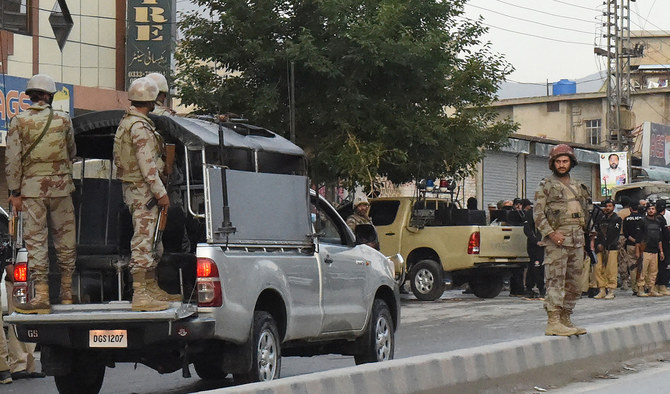
This representational file photo shows Pakistani paramilitary soldiers cordoning off the site of an attack by gunmen on soldiers in Quetta, Balochistan, on June 29, 2016. (AFP/File)
Short Url
Updated 12 July 2023
Follow

Pakistan army foils ambush attempt, killing 8 militants in southwestern Balochistan

  • Pakistan Army troops foil militants' attempt to ambush security convoy in district Kech, military says
  • Large cache of arms and ammunition, including explosives, seized from the slain militants, says army

ISLAMABAD: Pakistan military troops foiled an ambush attempt on a security forces convoy in the country's southwestern Balochistan province, killing eight militants in a heavy exchange of fire, the army's media wing said on Thursday. 

Balochistan, Pakistan's largest province by area but most impoverished, has long been the scene of a low-level insurgency by separatist groups seeking independence from the central government in Islamabad. The militant groups accuse the state of depriving Balochistan of its mineral riches for the benefit of other provinces. Pakistan's civilian and military leadership reject the allegations.

Pakistan has seen a surge in militant activity since November last year when the Pakistani Taliban unilaterally ended a ceasefire with the Pakistani state and announced it would target security forces across the country.

However, the TTP is not the most active militant group and the province is most at threat from separatist groups. 

In a press release, the Inter-Services Public Relations (ISPR) said a group of "terrorists" attempted to ambush a security forces convoy in Balochistan's District Kech on Wednesday evening. 

The military said that "alert and combat-ready troops" not only foiled the militant attack but also started a follow-up operation to hunt the militants down. 

"Resultantly, on the morning of 23 Feb 23, a suspected hideout of terrorists was identified in Mazaaband Range where a sanitization operation was launched," the ISPR said. 

"In ensuing, heavy exchange of fire, 8 x Terrorists have been killed while a large cache of arms and ammunition including explosives has also been recovered," it added. 

The military said Pakistan's security forces would continue to thwart any attempt by "inimical elements" at the behest of hostile intelligence agencies to disrupt "hard-earned peace" in the province. 

The exchange of fire takes place a couple of days after militants attacked a security checkpost in district Mastung in Balochistan and killed two paramilitary soldiers. 


EU, Pakistan sign €60 million loan agreement for clean drinking water in Karachi

Updated 17 December 2025
Follow

EU, Pakistan sign €60 million loan agreement for clean drinking water in Karachi

  • Project will finance rehabilitation, construction of water treatment facilities in Karachi city, says European Investment Bank
  • As per a report in 2023, 90 percent of water samples collected from various places in city was deemed unfit for drinking

ISLAMABAD: The European Investment Bank (EIB) and Pakistan’s government on Wednesday signed a €60 million loan agreement, the first between the two sides in a decade, to support the delivery of clean drinking water in Karachi, the EU said in a statement. 

The Karachi Water Infrastructure Framework, approved in August this year by the EIB, will finance the rehabilitation and construction of water treatment facilities in Pakistan’s most populous city of Karachi to increase safe water supply and improve water security. 

The agreement was signed between the two sides at the sidelines of the 15th Pak-EU Joint Commission in Brussels, state broadcaster Radio Pakistan reported. 

“Today, the @EIB signed its first loan agreement with Pakistan in a decade: a €60 million loan supporting the delivery of clean drinking water for #Karachi,” the EU said on social media platform X. 

Radio Pakistan said the agreement reflects Pakistan’s commitment to modernize essential urban services and promote climate-resilient infrastructure.

“The declaration demonstrates the continued momentum in Pakistan-EU cooperation and highlights shared priorities in sustainable development, public service delivery, and climate and environmental resilience,” it said. 

Karachi has a chronic clean drinking water problem. As per a Karachi Water and Sewerage Corporation (KWSC) study conducted in 2023, 90 percent of water from samples collected from various places in the city was deemed unsafe for drinking purposes, contaminated with E. coli, coliform bacteria, and other harmful pathogens. 

The problem has forced most residents of the city to get their water through drilled motor-operated wells (known as ‘bores’), even as groundwater in the coastal city tends to be salty and unfit for human consumption.

Other options for residents include either buying unfiltered water from private water tanker operators, who fill up at a network of legal and illegal water hydrants across the city, or buying it from reverse osmosis plants that they visit to fill up bottles or have delivered to their homes.

The EU provides Pakistan about €100 million annually in grants for development and cooperation. This includes efforts to achieve green inclusive growth, increase education and employment skills, promote good governance, human rights, rule of law and ensure sustainable management of natural resources.