

Pakistan to impose Rs170 billion in additional taxes as finance bill approved by president 

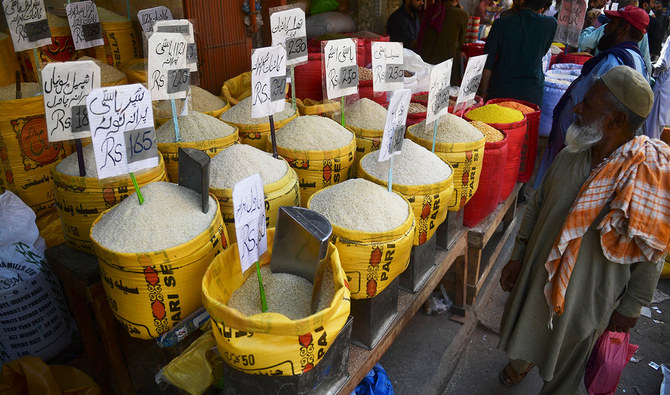
A man looks at rice prices at a market in Karachi on February 3, 2023. (Photo courtesy: AFP/FILE)
Short Url
Updated 23 February 2023
Follow

Pakistan to impose Rs170 billion in additional taxes as finance bill approved by president 

  • Move is part of meeting IMF conditions to unlock economic bailout Pakistan needs to avoid the risk of default
  • Government has already jacked up prices of petroleum products, natural gas and electricity to fulfill IMF prior actions

ISLAMABAD: Pakistan will be able to collect additional taxes worth Rs170 billion after President Dr. Arif Alvi on Thursday approved the Finance Supplementary Bill 2023, fulfilling a major prior condition for the signing of a staff-level-agreement with the International Monetary Fund (IMF) to revive a stalled $7 billion bailout program.

The IMF had asked Pakistan to raise an additional Rs170 billion through tax revenue, with the bulk of tax measures worth Rs115 billion implemented from February 14 through Statutory Regulatory Orders (SROs). Now, with the president’s formal assent to the new finance bill, or mini budget, the remaining Rs55 billion tax measures will also come into effect.

Pakistan has been struggling to reach a deal with the global lender to receive the $1.1 billion tranche of a package signed in 2019. Discussions in Islamabad from January 31 to February 9 this year ended without the signing of a staff-level agreement but virtual discussions are continuing and the IMF has continued to push Islamabad to fulfil more ‘prior actions,’ including the collection of additional revenues to revive the deal.

The government has already jacked up the prices of petroleum products, natural gas and electricity to meet the global lender’s defined prior actions for the deal.

“President Dr. Arif Alvi has approved the Finance (Supplementary) Bill 2023. The approval was given under Article 75 of the Constitution,” the President’s House announced in a Twitter post.


Through the new legislation, the government has increased General Sales Tax (GST) on all luxury items from 17 to 25 percent, imposed a fixed tax on all business and first class air travel ranging from Rs75,000 to Rs250,000 and a 10 percent withholding tax on marriage halls, as well as raised federal excise duty on cement from Rs1.5 to Rs2 per kilogram. 

Pakistan is in dire need of funds as it battles a worsening economic crisis, with foreign exchange reserves falling to around $3 billion, barely enough to cover three weeks of controlled imports. An agreement with the IMF would not only release an over $1.1 billion loan but also unlock other avenues of funding for Pakistan.

On Wednesday, Commerce minister Syed Naveed Qamar said during a visit to Washington he was hopeful for the resumption of the loan program “as early as this week.”


Pakistan blocks ‘thousands’ of passports in crackdown on overseas begging in Gulf countries

Updated 5 sec ago
Follow

Pakistan blocks ‘thousands’ of passports in crackdown on overseas begging in Gulf countries

  • Authorities impose five- to 10-year passport restrictions on deported offenders, report sharp decline in cases
  • Government links enforcement drive to broader push for skilled labor exports and record remittance inflows

ISLAMABAD: Pakistan has blocked “several thousand passports” and imposed long-term travel restrictions on citizens involved in begging abroad, the country’s overseas minister said on Wednesday, reporting a sharp decline in such cases following enforcement reforms.

Last August, the government announced a sweeping crackdown on what it described as a “beggar mafia” accused of exploiting visas to solicit money in Saudi Arabia and other Middle Eastern states. The practice had drawn complaints from Riyadh, prompting Islamabad to direct the Federal Investigation Agency (FIA) to curb the trend.

Federal Minister for Overseas Pakistanis Chaudhry Salik Hussain said authorities were targeting individuals who misuse Umrah and other visit visas to beg overseas, particularly in Gulf countries.

“We are not sending the beggars abroad,” he said at the Pakistan Governance Forum 2026 in the federal capital. “It is not written on the face of the beggar that he is a beggar. They go through the normal process of getting a visa for Umrah and then start this work on the side.”

Hussain said passports of deported individuals involved in begging or criminal activity were being blocked to prevent repeat travel.

“For that we can only do that if someone is involved in this work and he is caught and when he is deported, then at least we block his passport, which is happening,” he said. “Believe me, there has been a drastic drop in this.”

“There is no visa for begging. They go on a normal visa. Every document is 100 percent correct,” he added.

According to Hussain, the FIA is imposing passport restrictions of five to 10 years on offenders, preventing them from obtaining new travel documents.

He added that “several thousand passports” had so far been blocked.

Pakistan, which relies heavily on remittances from its overseas workforce, is also seeking to improve the quality of labor exports following meetings with labor ministers in Qatar, Bahrain, Saudi Arabia and the United Arab Emirates.

“We want our workforce to go there. The quantity is increasing but the quality element is very important,” he said, adding that the government plans to make soft skills training compulsory for Pakistanis going abroad “from the labor class to the undergraduates” so they better understand local norms and regulations.

The minister said exporting skilled labor helps ease unemployment pressures driven by Pakistan’s growing youth population while boosting remittances, which recently hit an all-time high.

“I think this is one of the reasons because our youth bulge is very high in Pakistan and local industries are not enough to cater to that. So we should at least find good jobs in foreign countries and send them there,” he said, adding that overseas workers “not only get employed but also send valuable remittances back home.”

Hussain said broader reforms were also under way to digitize overseas employment processes and reduce corruption.

“We are moving toward maximum digitization,” he said. “Problems and issues arise where humans interact with humans. We are moving toward digitization very quickly.”