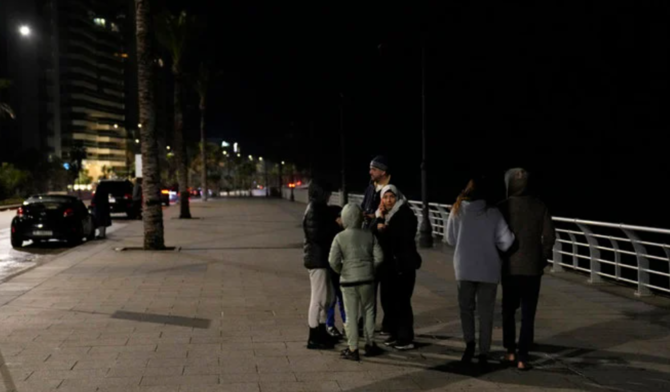
BEIRUT: A small earthquake that struck South Lebanon early on Wednesday sparked widespread panic as residents ran from their homes barefoot, with many saying they “feared for their children’s lives.”
The 4.3-magnitude tremor, the latest in a series of minor quakes, hit the coastline near the southern city of Sidon shortly after 8 a.m., further terrifying Lebanese still recovering from the shock of twin earthquakes that devastated large areas of Turkiye and Syria over two weeks ago.
Earlier, a 6.3-magnitude quake centered 20 km offshore struck northern Lebanon on Monday night, followed by two others off the coast of southern Lebanon, near Sidon, on Tuesday.
Experts joined caretaker Prime Minister Najib Mikati in appealing for calm.
However, many Lebanese fear their houses will be unable to withstand a violent quake and that they will be abandoned to their fate by the state.
Mikati visited the National Center for Geophysics on Wednesday to inspect its seismic monitoring equipment, but warned: “What is certain, according to science, is that no one can predict when an earthquake or tremor may occur.”
He appealed for calm, adding that the Disaster Management Authority has taken “all necessary measures to protect citizens” and is testing its readiness with trials in several governorates.
Amid growing alarm after the quake on Monday, American University of Beirut earthquake researcher Tony Nemer said that people must accept that Lebanon is located in a seismic zone.
“But the Lebanese must remain calm,” he added.
George Kettaneh, head of the Lebanese Red Cross, said that several cases of anxiety and panic attacks were treated after the quake.
Zeina, 50, who lives on the 13th floor of an apartment block in Beirut, said: “My family and I will not be able to escape if a major earthquake hits. We have decided to stay, but I do not hide the fact that we are psychologically devastated and can no longer bear the stress.”
Ghada, 31, who lives two floors below, said: “The sound of the building shaking was terrifying. My husband refuses to leave and believes it does not make sense to go outside. I tried my best to remain calm and seated on the couch during Monday’s tremors. Thankfully, I did not feel Tuesday’s earthquakes, but God knows what could happen and when. We are living an ongoing trauma.”
Ezzat, 35, said: “I feared for my children’s lives. I put my family in the car and started driving like hundreds of others around us. In Lebanon, one cannot know for sure if the building is earthquake-resistant or if the laws were circumvented.
“Over two years ago, we survived the Beirut port explosion, and now we have to survive daily tremors. I live in a newly constructed building, but who knows if it can withstand so many tremors?”
Many Lebanese were also alarmed by photos showing a noticeable fall in the sea level near Sidon, with some linking the phenomenon to the latest earthquake.
However, Milad Fakhri, director of the National Center for Marine Sciences, said: “This is a natural phenomenon related to the tidal process and occurs throughout the year. It is in no way related to the quakes and tremors hitting the region, nor is it an early sign of a possible tsunami.”


![]()

Lebanese panic as tremor strikes, sea retreats
Short Url
https://arab.news/9d7q7
Lebanese panic as tremor strikes, sea retreats
- The 4.3-magnitude tremor, the latest in a series of minor quakes, hit the coastline near the southern city of Sidon shortly after 8 a.m.
- Earlier, a 6.3-magnitude quake centered 20 km offshore struck northern Lebanon on Monday night


Latest updates


Recommended


© 2026 SAUDI RESEARCH & PUBLISHING COMPANY, All Rights Reserved And subject to Terms of Use Agreement.