

Hezbollah expands financial wing as Lebanon’s banking crisis continues

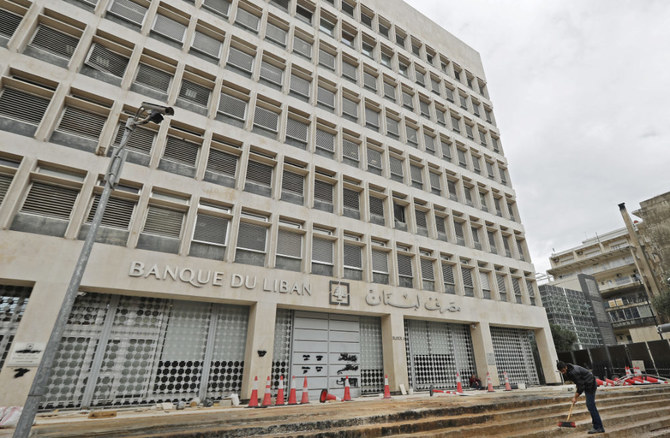
Workers carry out renovation works outside the headquarters of the Banque du Liban (Lebanese Central Bank) in the capital Beirut. (AFP file photo)
Short Url
Updated 18 February 2023
Follow

Hezbollah expands financial wing as Lebanon’s banking crisis continues

  • The association accused the state of having spent more than $20 billion since 2019 in support of smuggling — by subsidizing materials being illegally taken into Syria — and to maintain an exchange rate of LBP1,500 to the dollar

BEIRUT: The Association of Banks in Lebanon has warned against “a plan to systematically destroy the banking sector, carried out by a group of no more than 50 mercenaries.”

The association was referring to a group of protesters who set banks alight on Thursday. It released a statement saying: “The funds needed to pay off your deposits are not with the banks, so entering them by force, destroying them, or breaking their contents will not benefit you. You are only harming yourselves and reducing the chances of regaining your rights. The time has come for you to realize who took away your rights and who you should direct your arrows at and pressure to recover them.”

ABL said it was baffled by all the accusations that its strike is contributing to the depreciation of the local currency. “If banks close, they are accused of devaluating the local currency; if they open, they are accused of playing the market.

SPEEDREAD

Lebanese economic bodies denounced the attacks on the banking sector, stressing that everyone needs to act rationally and responsibly to overcome the prevailing crises with the fewest possible losses, and to preserve the rights of depositors.

“The banks deposit their customers’ deposits with the Banque du Liban, in (accordance with) BDL’s circulars and in line with the principles of global banking. These funds were used to support the exchange rate and to finance the state, which then failed to return them. Some parties set out to absolve the state of its obligations and, because of these dealings, banks lost all their private money, which amounted to over $24 billion. Still, banks are accused of seizing deposits and lending them to the BDL (out of) greed.”

The association accused the state of having spent more than $20 billion since 2019 in support of smuggling — by subsidizing materials being illegally taken into Syria — and to maintain an exchange rate of LBP1,500 to the dollar.

It said: “Banks had lent over $55 billion in deposits and are working to recover them in order to return them to the depositors, so most judicial decisions oblige them to collect these debts on the basis of the official exchange rate prior to the collapse — i.e. 1,507 Lebanese pounds to the dollar, or, at best, according to a banker’s draft drawn from the BDL, equal to less than 15 percent of the value of the loan it obtained. So how can banks return the deposits to their customers now?”

One economic observer feared that the banks would be dragged into an open strike, leading to complete closure, following the attacks on various branches, thus putting them in direct confrontation with citizens.

On Saturday, Lebanese economic bodies denounced the attacks on the banking sector, stressing that everyone needs to act rationally and responsibly to overcome the prevailing crises with the fewest possible losses, and to preserve the rights of depositors.

Meanwhile, Hezbollah has announced the opening of a new branch of its Al-Qard Al-Hasan Association, which is subject to US sanctions, in the predominantly Druze and Christian Souk Al-Gharb Aley area, where the party has little to no presence.

Al-Qard Al-Hasan is described as Hezbollah’s financial wing, so the new branch reveals growth in Hezbollah’s financial institutions at the expense of the state’s, which are collapsing.

An economic observer, who asked to remain anonymous, noted that Al-Qard Al-Hasan seems to have benefitted from the banks’ decline and their inability to grant loans, and has stepped in to fill the gap by providing loans in exchange for mortgages of gold or property.

“This association lends money and keeps mortgages until it collects the amount, and, in the event that the customer does not clear the loan, it sells the gold or real estate,” they said.

The association’s files were hacked a year ago and some data was leaked, including information about depositors and borrowers. The leaks showed that the association possesses deposits amounting to around $500 million and had provided loans worth $450 million.

The Al-Qard Al-Hasan Association is not licensed by the BDL, and cannot be pursued or held accountable by the judiciary in the event that a borrower encounters any problems.

Former MP Mustafa Alloush told Arab News: “By opening this new branch, Hezbollah is trying to give the impression that it is non-sectarian and for all people. The fact is, the party does not make profits from this association, as it does from cross-border smuggling, captagon trade, and the collapse of the state.”

He continued: “The state’s hands are tied; what’s left of the state is unable to take decisions unless the constitution is applied and the reforms that Lebanon committed to are implemented.”

Alloush added that banks could benefit from the riots and use them as an excuse to put pressure on the state so it would not be the only one responsible for the loss of people’s deposits, but become a “partner in crime” with the state and the BDL.


Aoun reassures Lebanon that risk of war is ‘fading’ in year-end message

Lebanese President Joseph Aoun. (File/AFP)
Updated 46 min 55 sec ago
Follow

Aoun reassures Lebanon that risk of war is ‘fading’ in year-end message

  • Israeli military spokesperson said it targeted 380 armed operatives, 950 military sites in Lebanon in past year
  • Beirut’s southern suburb residents pledge to avoid celebratory gunfire on New Year’s Eve

BEIRUT: Lebanese President Joseph Aoun on Wednesday sought to reassure citizens in his year-end address, saying “the overall atmosphere remains positive and the risk of war is fading,” amid widespread concern over a possible Israeli escalation against Hezbollah.

Fear of renewed attacks followed Israeli criticism of a Lebanese Army weapons-confiscation operation that is set to enter its second phase at the start of the 2026. The plan include the expansion from areas north of the Litani River to the Awali River, after the first phase was completed south of the Litani.

President Aoun cautioned that this does not mean “completely eliminating the risk of war,” stressing that “work is underway with various friendly and brotherly countries to completely neutralize the threat of war.”

Addressing Internal Security officials, Aoun said that the “situation is among the best,” noting that this assessment has been echoed by foreign visitors to Lebanon, despite the strain caused by large numbers of Syrian and Palestinian refugees.

He added that security forces were fully carrying out their duties and solving crimes with notable speed, pointing to the successful visit of Pope Leo XIV earlier this year as further evidence of progress.

On Monday, Egyptian Ambassador to Lebanon Alaa Moussa stressed during a Beirut press conference that implementing “international agreements and resolutions, foremost among them the Nov. 27, 2014 agreement and Resolution 1701, constitutes the fundamental approach to sparing Lebanon further security tensions,” speaking of “dire consequences that could result from continued escalation.”

The Egyptian diplomat indicated that “there are no hidden warnings or threats directed at Lebanon, but rather a clear commitment to the agreements signed by the concerned parties, which must be fully implemented by everyone.”

The ambassador stated that his country, under the directives of President Abdel Fattah El-Sisi, is “exerting intensive efforts to reduce tensions in southern Lebanon and the region in general, through active diplomatic contacts led by the Minister of Foreign Affairs Badr Abdelatty with relevant regional and international parties.”

Israeli military spokesman Avichai Adraee published on Wednesday a summary of Israeli attacks on Hezbollah in Lebanon in 2025.

“The Army targeted approximately 380 armed operatives, including Ali Tabatabai (chief of staff), Hassan Kamal (responsible for anti-tank missiles on the southern front), Abbas Hassan Karky (logistics officer in the southern command), and Khodr Saeed Hashem (commander of the naval force in the Radwan Unit),” he said.

“It also attacked approximately 950 military targets, including 210 launch sites and weapons depots, 140 military buildings, and about 60 tunnel entrances,” Adraee added.

In the statement, he accused Hezbollah of committing about 1,920 ceasefire violations and said the military would continue its raids and targeting operations in the new year.

UNIFIL Com. Gen. Diodato Abagnara said in his end-of-the-year message that “UNIFIL will continue to support Lebanon and Israel in implementing their obligations under Resolution 1701, building on the stability achieved in 2025 and strengthening efforts toward a lasting peace.”

As part of the weapons restriction plan, on Tuesday, the Fatah movement — the Palestinian National Security Forces in Lebanon — handed over a new batch of heavy and medium weapons from the Ain Al-Hilweh Palestinian refugee camp to the Lebanese Army in four trucks, away from the media.

This is the second batch of weapons to be handed over from the camp, which is the largest Palestinian refugee camp in Lebanon. It represents the fifth phase of the Palestinian weapons handover process in the camps, four of which were completed between Aug. 21 and Sept. 13, 2025, encompassing nine camps, including Ain Al-Hilweh.

The handover follows and implements an agreement reached between Aoun and Palestinian President Mahmoud Abbas after the latter’s visit to Lebanon in May.

Abbas had announced “the Palestinian Authority’s support for the Lebanese state’s plan to extend its authority over all Lebanese territory, including the Palestinian camps.”

Hamas continues to refuse to hand over its weapons to the Lebanese Army, while Hezbollah maintains its weapons north of the Litani River.

The Lebanese Army implemented “exceptional security measures in various Lebanese regions on New Year’s Eve, with the aim of maintaining security.”

It called on citizens to “cooperate with the security measures taken to maintain public safety and prevent incidents,” warning of the consequences of firing weapons, which will be prosecuted as it poses a threat to public safety.

In another measure, authorities announced that gun licenses and traffic permits will be suspended until Jan. 2, 2026.

In Beirut’s southern suburbs, residents signed a pledge as part of an Internal Security Forces campaign against celebratory gunfire on New Year’s Eve, committing not to fire weapons in public and to report violations with photos or videos.