

UK couple and accomplice hid Iraqis in sofas in smuggling operation

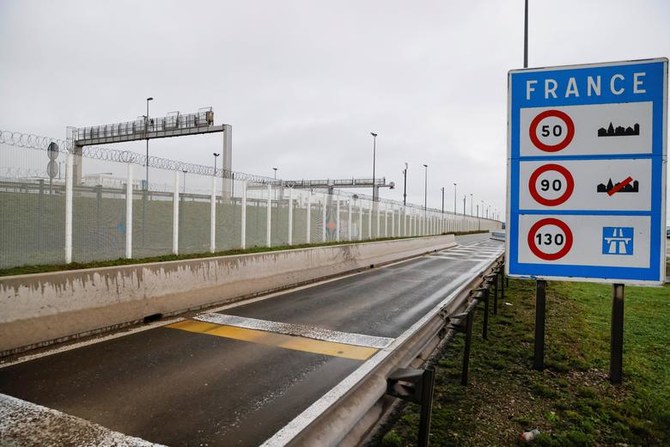
An empty road were trucks from Britain usually leave the Eurotunnel terminal to join the highway is seen in Coquelles, France. (File/Reuters)
Short Url
Updated 21 February 2023
Follow

UK couple and accomplice hid Iraqis in sofas in smuggling operation

  • Nicholas Fullwood and Azad Ahmahi, of Derbyshire, jailed while Pamela Fullwood handed suspended sentence

LONDON: A British couple and their accomplice have been sentenced for trying to smuggle Iraqi migrants into the UK hidden in sofas.

Nicholas Fullwood, 48, and his wife Pamela, 45, both of Chesterfield, were stopped in their van by Border Force officers in the UK control zone in Coquelles, France on Jan. 5, 2019. 

The couple said they were returning to the UK after picking up furniture in Lille. Officers searched their van and discovered two Iraqi men in the bases of two sofas. 

A Home Office investigation later identified 31-year-old Azad Ahmadi, a car wash owner in Derby, as a suspect who helped organize the smuggling attempt with the Fullwoods, the Independent reported.

The Fullwoods pleaded guilty to charges of conspiracy to assist unlawful immigration. Ahmadi pleaded not guilty to the same charge.

At a hearing in Canterbury Crown Court, Nicholas Fullwood was sentenced to three years in prison while his wife was given a two-year suspended sentence. 

According to a report in the Independent, defense lawyers said that Nicholas Fullwood was under duress due to money he owed to a loan shark, while his wife was found in a psychiatric report to have “significant problems” with “suggestibility and compliance”. 

The court was also told that she has had cancer and was due to undergo an operation next month.

Ahmadi was described as the “the head” of the operation by Recorder Michael Turner in sentencing, the Independent reported. He was found guilty and jailed for four years and six months. 

Immigration Minister Robert Jenrick said after sentencing that the British government was “determined to bring to justice the criminal gangs that undertake the repulsive trade of people-smuggling. 

“The Home Office is working night and day to dismantle people-smuggling networks and tackle illegal migration head-on,” he added.


Geoeconomic confrontation tops global risks in 2026: WEF report

Updated 4 sec ago
Follow

Geoeconomic confrontation tops global risks in 2026: WEF report

  • Also armed conflict, extreme climate, public polarization, AI
  • None ‘a foregone conclusion,’ says WEF’s MD Saadia Zahidi

DUBAI: Geoeconomic confrontation has emerged as the top global risk this year, followed by state-based armed conflict, according to a new World Economic Forum report.

The Global Risks Report 2026, released on Wednesday, found that both risks climbed eight places year-on-year, underscoring a sharp deterioration in the global outlook amid increased international competition.

The top five risks are geoeconomic confrontation (18 percent of respondents), state-based armed conflict (14 percent), extreme weather events (8 percent), societal polarization (7 percent) and misinformation and disinformation (7 percent).

The WEF’s Managing Director Saadia Zahidi said the report “offers an early warning system as the age of competition compounds global risks — from geoeconomic confrontation to unchecked technology to rising debt — and changes our collective capacity to address them.

“But none of these risks are a foregone conclusion.”

The report assesses risks across three timeframes: immediate (2026); short-to-medium term (next two years); and long term (next 10 years).

Economic risks show the largest overall increase in the two-year outlook, with both economic downturn and inflation jumping eight positions.

Misinformation and disinformation rank fifth this year but rise to second place in the two-year outlook and fourth over the 10-year horizon.

The report suggests this reflects growing anxiety around the rapid adoption of artificial intelligence, with adverse outcomes linked to AI surging from 30th place in the two-year timeframe to fifth in the 10-year outlook.

Uncertainty dominates the global risk outlook, according to the report.

Surveyed leaders and experts view both the short- and long-term outlook negatively, with 50 percent expecting a turbulent or stormy global environment over the next two years, rising to 57 percent over the next decade.

A further 40 percent and 32 percent, respectively, describe the outlook as unsettled across the two- and 10-year timeframes, while just 1 percent anticipate a calm global outlook in either period.

Environmental risks ease slightly in the short-term rankings. Extreme weather fell from second to fourth place and pollution from sixth to ninth. Meanwhile, critical changes to Earth systems and biodiversity loss dropped seven and five positions, respectively.

However, over the next decade, environmental threats re-emerge as the most severe, with extreme weather, biodiversity loss, and critical changes to Earth systems topping the global risk rankings.

Looking ahead over the next decade, around 75 percent of respondents anticipate a turbulent or stormy environmental outlook, making it the most pessimistic assessment across all risk categories.

Zahidi said that “the challenges highlighted in the report underscore both the scale of the potential perils we face and our shared responsibility to shape what comes next.”

Despite the gloomy outlook, Zahidi signaled a positive shift in global cooperation.

 “It is also clear that new forms of global cooperation are already unfolding even amid competition, and the global economy is demonstrating resilience in the face of uncertainty.”

Now in its 21st year, the Global Risks Report highlights a core message: global risks cannot be managed without cooperation.

As competition intensifies, rebuilding trust and new forms of collaboration will be critical, with the report stressing that today’s decisions will shape future outcomes.

The report was released ahead of WEF’s annual meeting, which will be held in Davos from Jan. 19 to 23.