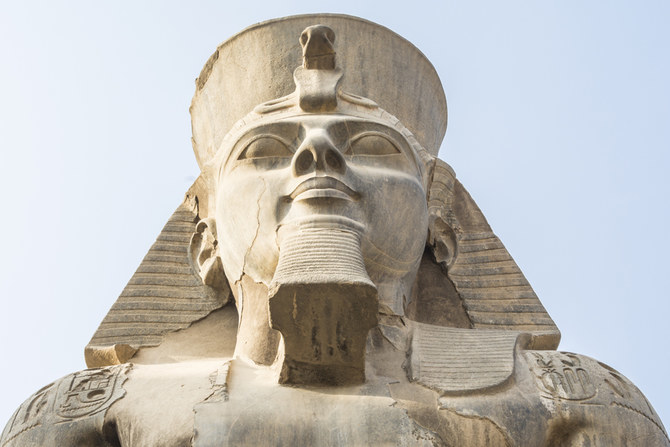
King Ramses II misses his sun tan session

The Statue of Ramses II will have to wait a while longer for the sun to shine this year as thick cloud cover prevented it bathing his statue with light in a usually twice-yearly marvel. (Shutterstock)
Short Url
Updated 21 February 2023
Follow

King Ramses II misses his sun tan session

  • The 11-meter-high statue was originally placed in Aswan’s Abu Simbel temple more than 3,000 years ago so that the sun would be perpendicular to its face on Feb. 22 and Oct. 22 every year

CAIRO: King Ramses II will have to wait a while longer for the sun to shine this year, as thick cloud cover prevented it bathing his statue with light in a usually twice-yearly marvel believed to mark both his birth and coronation as Egyptian pharaoh.
The 11-meter-high statue, which weighs 80 tons, was originally placed in Aswan’s Abu Simbel temple more than 3,000 years ago so that the sun would be perpendicular to its face on Feb. 22 and Oct. 22 every year.
It was moved to the lobby of the Grand Egyptian Museum in Giza in 2018 and placed to receive the same light show, albeit a day earlier than usual. However, on Tuesday visitors were disappointed as poor weather meant it remained in shadow.
For centuries, the sun’s rays rose above the waters of Lake Nasser, crept into the ancient temple and extended 60 meters to illuminate a passage between four giant statues including that of the Egyptian pharaoh, bathing it in light for 20 minutes.
There are two theories as to why. The first is that the temple was designed so that the sun would mark the start and end of the farming season; the second that the two illumination days fell on Ramses II’s birthday and his coronation.
The temple area was flooded following the construction of the High Dam and formation of Lake Nasser, prompting a $40 million international campaign in the 1960s to save the monuments of Abu Simbel and Nubia.
The campaign involved moving the temple in sections. Ramses II’s statue was moved four times before being installed at the museum, which is 65 meters above river level.
It is believed that the Abu Simbel complex was built between 1265 B.C. and 1244 B.C. It was rediscovered in 1817 by Giovanni Pelonzi, an Italian Egyptologist.
The sun phenomenon was noticed in 1874 by British novelist and Egyptologist Amelia Edwards, who went on to publish her findings in “A Thousand Miles Up the Nile.”



UN presses Houthis for release of 73 detained staff as Yemen envoy holds talks in Oman

Updated 14 sec ago
Follow

UN presses Houthis for release of 73 detained staff as Yemen envoy holds talks in Oman

  • Hans Grundberg meets in Muscat with senior Omani officials, and discusses with chief Houthi negotiator Mohammed Abdul Salam pathways for political dialogue
  • The Houthis, who control much of northwestern Yemen including the capital, Sanaa, have detained UN employees and conducted raids on the organization’s premises

NEW YORK CITY: The UN said on Tuesday that extensive diplomatic efforts continue in an effort to secure the immediate release of dozens of UN staff arbitrarily detained by the Houthi militia in Yemen.
It came as the UN’s special envoy for the war-torn country, Hans Grundberg, held talks in the region aimed at reviving a political process to end the conflict.
He met senior Omani officials in Muscat on Tuesday to discuss recent developments in Yemen and the wider regional context, a UN spokesperson said. Oman has played a key mediation role during the conflict in Yemen.
Grundberg also met Mohammed Abdul Salam, chief negotiator for the Houthis, to discuss pathways for political dialogue.
The issue of detained UN staff featured prominently in the meetings. During the talks, the UN said, the envoy stressed the need to maintain momentum regarding the release of conflict-related detainees, building on discussions held in Muscat in December.
Grundberg and Muin Shreim, the UN official leading discussions about detainees, raised concerns about the continuing arbitrary detention of UN personnel and called for their immediate and unconditional release, stressing the need to respect the safety and security of all UN staff, both locals and foreigners.
“One of the main topics consistently raised in all our discussions, as you can imagine, remains the fate of 73 of our colleagues who continue to be arbitrarily detained by the Houthis, some since 2021,” UN spokesperson Stephane Dujarric told reporters in New York.
The UN demands the immediate and unconditional release of all detained members of staff from international and local nongovernmental organizations and civil society groups, and persons who had previously worked with diplomatic missions, he added.
The Houthis, who control much of northwestern Yemen including the capital, Sanaa, have detained UN employees and conducted raids on the organization’s premises in areas under their control.
In October last year, Houthi leader Abdul-Malik Al-Houthi accused employees of the UN and humanitarian agencies of spying for Israel and the US. The UN denies the allegations. Following the accusations, the Houthis detained several members of UN staff and seized assets belonging to the organization.
During his meetings, Grundberg reaffirmed the UN’s continuing engagement with all parties in support of efforts to ensure a return to an inclusive political process that ends the near-decade-long war, which has devastated Yemen and triggered one of the worst humanitarian crises in the world.