


WASHINGTON: The Biden administration is scrambling to avert a diplomatic crisis over Israeli settlement activity this week at the United Nations that threatens to overshadow and perhaps derail what the US hopes will be a solid five days of focus on condemning Russia’s war with Ukraine.
Secretary of State Antony Blinken made two emergency calls on Saturday from the Munich Security Conference, which he is attending in an as-yet unsuccessful bid to avoid or forestall such a showdown. It remained unclear whether another last-minute intervention might salvage the situation, according to diplomats familiar with the ongoing discussions who spoke to The Associated Press on condition of anonymity.
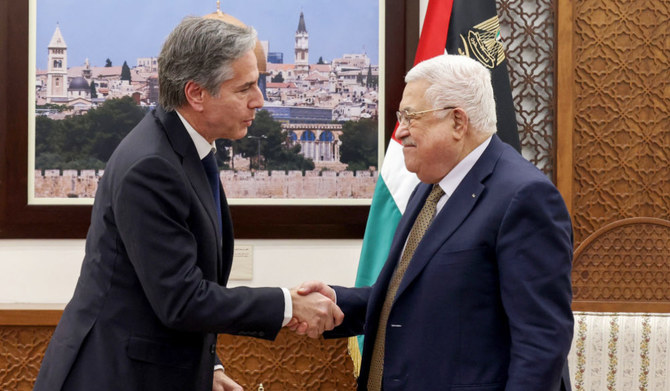
Without giving details, the State Department said in nearly identical statements that Blinken had spoken to Palestinian leader Mahmoud Abbas and Israeli Prime Minister Benjamin Netanyahu from Munich to “reaffirm the US commitment to a negotiated two-state solution and opposition to policies that endanger its viability.”
“The secretary underscored the urgent need for Israelis and Palestinians to take steps that restore calm and our strong opposition to unilateral measures that would further escalate tensions,” the statements said.
Neither statement mentioned the proposed UN Security Council resolution demanding an immediate halt to Israeli settlements. The Palestinians want to bring that resolution to a vote on Monday. And neither statement gave any indication as to how the calls ended.
But diplomats familiar with the conversations said that in his call to Abbas, Blinken reiterated an offer to the Palestinians for a US package of incentives to entice them to drop or at least delay the resolution.
Those incentives included a White House meeting for Abbas with President Joe Biden, movement on reopening the American consulate in Jerusalem, and a significant aid package, the diplomats said.
Abbas was noncommittal, the diplomats said, but also suggested he would not be amenable unless the Israelis agreed to a six-month freeze on settlement expansion on land the Palestinians claim for a future state.
Blinken then called Netanyahu, who, according to the diplomats, was similarly noncommittal about the six-month settlement freeze. Netanyahu also repeated Israeli opposition to reopening the consulate, which was closed during President Donald Trump’s administration, they said.
The US and others were hoping to resolve the deadlock on Sunday, but the diplomats said it was unclear if that was possible,
The drama arose just ahead of the one-year anniversary of the Russian invasion of Ukraine, which will be the subject of special UN General Assembly and Security Council sessions on Thursday and Friday.
The US opposes the Palestinian resolution and is almost certain to veto it. Not vetoing would carry considerable domestic political risk for Biden on the cusp of the 2024 presidential race and top House Republicans have already warned against it.
But the administration also fears that using its veto to protect Israel risks losing support at the world body for measures condemning Russia’s war in Ukraine.
Senior officials from the White House, the State Department and the US Mission to the UN have already engaged frantic but fruitless diplomacy to try to persuade the Palestinians to back down. The dire nature of the situation prompted Blinken’s calls on Saturday, the diplomats said.
The Biden administration has already said publicly that it does not support the resolution, calling it “unhelpful.” But it has also said the same about recent Israeli settlement expansion announcements.
UN diplomats say the USwants to replace the Palestinian resolution, which would be legally binding, with a weaker presidential statement, or at least delay a vote on the resolution until after the Ukraine war anniversary.
The Palestinian push comes as Israel’s new right-wing government has reaffirmed its commitment to construct new settlements in the West Bank and expand its authority on land the Palestinians seek for a future state.
Israel captured the West Bank, along with east Jerusalem and the Gaza Strip, in the 1967 Mideast war. The United Nations and most of the international community consider Israeli settlements illegal and an obstacle to ending the decades-old Israeli-Palestinian conflict. Some 700,000 Israeli settlers live in the West Bank and Israeli-annexed east Jerusalem.
Ultranationalists who oppose Palestinian statehood comprise a majority of Israel’s new government, which has declared settlement construction a top priority.
The draft resolution, circulated by the United Arab Emirates, the Arab representative on the council, would reaffirm the Security Council’s “unwavering commitment” to a two-state solution with Israel and Palestine living side-by-side in peace as democratic states.
It would also reaffirm the UN Charter’s provision against acquiring territory by force and reaffirm that any such acquisition is illegal.
Last Tuesday, Blinken and the top diplomats from Britain, France, Germany and Italy condemned Israel’s plans to build 10,000 new homes in existing settlements in the West Bank and retroactively legalize nine outposts. Netanyahu’s Cabinet had announced the measure two days earlier, following a surge in violence in Jerusalem.
In December 2016, the Security Council demanded that Israel “immediately and completely cease all settlement activities in the occupied Palestinian territory, including East Jerusalem.” It stressed that halting settlement activities “is essential for salvaging the two-state solution.”
That resolution was adopted after President Barack Obama’s administration abstained in the vote, a reversal of the United States’ longstanding practice of protecting its close ally Israel from action at the United Nations, including by vetoing Arab-supported resolutions.
The draft resolution before the council now is much shorter than the 2016 document, though it reiterates its key points and much of what the US and Europeans already said last week.
Complicating the matter for the US, the Security Council resolution was introduced and is supported by the UAE, an Arab partner of the United States that has also normalized relations with Israel, even as it has taken a tepid stance on opposing Russia’s attack on Ukraine.
The US will be looking to the UAE and other council members sympathetic to the Palestinians to vote in favor of resolutions condemning Russia for invading Ukraine and calling for a cessation of hostilities and the immediate withdrawal of all Russian forces.


