

Pakistan’s ‘first and foremost’ literature festival concludes 14th edition in Karachi

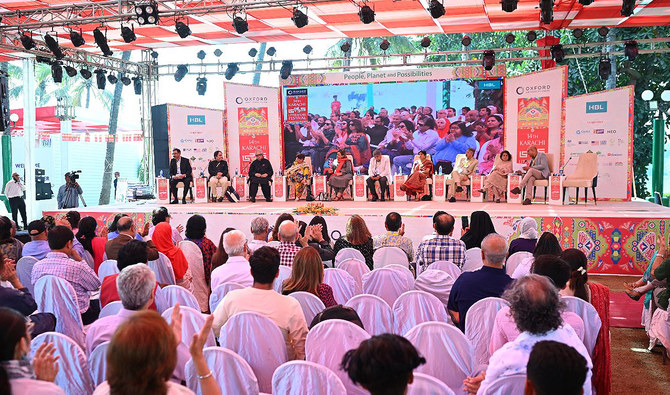
Panelists address attendees during a session titled 'Bayad e Raftagaan' on day two of the Karachi Literature Festival at the Beach Luxury Hotel in Karachi, Pakistan, on February 18, 2023. (Photo courtesy: KLF)
Short Url
Updated 19 February 2023
Follow

Pakistan’s ‘first and foremost’ literature festival concludes 14th edition in Karachi

  • Theme for this year’s Karachi Literature Festival 2023 was “People, Planet and Possibilities.”
  • Director of three-day festival says she aims to pull younger audiences toward literature

KARACHI: As the Karachi Literature Festival’s (KLF) 14th edition concluded on Sunday, the event’s festival director Rahila Bukhari said organizers aimed to draw the youth toward books in an age when there are many distractions on digital and electronic media.

According to its website, the KLF describes itself as “the first and by far the foremost” literature festival that has become an integral part of Pakistan’s social and intellectual calendar. The three-day annual festival was held from February 17-19 on the theme “People, Planet and Possibilities.”

The festival features talks and discussions by literary figures from eight countries including Pakistan, the UK, the US, Canada, and France. Over 200 speakers participated in around 60 sessions while the event also featured 24 book launches, both in English and Urdu.

All the sessions were live-streamed for viewers in Pakistan and around the world.

In line with this year’s theme, plenty of KLF sessions featured discussions on the environment, climate change, education, and the economy.

“It’s an awareness for people to learn about the circumstances we are going through. The world is going through an economic recession and we are trying to create awareness around that too,” Bukhari told Arab News.

At least four people were killed on Friday when a Pakistani Taliban suicide squad stormed a police compound in the city. A gunbattle between militants and security forces raged for hours before the compound was recaptured. Bukhari said the response on Saturday was a bit “lukewarm” due to the incident.

“The response has been really good today [Sunday],” Bukhari said. “Yesterday, it was a bit lukewarm due to the incident [in Karachi] from the previous night [Friday]. Half the people were apprehensive whether [they wanted] to leave the house or not,” she added.

Bukhari said organizers were trying to pull the youth toward books and literature for the past 14 years, adding that there were many distractions on digital and electronic media in the current era.

“When they [the youth] meet authors, get books, and get them signed by authors, they are interested to read as well,” she said. “It’s a very slow process of pulling our youth toward literature,” Bukhari added.

She said KLF had slowly evolved over the years, describing it as “one of the largest and most anticipated literature festivals in Pakistan.”

“This is its success. As organizers of Pakistan’s first and foremost literature festival, we aim to introduce something new and good to it every year and have a fruitful discussion and discourse,” she added.

Bukhari hopes to invite literary figures from India next year, which hasn’t been possible for the past couple of years due to “political conditions” of the two countries.

“The most prominent thing I noticed this year [at KLF] is that there is a huge focus on environmentalism and climate, compared to the previous sessions,” Aqdas Fatima, an anthropologist, told Arab News.

However, she added that KLF “used to be” a place for literature enthusiasts, adding that this year’s edition did not feature a lot of talks with fiction authors.

“I see fiction dying down in at least Pakistani literature,” she added.

Retired English Literature Professor Dr. Ambreen Kazi, however, told Arab News the festival is one of the most effective ways to “make reading and writing popular”.

“You can see people from all walks of life make it a point to come here every year,” she said. “It’s open to all and it’s free. There are books, there are discussions, and there are opportunities to meet people and to meet writers,” Kazi said.

“It is an absolutely fabulous, fantastic legacy and I have been coming [to KLF] since the very first one,” she added.


Abu Dhabi Royal Equestrian Arts Library taps into deep-rooted Arabian heritage of horsemanship

Updated 03 January 2026
Follow

Abu Dhabi Royal Equestrian Arts Library taps into deep-rooted Arabian heritage of horsemanship

DUBAI: Inside Abu Dhabi Royal Equestrian Arts, a new institution brings together centuries of horsemanship and the written word. The ADREA Library, the Middle East and North Africa region’s first all-equestrian library, has been carefully curated by Isobel Abulhoul, whose influence on the UAE’s literary landscape spans more than five decades.

“The ADREA Library is infused with the spirit of horses,” said Abulhoul in an interview with Arab News. Its shelves hold more than 14,000 titles dedicated entirely to equestrianism, encompassing “every aspect” of the field — from equine history and breeding to veterinary health, polo, racing, dressage, show jumping, training and saddlery. The result is a collection as comprehensive as it is specialized, designed to serve scholars, riders and enthusiasts alike.

Its shelves hold more than 14,000 titles dedicated entirely to equestrianism, encompassing “every aspect” of the field. (Supplied)

Beyond its scope, Abulhoul believes the library’s emotional resonance sets it apart. “It is a space that speaks across centuries, with a sense of legacy,” she said, pointing to stories of famous horses through history.

In the region, where the horse occupies a cherished cultural position, the library taps into a deep-rooted heritage. Arab horses, bred for centuries for “their loyalty, their speed and their beauty,” are central to that narrative. Visitors, she hopes, will be drawn into the collection and intrigued to learn more as they browse.

For Abulhoul, the project unites two lifelong passions. Since arriving in the UAE in 1968, she has played a defining role in shaping its reading culture, from co-founding Magrudy’s Bookshop in 1975 to founding the annual Emirates Airline Festival of Literature.

Beyond its scope, Abulhoul believes the library’s emotional resonance sets it apart. (Supplied)

But horses have always run alongside books in her life. She recalls helping to establish the Dubai Equestrian Centre in the 1980s, importing pure-bred Arabian horses and riding with her children through the desert. “Horses always can find their way home,” she said.

Being asked to curate the ADREA Library, she added, “was a dream come true.”

She sees strong parallels between fostering a literary community and nurturing equestrian excellence. “Humanity’s connection with horses is so special,” she said, describing them as noble creatures that respond to “gentleness and kindness.”

The ADREA Library has been carefully curated by Isobel Abulhoul. (Supplied)

Books, too, are teachers. “Both books and horses can nurture our creativity and empathy,” she said. “We can learn much about ourselves when we ride and when we read.”

That philosophy shapes the library’s role in preserving Emirati heritage. Abulhoul references Sheikh Zayed bin Sultan Al-Nahyan’s words: “A nation without a past is a nation without a present or a future,” and his declaration of a love for horses “rooted deeply in the history of our people.”

A dedicated children’s and youth section aims to spark both an interest in horses and “a love of reading for pleasure” among younger generations.

Assembling the collection took over a year of research into equestrian publishing worldwide. The final selection spans Arabic and English titles, with additional works in Spanish and Portuguese, including books on the Spanish Riding School. Rare and out-of-print volumes were sourced globally, and the collection is fully catalogued using the Dewey system, supported by specialist software that allows members to borrow titles.

Looking ahead, Abulhoul envisions steady growth, guided by community needs and borrowing patterns. Over time, the ADREA Library will continue to expand — organically and always with horses at its heart.