

Global investment in carbon capture and storage projects hit $6.4 bn in 2022: KAPSARC official 

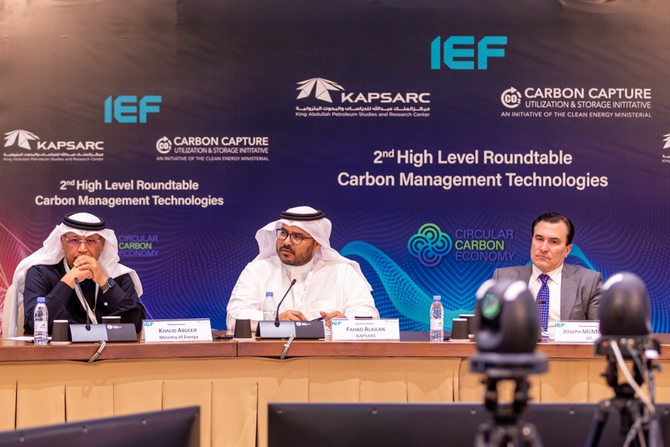
KAPSARC co-hosted the second International Energy Forum High-Level Roundtable on Carbon Management Technologies in collaboration with the IEF and the Clean Energy Ministerial. (Supplied)
Short Url
Updated 19 February 2023
Follow

Global investment in carbon capture and storage projects hit $6.4 bn in 2022: KAPSARC official 

RIYADH: The volume of global investment in carbon capture and storage projects has hit $6.4 billion in 2022, said Fatih Yilmaz, an expert in the Climate and Sustainability Program at the King Abdullah Petroleum Studies and Research Center. 

Speaking during a panel discussion on carbon management techniques with the International Energy Forum and the Clean Energy Forum in Riyadh, Yilmaz highlighted that the average investment in CCUS projects ranged from $2 billion to $3 billion annually until 2022. 

This indicates that last year witnessed a jump in the rate of investments in the sector, which further implies the need to invest in clean hydrogen. 

Citing a recent study by the International Energy Agency which listed CCUS as one of the seven pillars of achieving net-zero by 2050, he added that there is an underlying need to reach a capacity to capture and store 8 million tons of carbon dioxide by 2050. 

The world striving to achieve net-zero carbon emissions goals needs a new approach to attract investments to scale up carbon capture and storage capacity, said experts who participated in the roundtable.   

“We cannot achieve net-zero without carbon capture, and we need to scale up carbon capture and storage over the coming years to deliver it,” said KAPSARC President Fahad Alajlan. 

He added that the world needs a new approach to attract financiers to support CCUS initiatives. 

Stressing on the importance of the roundtable, the KAPSARC president said such events will allow experts to share their knowledge and identify ways to promote carbon management technologies. 

Speaking at the event, IEF Secretary General Joseph McMonigle, added: “We need to make 2023 the year of CCUS, and enhance collaboration to improve the investment in and usage of this technology.” 

The panel, which comprised representatives from industry, government and academia also discussed ways to enhance investment momentum in CCUS projects to reach zero neutrality. It also addressed how large-scale investments can be de-risked through clear and cohesive policies.  

Delegates also spoke about how carbon market initiatives and environmental, social and governance standards advance the circular carbon economy. In addition, they identified the CCUS synergies between hydrogen and material transitions. 

A research consulting center, KAPSARC has so far published more than 700 research papers on topics ranging from climate change policy and governance to energy and economic diversification. 


Saudi exchange leads GCC in foreign net buying in 2025, hits $5.5bn: Kamco Invest

Updated 10 sec ago
Follow

Saudi exchange leads GCC in foreign net buying in 2025, hits $5.5bn: Kamco Invest

RIYADH: Foreign investors poured $5.5 billion into the Saudi exchange in 2025, the highest net buying in the Gulf Cooperation Council, an analysis showed. 

In its latest report, Kamco Invest said the Kingdom was followed by the Abu Dhabi and Kuwait exchanges, which saw net foreign inflows of $3.4 billion and $1.5 billion, respectively, over the 12 months.

Dubai and Qatar also registered net buying in 2025, amounting to $1.3 billion and $171 million, respectively. 

The steady performance in the majority of exchanges in the region comes as GCC equity markets continue to attract global capital, buoyed by strong corporate earnings and ongoing economic reforms.

“The yearly trend indicated continued positive activity by foreign investors on GCC exchanges in 2025, although total buying declined over the course of the year,” said Kamco Invest in the report. 

According to the analysis, the Oman Exchange recorded the largest net sales by foreign investors in 2025 at $440 million, followed by Bahrain, which posted net sales of $10.3 million. 

In the fourth quarter of 2025, net buying by foreign investors in the Kingdom stood at $1 billion, followed by Oman at $86.6 million. 

All other exchanges, excluding the Kingdom and Oman, witnessed a net selling trend in the fourth quarter. 

“Quarterly trading data showed that foreign investors were net sellers in Q4-2025 on all exchanges barring Saudi Arabia and Oman. Saudi Arabia recorded net foreign buying of $1 billion, while Oman saw net inflows of $86.6 million during the (fourth) quarter, partially offsetting the overall net sales across the region,” added Kamco Invest. 

Foreign investors were the biggest sellers of Abu Dhabi stocks with net sales of $1 billion during the quarter, followed by Kuwait at $187.9 million, Bahrain at $45.6 million, and Qatar at $8.8 million. 

Saudi Arabia and Oman also recorded consecutive net buying by foreign investors across all three months of the fourth quarter, signaling rising investor interest in these countries. 

Dubai exhibited a net selling trend during the first two months of the fourth quarter, which subsequently reversed to net buying in the final month of the year. 

Qatar registered net buying in the first month of the quarter before shifting to net selling in the second month, and returned to net buying in the final month.

The UAE and Kuwait exchanges experienced consistent net selling by foreign investors across all three months of the fourth quarter.

Kamco Invest said that the key factors which affected the flow of foreign money in the region included regional market trends, economic health of individual countries and crude oil prices.