

Imran Khan says ex-army chief Bajwa ‘violated oath’, asks president to initiate inquiry against him

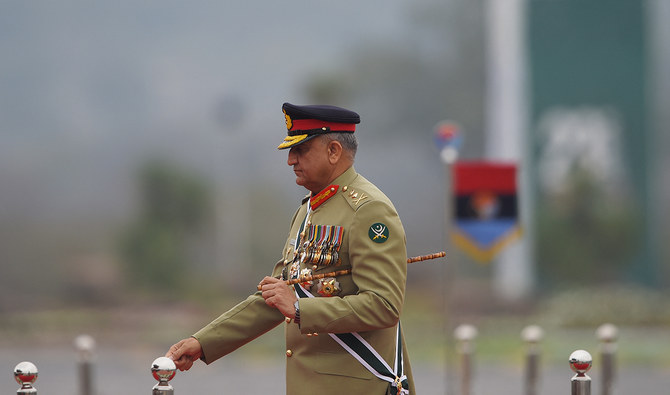
Former Pakistan Army Chief General (R) Qamar Javed Bajwa arrives to attend the Pakistan Day parade in Islamabad on March 23, 2019. (Photo courtesy: AFP/FILE)
Short Url
Updated 17 February 2023
Follow

Imran Khan says ex-army chief Bajwa ‘violated oath’, asks president to initiate inquiry against him

  • Khan writes letter to President Alvi, includes list of instances when Gen. Bajwa allegedly violated constitution
  • Interior minister, in indirect reference to Khan, says some people “piggybacked off establishment” but are now criticizing Bajwa

ISLAMABAD: Former prime minister Imran Khan on Thursday asked President Arif Alvi to order an “immediate inquiry” against ex-army chief, General Qamar Javed Bajwa, for allegedly violating the oath of his office repeatedly as well as the country’s constitution.

Ever since his ouster from power in April last year through a no-trust vote, Khan has been at loggerheads with the ex-army chief, arguably the most powerful post in the country. Khan blames Pakistan’s powerful military establishment for not saving his government. 

After months of blaming the US for triggering a regime change in Pakistan, Khan said this week that only Bajwa was responsible for his removal. The cricketer-turned-politician said that in light of the “evidence” he has come across recently, the former army chief— whom he referred to as a “super king“--somehow managed to convince Washington that Khan was anti-US

In a letter written to President Alvi dated February 14, Khan included a list of reasons in his attempt to prove how Bajwa repeatedly violated the constitution and demanded urgent action against him.

“Some very disturbing information has now come into the public domain whereby it is clear that Gen retd Bajwa as COAS violated his oath of [the] office repeatedly,” Khan wrote in the letter, a copy of which was posted on Pakistan Tehreek-e-Insaf’s official Twitter account on Thursday.

Khan explained in the letter that in conversation with a journalist, Bajwa had admitted that Khan was “dangerous to the country if he continued to stay in power”, adding that assuming the right to decide such a thing was a violation of his oath as given in Third Schedule Article 244 of the Constitution.

“Regardless of the merits of his claims in this case, he has also admitted he managed to get the NAB [National Accountability Bureau] case against Shaukat Tarin dismissed revealing that NAB was under his control — again a clear violation of the Constitutional oath because the army itself is a department under the Ministry of Defense and civilian official autonomous institutions do not come [under] military control,” the letter added.

Khan also claimed that Bajwa told a journalist that he was in possession of audio tapes that featured conversations between the former army chief and Khan. He said it was again a violation of his oath and fundamental human rights.

Towards the end of the letter, Khan also pointed out that Bajwa went against the government’s policy of “maintaining neutrality in the Russia-Ukraine War”.

“I would also point out that Chapter II of the Constitution describes the mandate of the Armed Forces and specifically refers to Articles 243 and 244. Therefore, it is your Constitutional duty as President and as Supreme Commander of the Armed Forces to take immediate action and institute an inquiry so as to establish whether such grave violations of the Constitution and oath of Office under the Constitution have taken place,” the letter said.

Commenting on Khan’s move, Interior Minister Rana Sanaullah said during a press conference that “these people piggybacked off the establishment’s shoulders” to be imposed on the nation.

“What are they doing to the establishment now? What kind of things is [Khan] saying about General Bajwa? And now they are also targeting the judiciary,” he said. 


Pakistan vows to play active role against climate change on International Day of Clean Energy 

Updated 26 January 2026
Follow

Pakistan vows to play active role against climate change on International Day of Clean Energy 

  • Governments, civil societies every year mark Jan. 26 as International Day of Clean Energy, calling for inclusive transition to clean power
  • Pakistan ranks among nations most vulnerable to climate change, suffering from erratic weather patterns such as floods, heatwaves, storms

ISLAMABAD: Pakistan will play an active role in global efforts against climate change, President Asif Ali Zardari vowed on Monday as the world marks International Day of Clean Energy today. 

The International Day of Clean Energy is marked every year on Jan. 26 during which governments and civil societies around the world call for awareness on climate change impacts and demand action for a just and inclusive transition to clean energy for the benefit of the people.

Burdened by an energy crisis that has resulted in costly fuel imports over the past couple of years, Pakistan has sought to shift to clean energy to place less burden on its fragile economy. The South Asian country has emerged as one of the world’s fastest growing solar markets, with 12 gigawatts (GWs) of off-grid and over 6GWs of net-metered solar capacity by the end of 2025. In the last fiscal year, renewables accounted for a historic 53 percent of total electricity generation, according to the prime minister’s coordinator on climate change, Romina Khurshid Alam. 

“Pakistan will play an active role in global efforts against climate change,” Zardari was quoted in a statement released by his office. “Investment in safe technologies is essential for the protection of the planet.”
Zardari stressed that clean energy is essential for inclusive development, noting that Pakistan has made the transition toward it a “national priority.”

He said clean energy occupies a central place in the government’s policy framework, adding that Pakistan has set a target of electric vehicles comprising 30 percent of all passenger vehicles and heavy-duty truck sales by 2030. 

The Pakistani president cited air pollution as a major challenge to public health in the country, noting its social and economic costs for the government and the people. 

“Pakistan is committed to building a reliable and sustainable energy system,” he said. 

Pakistan ranks among nations most vulnerable to climate change and has seen erratic changes in its weather patterns that have led to frequent heatwaves, untimely rains, storms, cyclones, floods and droughts in recent years. 

In 2022, monsoon floods killed over 1,700 people, displaced another 33 million and caused over $30 billion losses. Over 1,000 people were killed in floods last year as well due to torrential monsoon rains and floods triggered by climate change impacts and excess water released by Indian dams.