

IAEA chief calls Pakistan 'privileged partner,' seeks enhanced nuclear cooperation

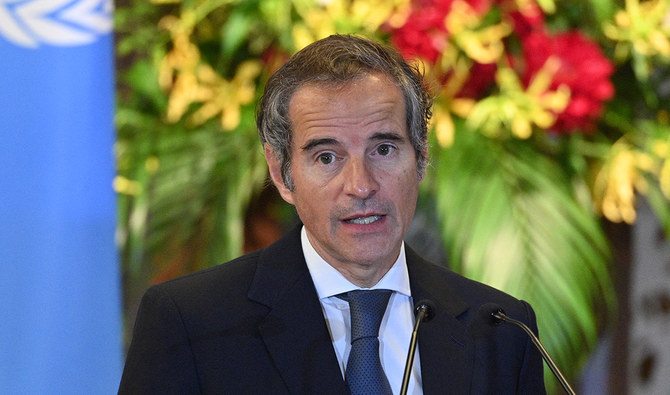
International Atomic Energy Agency (IAEA) director general Rafael Mariano Grossi speaks after meeting with Japan's Foreign Minister Yoshimasa Hayashi at the Iikura Guest House in Tokyo on May 19, 2022. (Photo courtesy: AFP/FILE)
Short Url
Updated 15 February 2023
Follow

IAEA chief calls Pakistan 'privileged partner,' seeks enhanced nuclear cooperation

  • PM Sharif stresses greater collaboration with IAEA in terms of research, new high-yield and drought-resistant varieties of crops
  • IAE chief is on a two-day visit to Pakistan where he is expected to visit health facilities using advanced nuclear technology

ISLAMABAD: Rafael Mariano Grossi, the director-general of the International Atomic Energy Agency (IAEA) on Wednesday labeled Pakistan as a “privileged partner,” saying that his agency would enhance cooperation with Islamabad both as a recipient and provider of safe nuclear technology. 

Grossi is in Islamabad on a two-day visit to attend bilateral meetings and visit different institutions that make use of nuclear technology in health, agriculture, industry, and power generation.

The IAEA, an intergovernmental body, promotes safe and peaceful nuclear technology internationally. As a collaborative effort with its members and partners, it focuses on advancing the development of nuclear energy while ensuring its security and safety.

According to the foreign office, Pakistan is one of the founding members of the agency since 1957 and enjoys longstanding and mutually beneficial collaboration with it.

“Pakistan is our privileged partner and we are working to enhance the cooperation,” Grossi told reporters after his visit to the Nuclear Medicine Oncology and Radiotherapy Institute (NORI) in Islamabad. 

During his visit, the IAEA chief inaugurated the state-of-the-art CyberKnife machine, a fully robotic radiotherapy device. 

Grossi said the IAEA had launched a special “Rays of Hope” program over the past year to expand radiotherapy, with a particular focus on developing countries. He added Pakistan could play a very important role in this program as it has “top-notch service centers.

“And we have this wonderful technology and you have good technology and wonderful professionals,” he said. “So we can provide technology and from Pakistan, we can take professionals who can serve not only in Pakistan but other countries as well,” Grossi added.

The IAEA chief separately met Prime Minister Shehbaz Sharif and Foreign Minister Bilawal Bhutto-Zardari to discuss bilateral energy cooperation.

“The Prime Minister expressed Pakistan’s full support for various projects and programs of the Agency and conveyed Pakistan’s keenness to expand its footprints in the Agency’s work both as a recipient and provider of expertise and technical assistance,” the Prime Minister’s Office (PMO) said in a statement after the meeting.

Sharif highlighted the impact climate change has had on Pakistan and its challenges, such as water, energy, and food security. The premier stressed the need for greater collaboration with the IAEA in terms of research on new high-yield and drought-resistant varieties of crops, the PMO added. 

“Prime Minister further noted the contribution of nuclear power generation to Pakistan’s energy mix as a cleaner and more affordable source of energy,” the PMO said. 

The statement added that the IAEA Director General agreed to the need for expanding applications of nuclear technology in countries like Pakistan to address a whole suite of climate-related challenges.

He expressed his appreciation for the good work of agricultural research institutions in Pakistan, including the Nuclear Institute for Agriculture & Biology (NIAB), which is one of the IAEA’s collaborating centers in Pakistan.

FM Bhutto-Zardari emphasized the importance of using atomic energy in health, agriculture industry, and power sector in his meeting with Grossi.

Speaks to Arab News, a Pakistan Atomic Energy Commission (PAEC) spokesperson, Shahid Riaz Khan said the delegation would visit NIAB and National Institute for Biotechnology and Genetics Engineering (NIBGE) in Faisalabad on Thursday.

There, he said, the IAEA chief would also inaugurate Zodac Lab, which is doing research on zoonotic diseases spread by animals.


Islamabad dismisses claims about paying up to 8 percent interest on foreign loans as ‘misleading’

Updated 22 February 2026
Follow

Islamabad dismisses claims about paying up to 8 percent interest on foreign loans as ‘misleading’

  • Pakistan has long relied on external loans to help bridge persistent gaps in public finances and foreign exchange reserves
  • Pakistan’s total external debt, liabilities stand at $138 billion at an overall average cost of around 4 percent, ministry says

KARACHI: Pakistan’s finance ministry on Sunday dismissed as “misleading” claims that the country is paying up to 8 percent interest on external loans, saying the overall average cost of external public debt is approximately 4 percent.

Pakistan has long relied on external loans to help bridge persistent gaps in public finances and foreign exchange reserves, driven largely by a narrow tax base, chronic trade deficits, rising debt-servicing costs and repeated balance-of-payments pressures.

Over the decades, successive governments have turned to multilateral and bilateral lenders, including the International Monetary Fund, the World Bank and the Asian Development Bank, to support budgetary needs and shore up foreign exchange reserves.

The finance ministry on Sunday issued a clarification in response to a “recent press commentary” regarding the country’s external debt position and associated interest payments, and said the figures required contextual explanation to ensure accurate understanding of Pakistan’s external debt profile.

“Pakistan’s total external debt and liabilities currently stand at $138 billion. This figure, however, encompasses a broad range of obligations, including public and publicly guaranteed debt, debt of Public Sector Enterprises (both guaranteed and non-guaranteed), bank borrowings, private-sector external debt, and intercompany liabilities to direct investors. It is therefore important to distinguish this aggregate figure from External Public (Government) Debt, which amounts to approximately $92 billion,” it said.

“Of the total External Public Debt, nearly 75 percent comprises concessional and long-term financing obtained from multilateral institutions (excluding the IMF) and bilateral development partners. Only about 7 percent of this debt consists of commercial loans, while another 7 percent relates to long-term Eurobonds. In light of this composition, the claim that Pakistan is paying interest on external loans ‘up to 8 percent’ is misleading.

The overall average cost of External Public Debt is approximately 4 percent, reflecting the predominantly concessional nature of the borrowing portfolio.”

With respect to interest payments, public external debt interest outflows increased from $1.99 billion in Fiscal Year (FY) 2022 to $3.59 billion in FY2025, representing an increase of 80.4 percent, not 84 percent as reported. In absolute terms, interest payments rose by $1.60 billion over this period, not $1.67 billion, it said.

According to the State Bank of Pakistan’s records, Pakistan’s total debt servicing payments to specific creditors during the period under reference were as follows: the IMF received $1.50 billion, of which $580 million constituted interest; Naya Pakistan Certificates payments totaled $1.56 billion, including $94 million in interest; the Asian Development Bank received $1.54 billion, including $615 million in interest; the World Bank received $1.25 billion, including $419 million in interest; and external commercial loans amounted to nearly $3 billion, of which $327 million represented interest payments.

“While interest payments have increased in absolute terms, this rise cannot be attributed solely to an expansion in the debt stock,” the ministry said. “Although the overall debt stock has increased slightly since FY2022, the additional inflows have primarily originated from concessional multilateral sources and the IMF’s Extended Fund Facility (EFF) under the ongoing IMF-supported program.”

Pakistan secured a $7 billion IMF bailout in Sept. 2024 as part of Prime Minister Shehbaz Sharif’s efforts to stabilize the South Asian economy that narrowly averted a default in 2023. The government has since been making efforts to boost trade and bring in foreign investment to consolidate recovery.

“It is also important to note that the increase in interest payments reflects prevailing global interest rate dynamics. In response to the inflation surge of 2021–22, the US Federal Reserve raised the federal funds rate from 0.75-1.00 percent in May 2022 to 5.25–5.50 percent by July 2023. Although rates have since moderated to around 3.75 percent, they remain significantly higher than 2022 levels,” the finance ministry said.

“The government remains committed to prudent debt management, transparency, and the continued strengthening of Pakistan’s macroeconomic stability,” it added.