Pakistani cabinet approves 1% increase in general sales tax in push to unlock IMF funding

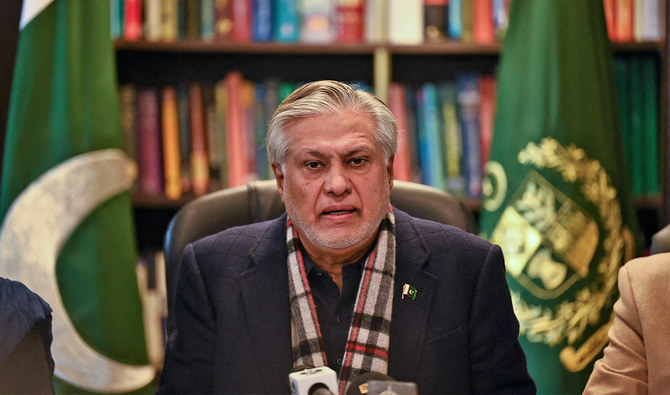
Pakistan’s Finance Minister Ishaq Dar speaks during a press conference in Islamabad on February 10, 2023. (AFP/File)
Short Url
Updated 15 February 2023
Follow

Pakistani cabinet approves 1% increase in general sales tax in push to unlock IMF funding

  • PM instructs his team of economic managers to put minimum burden on low-income segments
  • Sharif tells cabinet members not to tax daily use items and only increase tariff on luxury goods

ISLAMABAD: Pakistan’s finance minister Ishaq Dar is scheduled to present a supplementary finance bill in parliament today, Wednesday, after the federal cabinet approved increasing general sales tax by one percent and levied additional taxes on luxury items, state-run APP reported.

The measures are part of a reform agenda Pakistan has to fulfill to unlock the latest tranche of a bailout program from the International Monetary Fund. 

According to a statement released by the Prime Minister’s Office, the decision to increase taxes was taken after the cabinet received a briefing on economic reforms under the ninth review of a $7 billion IMF program. Pakistan desperately needs external financing amid its dwindling dollar reserves and a rapidly depreciating national currency.

“The federal cabinet on Tuesday approved the Finance Supplementary Bill 2023 providing for a 1 percent increase in general sales tax and additional taxes on luxury items as part of the reforms related to the International Monetary Fund’s Ninth Review,” state-run APP reported. 

The supplementary finance bill will now be tabled before parliament as President Dr. Arif Alvi has summoned sessions of the National Assembly and Senate.

“All effort must be made to put minimum burden on the low-income segments of the society,” APP quoted Prime Minister Shehbaz Sharif as saying at the cabinet meeting. “Immediate steps should also be taken to increase tax on luxury items.”

The PM issued directives to his economic team not to tax daily use items amid rising inflation which is at a multi-decade high in Pakistan. He highlighted the importance of embracing austerity at the governmental level and said a policy in this regard would be announced soon.


At ECO meeting, Pakistan proposes ‘Regional Innovation Hub’ to curb natural disasters

Updated 21 January 2026
Follow

At ECO meeting, Pakistan proposes ‘Regional Innovation Hub’ to curb natural disasters

  • Pakistan hosts high-level 10th ECO Ministerial Meeting on Disaster Risk Reduction in Islamabad
  • Innovation hub to focus on early warning technologies, risk informed infrastructure planning

ISLAMABAD: Pakistan has proposed to set up a “Regional Innovation Hub on Disaster Risk Reduction” that focuses on early warning technologies and risk informed infrastructure planning, the Press Information Department (PID) said on Wednesday, as Islamabad hosts a high-level meeting of the Economic Cooperation Organization (ECO).

The ECO’s 10th Ministerial Meeting on Disaster Risk Reduction (DRR) is being held from Jan. 21-22 at the headquarters of the National Disaster Management Authority (NDMA) in Pakistan’s capital. 

The high-level regional forum brings together ministers, and senior officials from ECO member states, representatives of the ECO Secretariat and regional and international partner organizations. The event is aimed to strengthen collective efforts toward enhancing disaster resilience across the ECO region, the PID said. 

“Key agenda items include regional cooperation on early warning systems, disaster risk information management, landslide hazard zoning, inclusive disaster preparedness initiatives, and Pakistan’s proposal to establish a Regional Innovation Hub on Disaster Risk Reduction, focusing on early warning technologies, satellite data utilization, and risk-informed infrastructure planning,” the statement said. 

The meeting was attended by delegations from ECO member states including Pakistan, Türkiye, Azerbaijan, Iran, Kyrgyzstan, Tajikistan, Turkmenistan and Uzbekistan. Representatives of regional and international organizations and development partners were also in attendance.

Discussions focused on enhancing regional coordination, harmonizing disaster risk reduction frameworks, and strengthening collective preparedness against transboundary and climate-induced hazards impacting the ECO region, the PID said. 

ECO members states such as Pakistan, Türkiye, Afghanistan and others have faced natural calamities such as floods and earthquakes in recent years that have killed tens of thousands of people. 

Heavy rains triggered catastrophic floods in Pakistan in 2022 and 2025 that killed thousands of people and caused damages to critical infrastructure, inflicting losses worth billions of dollars. 

Islamabad has since then called on regional countries to join hands to cooperate to avert future climate disasters and promote early warning systems to avoid calamities in future.