

Economic crisis dims joy of Ramadan lanterns in Egypt

1 / 3
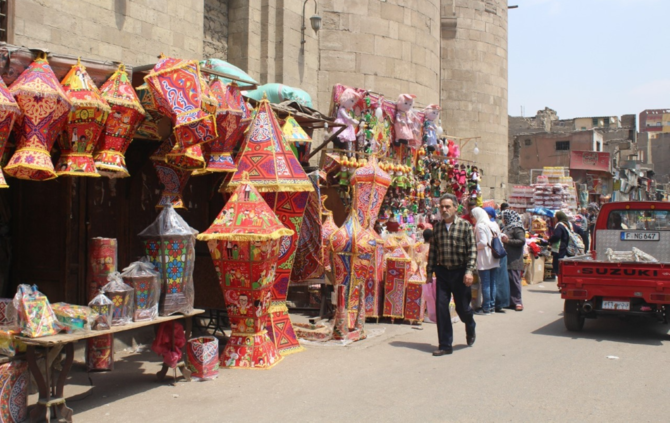
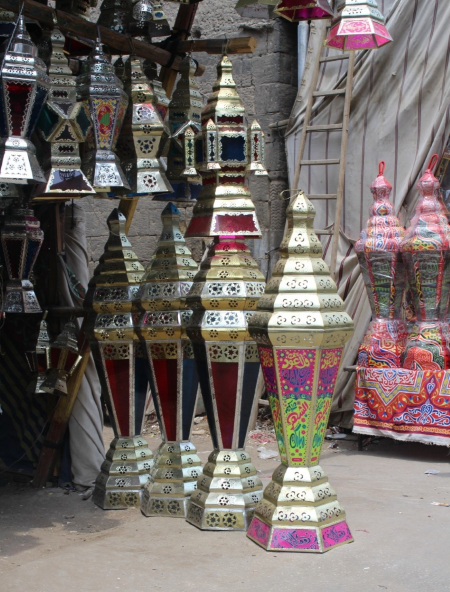
Lanterns on sale in a Cairo market. (AN Photo)
2 / 3
Lanterns on sale in a Cairo market. (AN Photo)
3 / 3
Lanterns on sale in a Cairo market. (AN Photo)
Short Url
Updated 14 February 2023
Follow

Economic crisis dims joy of Ramadan lanterns in Egypt

  • Egyptian lantern-making business in full swing at workshops in Taht Al-Rabaa, near Cairo’s Al-Azhar district
  • Cheaper Chinese-made lantern pressurizing Egyptian equivalent in the marketplace

CAIRO: With about a month left until the start of the holy month of Ramadan, the Egyptian lantern-making business is in full swing at workshops in the Taht Al-Rabaa area near Cairo’s Al-Azhar district.

The most popular national item in the festive season is the metallic lantern that features different shapes printed on glass. Other lanterns are made using fabric and wood.

Their production begins at least two months before Ramadan, with each workshop known for making lanterns in a specific shape.

Ahmed Abdel Nasser, the owner of a workshop in the Al-Hussein area, said: “The most expensive lanterns are about two meters high and are produced according to demand. However, the rising cost of raw materials has caused a price increase for lanterns in the market this year.”

Fadi Sayed, a lantern maker in the area, complained about the lack of sales, saying that customers come to see lanterns but often do not buy an item “because of the economic crisis and the high prices.”

Customers prefer lower-priced Chinese lanterns instead, he added, noting the higher cost of materials and labor in the production of Egyptian-made items.

Hana Tawhid, a housewife and mother of two, used to buy Ramadan supplies such as lanterns and mattresses from the Taht Al-Rabaa area. This year, however, she opted for plastic lanterns, which cost no more than 50 Egyptian pounds ($1.7) each.

To provide an affordable alternative to pricey imported gifts and lanterns, the Egyptian government, through the National Council for Women, conducted a workshop to train women in the manufacturing of Ramadan lanterns using beads.

Malls, hotels and offices are decorated at night with the colorful lanterns, known as fanous in Arabic.

The fanous has become a worldwide symbol that represents the holy month.


Iran urges US to drop ‘excessive demands’ to reach deal

Updated 10 sec ago
Follow

Iran urges US to drop ‘excessive demands’ to reach deal

  • Longtime adversaries Iran and the United States held their third round of Omani-mediated nuclear talks on Thursday in Geneva
  • Both Iran and Oman cited progress after the talks, with technical discussions scheduled for Monday in Vienna
TEHRAN: Iran’s Foreign Minister Abbas Araghchi said on Friday that in order to reach a deal, the United States will have to drop its “excessive demands,” after the two sides held talks in Geneva.
In a phone call with Egypt’s top diplomat Badr Abdelatty, Araghchi said “success in this path requires seriousness and realism from the other side and avoidance of any miscalculation and excessive demands.”
Araghchi did not clarify what demands he was referring to, but Washington has pointed to Iran’s ballistic missile program and has repeatedly described Tehran’s uranium enrichment capability as a red line.
US President Donald Trump said on Wednesday that Tehran had “already developed missiles that can threaten Europe and our bases overseas, and they’re working to build missiles that will soon reach the United States of America.”
Also on Wednesday, US Secretary of State Marco Rubio said Iran is “not enriching right now, but they’re trying to get to the point where they ultimately can,” adding that Tehran “refuses” to discuss its ballistic missile program and “that’s a big problem.”
Iran has repeatedly said its missile program is part of its defensive capabilities and has ruled out abandoning uranium enrichment, insisting its nuclear program is solely for peaceful purposes.
Longtime adversaries Iran and the United States held their third round of Omani-mediated nuclear talks on Thursday in Geneva, seeking to avert military escalation as Washington expands its military build-up in the region.
Both Iran and Oman cited progress after the talks, with technical discussions scheduled for Monday in Vienna ahead of a fourth round expected next week.