

Showman Zia Mohyeddin, icon of Pakistan’s art and culture landscape, dies at 91

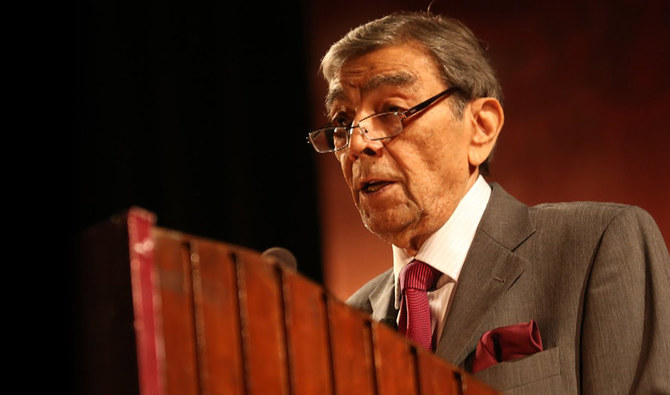
In this file photo taken on March 14, 2015, Pakistani writer and director Zia Mohyeddin speaks during a recitation session at the Jashn-e-Rekhta literature festival at India International Center, New Delhi. (Photo courtesy: Facebook/Jashn-e-Rekhta)
Short Url
Updated 13 February 2023
Follow

Showman Zia Mohyeddin, icon of Pakistan’s art and culture landscape, dies at 91

  • Mohyeddin played the ill-fated Arab guide Tafas in 1962 blockbuster “Lawrence of Arabia”
  • In Pakistan, Mohyeddin gained nationwide popularity through The Zia Mohyeddin Show in 1960s

KARACHI: Zia Mohyeddin, a veteran British-Pakistani actor who made his Hollywood debut in the 1962 epic, “Lawrence of Arabia,” died on Monday at a hospital in Karachi.

Mohyeddin, 91, had been ill and was admitted to the intensive care unit of a private hospital in Pakistan’s commercial capital before he passed away on Monday morning.

Pakistanis across the country mourned his passing, with Prime Minister Shehbaz Sharif describing his art as “one of a kind.”

“Zia Sahib’s personality was full of wonderful qualities. He mesmerized people for more than half a century with his unparalleled skills in theatre, broadcasting and oratory and the magic of his voice. Hundreds of students under his tutelage will keep his legacy alive,” Sharif said on Twitter.

The Ministry of Information and Broadcasting said he was “a true icon of Pakistan’s art and culture,” adding that his contributions to the country and the arts would never be forgotten.

Born in the eastern Pakistani city of Faisalabad, Mohyeddin spent his early years in Lahore and was trained at London’s Royal Academy of Dramatic Art from 1953 to 1956. He began his career in theater, making his debut at London’s West End in 1960 through the role of Dr. Aziz in “A Passage to India.”

In the 1962 blockbuster “Lawrence of Arabia,” he played the ill-fated Arab guide named Tafas. Directed by David Lean, the British epic historical drama is widely regarded as one of the greatest films ever made and won seven Oscars at the 1963 Academy Awards.

He was also seen in Behold the Pale Horse in 1964 by director Fred Zinnemann, and in Immaculate Conception in 1992, directed by amil Dehlavi. He also authored three books, A Carrot is a Carrot, Theatrics and The God of My Idolatry Memories, and Reflections.

Mohyeddin returned to Pakistan in the late 1960s and gained national popularity through a television talk show, “The Zia Mohyeddin Show,” which ran from 1969 until 1973.

“Mr. Zia’s life will be celebrated by many. He lived a long, happy, and healthy life. He kept working ‘till his last days and has left so much meaning behind to be cherished and take inspiration from. Mr. Zia will keep living as an immortal voice,” Pakistani screenwriter Bee Gul told Arab News.

Mohyeddin was also widely known for his poetry and prose recitations as well as acting and theatre direction, and one of his last works was directing the first Urdu adaptation of Shakespeare’s “Romeo and Juliet,” which was performed last year at the National Academy of Performing Arts, an organization Mohyeddin helped set up in 2005.

Uzma Sabeen, who assisted Mohyeddin during the recent production and knew him for over 15 years, said she was proud to have worked with him.

“I was fortunate to have worked with him. We learnt a new thing from him every day,” she told Arab News. “He was a gentleman who respected everyone, particularly women. He was a very genuine artist and a genuine human being. We never saw him speaking ill. He was a very honest person.”

Mohyeddin was awarded the Hilal-e-Imtiaz, the second-highest civilian honor in Pakistan, for his contributions to the arts, in 2012.

“The world of arts bids farewell to a maestro - Zia Mohyeddin - broadcasting legend, poetic virtuoso, actor, and theatre director,” Pakistani actor Adnan Siddiqui said on Twitter. 

“As we celebrate his life and legacy, and mourn his loss, we are reminded of the immense impact he has had on our cultural landscape.”

The Rekhta Foundation, an archive of Urdu poetry and literature, said the news of Mohyeddin’s death came as a “huge shock leaving a void that cannot be filled.”


Golden Globes honor Hend Sabry, Alia Bhatt at Red Sea International Film Festival

Updated 37 sec ago
Follow

Golden Globes honor Hend Sabry, Alia Bhatt at Red Sea International Film Festival

  • Sabry given Omar Sharif Award, Bhatt the Horizon Award
  • Praise for the 2 women’s pioneering roles in world cinema

DUBAI: The Golden Globes on Wednesday recognized Tunisian-Egyptian actress Hend Sabry and Indian actress Alia Bhatt at a gala dinner held during the fifth Red Sea International Film Festival in Saudi Arabia.

Sabry, famous for her roles in “Asmaa,” “The Yacoubian Building” and “Blue Elephant 2,” received the Omar Sharif Award.

Sabry, famous for her roles in “Asmaa,” “The Yacoubian Building” and “Blue Elephant 2,” received the Omar Sharif Award. (Getty Images)

Bhatt, known for her performances in “Raazi,” “Gangubai Kathiawadi” and “Dear Zindagi,” was honored with the Golden Globes Horizon Award.

Bhatt, known for her performances in “Raazi,” “Gangubai Kathiawadi” and “Dear Zindagi,” was honored with the Golden Globes Horizon Award. (Getty Images)

The event featured a star-studded guest list, including US filmmakers Sean Baker and Darren Aronofsky, US actresses Sigourney Weaver and Shailene Woodley, British actress Naomie Harris, and French-Ukrainian star Olga Kurylenko.

Also in attendance were British actor-director Idris Elba, Venezuelan-American actor Edgar Ramirez, Indian actor Salman Khan, British-Malaysian actor Henry Golding, and British-Pakistani actor Riz Ahmed.

Helen Hoehne, president of the Golden Globes, said at the event that Sarby was “a truly iconic performer and humanitarian whose body of work reflects the depth, power and global impact of Arab cinema, while paying tribute to Omar’s remarkable legacy as a pioneering Egyptian artist.”

The late Sharif was the first Egyptian-born actor to win a Golden Globe, and was also a three-time recipient for his roles in “Lawrence of Arabia” and “Doctor Zhivago.”

“I am deeply honored to receive a prestigious award named after one of the true legends of cinema from this part of the world,” Sabry said.

“My career has been devoted to uplifting women with complex stories and I am thrilled to be sharing this Golden Globes stage with Alia Bhatt, one of the next generation’s brightest and most talented stars.

“It’s a significant moment for women in our industry and I am so pleased to be part of the Golden Globes’ enduring history.”

Hoehne said Bhatt was recognized for her “exceptional contributions to international cinema and the continued rise of the Middle East as a dynamic and influential hub for film and television on a global stage.”

The Golden Globes Horizon Award recognizes an emerging creative talent whose rising profile is shaping both regional and international culture.

“This is an honor to be recognized by the Golden Globes and I am grateful for the opportunity to speak for a new generation of aspiring performers and women who are making a difference in film and television around the world,” Bhatt said.

“At a time when global voices are coming together to tell more inclusive and impactful stories, this recognition feels especially meaningful.

“The Golden Globes are an iconic part of the global awards universe and I am delighted to be part of it and look forward to continuing my career in telling more stories of powerful and deserving women.”