Evolving regulatory framework attracting regional and global issuers to Saudi capital market    

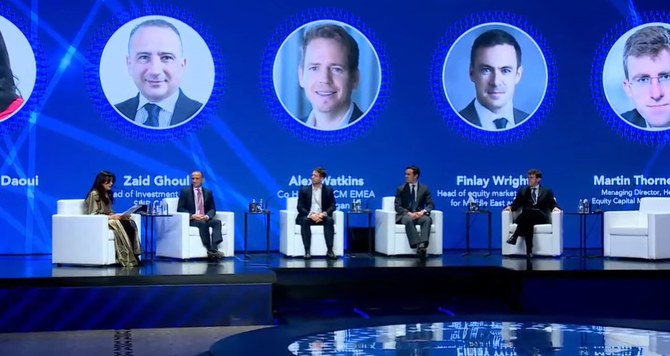
Speaking at a panel during the Saudi Capital Market Forum in Riyadh on Feb.13, Zaid Ghoul, head of investment banking at SNB Capital, noted that the Kingdom’s parallel market Nomu is also growing steadily. (Supplied)
Short Url
Updated 13 February 2023
Follow

Evolving regulatory framework attracting regional and global issuers to Saudi capital market    

RIYADH: The size of Saudi Arabia’s stock exchange, its liquidity and the continuous change in the regulatory framework are some of the key factors making the Kingdom’s market attractive to regional and international issuers, noted a top Saudi banker.   

Speaking at a panel during the Saudi Capital Market Forum in Riyadh on Feb.13, Zaid Ghoul, head of investment banking at SNB Capital, noted that the Kingdom’s parallel market Nomu is also growing steadily.  

“The interesting thing to look at Nomu, which is the parallel market, is that it attracted 19 listings in 2022 compared to only three in 2021. So, this area of the capital market is really growing,” he added.   

During the discussion titled “Public equity over-burn: where can the additional bandwidth come from?” Finlay Wright, managing director at Rothschild & Co., said there had been various high-quality initial public offerings that have come to Saudi Arabia and provided exposure to investors to explore new sectors, which previously they have been unable to do.  

“On the back of that, certain select companies that meet the criteria for dual listing are actively exploring the possibilities, and it is really exciting for the Saudi market,” he added.   

Wright pointed out that the increase in the number of IPOs in the Middle East, especially in Saudi Arabia, is happening due to very strong macro conditions combined with a strong oil price, adequately supported by structural and regulatory changes that have taken place.  

Top experts who attended a panel discussion suggested that an active follow-up after IPOs is necessary to improve the capital market in the Kingdom further.   

“There is clearly more to do around supporting an active following on market beyond the IPO. Like, as what happens after the IPO, whether companies can use the listings to access primary capital, and whether vendors can sell down secondary capital in an efficient form. That is the next leg,” said Martin Thorneycroft, managing director, and head of Cash Equity Capital Markets, EMEA at Morgan Stanley.

Wright noted that private equity owners who enter the Kingdom’s market would be eyeing to raise capital in 12 or 18 months and added that this is one of the main concerns for firms entering the secondary market in Saudi Arabia.  

“When we spend time speaking to our clients who are considering listing in Saudi Arabia, one of the issues which can come up is, if I am a private equity owner or a growth capital company, we will look to raise capital in 12 or 18 months. How easy will that be for me, especially considering the fact that the secondary market is relatively undeveloped in the Kingdom,” said Wright. 


Closing Bell: Saudi main index rises to 10,894

Updated 13 January 2026
Follow

Closing Bell: Saudi main index rises to 10,894

RIYADH: Saudi Arabia’s Tadawul All Share Index extended its upward trend for a third consecutive day this week, gaining 148.18 points, or 1.38 percent, to close at 10,893.63 on Tuesday. 

The total trading turnover of the benchmark index stood at SR6.05 billion ($1.61 billion), with 144 listed stocks advancing and 107 declining. 

The Kingdom’s parallel market Nomu also rose by 81.35 points to close at 23,668.29. 

The MSCI Tadawul Index edged up 1.71 percent to 1,460.89. 

The best-performing stock on the main market was Zahrat Al Waha for Trading Co., with its share price advancing 10 percent to SR2.75. 

Shares of CHUBB Arabia Cooperative Insurance Co. increased 8.27 percent to SR23.04, while Abdullah Saad Mohammed Abo Moati for Bookstores Co. saw its stock climb 6.17 percent to SR50.60. 

Conversely, the share price of Naseej International Trading Co. declined 9.90 percent to SR31.48. 

On the announcements front, Arabian Drilling Co. said it secured three contract extensions for land rigs with energy giant Saudi Aramco, totaling SR1.4 billion and adding 25 active rig years to its backlog. 

In a Tadawul statement, the company said one rig is currently operational, the second will begin operations by the end of January, and the third — currently suspended — is expected to resume operations in 2026. 

Since November 2025, Arabian Drilling has secured seven contract extensions amounting to SR3.4 billion, representing 55 committed rig years. 

The three contracts have durations of 10 years, 10 years, and five years, respectively.

“Securing a total of SR1.4 billion in new contracts and expanding our backlog by 25 rig-years demonstrates both the trust our clients place in us and our ability to consistently deliver quality and reliability,” said Ghassan Mirdad, CEO of Arabian Drilling, in a statement. 

Shares of Arabian Drilling Co. rose 3.15 percent to SR104.70. 

Separately, Alkhorayef Water and Power Technologies Co. said it signed a 36-month contract valued at SR43.35 million with National Water Co. to operate and maintain water networks, pumping stations, wells, reservoirs, and related facilities in Tabuk. 

In October, Alkhorayef Water and Power Technologies Co. announced it had been awarded the contract by NWC. 

In a Tadawul statement, the company said the financial impact of the deal began in the fourth quarter of 2025. 

The share price of Alkhorayef Water and Power Technologies Co. declined 0.49 percent to SR120.70.