

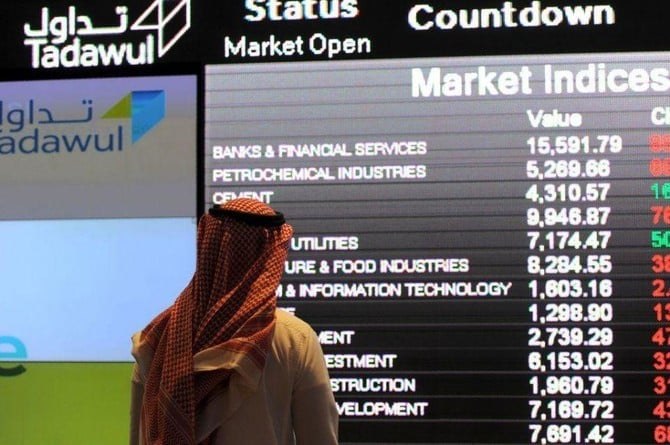
Closing bell: TASI hits a speed bump, closes flat at 10,419 points 

TASI’s total trading turnover of the benchmark index was SR2.69 billion ($720 million) as 95 stocks of the listed 224 advanced and 105 receded. 
Short Url
Updated 12 February 2023
Follow

Closing bell: TASI hits a speed bump, closes flat at 10,419 points 

RIYADH: Saudi Arabia’s Tadawul All Share Index on Sunday gained 7.28 points — or 0.07 percent — to close at 10,419.44. 

While MSCI Tadawul 30 Index also ended flat at 1,424.75, the parallel market Nomu closed 0.88 percent higher at 19,536.84. 

TASI’s total trading turnover of the benchmark index was SR2.69 billion ($720 million) as 95 stocks of the listed 224 advanced and 105 receded. 

Al-Jouf Agricultural Development Co. was the best performer, as its share price surged 8.85 percent to SR49.20. 

The other top performers were Americana Restaurants International, Al Gassim Investment Holding Co. and Abdullah Al Othaim Markets Co — all three soared by over 6 percent. 

In fact, Abdullah Al Othaim Markets Co.’s board of directors, on Sunday, informed the stock exchange that it declared a 27.5 percent cash dividend or SR2.75 per share for the fourth quarter of 2022, totaling SR247.5 million. 

However, the worst-performing stock of the day was Fawaz Abdulaziz Alhokair Co., which slipped 5.67 percent to SR16.98. 

Other poor performers were Etihad Atheeb Telecommunication Co., Alamar Foods Co., Abdulmohsen Alhokair Group for Tourism and Development and Gulf General Cooperative Insurance Co. 

Among sectoral indices, 12 of the 21 listed on the stock exchange advanced while the rest declined. 

On the announcements front, Banque Saudi Fransi reported a 4 percent increase in net profit for 2022 to SR3.57 billion from SR3.44 billion in the year-earlier period. 

The higher profit was driven mainly by a 12.47 percent rise in total operating income, which was partly offset by an increase in total operating expenses by 21.97 percent. 

BSF, however, reported a 9 percent decline in its net profit during the fourth quarter of 2022 to SR902.60 million from SR993.27 million a year earlier. Its share price closed marginally higher at SR36.75. 

Tanmiah Food Co. reported a whooping net profit after zakat and tax of SR186.8 million compared to SR13.6 million in the year-earlier period. 

The annual net profit includes a one-off gain of SR101.9 million due to the strategic partnership with Tyson Foods. 

Tyson Foods acquired a 60 percent equity stake in Supreme Foods Processing Co, and the gain on the disposal of a 15 percent equity stake in Agricultural Development Co. to Tyson Foods, at SR74 million, was recorded directly in equity. 

Revenue increased 42.8 percent to SR1.72 billion, in line with the continued rise in sales across the company’s diversified portfolio of products and services. Tanmiah’s share price, however, fell slightly to SR124. 

Saudi Azm for Communication and Information Technology Co. also reported 38 percent in net profit after zakat and tax to SR 11.1 million for the first half ended Dec. 31, 2022, from SR8 million in the year-ago period. 

The profit rise came from an overall increase in revenue by 40.50 percent year on year, where all other costs were consistent with higher revenue, the company said in a statement to the Saudi Stock Exchange. The company’s share price fell 2.17 percent to finish at SR180. 


Industry leaders highlight Riyadh’s Metro, infrastructure as investment catalysts

Updated 29 December 2025
Follow

Industry leaders highlight Riyadh’s Metro, infrastructure as investment catalysts

RIYADH: Saudi Arabia’s capital, Riyadh, is experiencing a transformative phase in its real estate sector, with the construction market projected to reach approximately $100 billion in 2025, accompanied by an anticipated annual growth rate of 5.4 percent through 2029.

The Kingdom is simultaneously advancing its data center capacity at an accelerated pace, with an impressive 2.7 GW currently in the pipeline. This expansion underscores the critical role of strategic land and power planning in establishing national infrastructure as a cornerstone of economic growth.

These insights were shared by leading industry experts during JLL’s recent client event in Riyadh, which focused on the city’s macroeconomic landscape and emerging trends across office, residential, retail, hospitality, and pioneering sectors, including AI infrastructure and Transit-Oriented Development.

Saud Al-Sulaimani, Country Lead and Head of Capital Markets at JLL Saudi Arabia, commented: “Riyadh is positioned at the forefront of Saudi Arabia’s Vision 2030, offering unparalleled opportunities for both investors and developers. National priorities are continuously recalibrated to ensure strategic alignment of projects and foster deeper collaboration with the private sector.”

He added: “Recent regulatory developments, including the introduction of the White Land Tax and the rent freeze, are designed to stabilize the market and are expected to drive renewed focus on delivering premium-quality assets. This dynamic environment, coupled with evolving construction cost considerations in select segments, is fundamentally reshaping the market landscape while accelerating progress toward our national objectives.”

The event further underscored the transformative impact of infrastructure initiatives. Mireille Azzam Vidjen, Head of Consulting for the Middle East and Africa at JLL, highlighted Riyadh’s transit revolution. She detailed the Riyadh Metro, a $22.5 billion investment encompassing 176 kilometers, six lines, and 84 stations, providing extensive geographic coverage, with a depth of 9.8 km per 100 sq. km. This strategic development generates significant TOD opportunities, with properties in proximity potentially commanding a 20-30 percent premium. JLL emphasized the importance of implementing climate-responsive last-mile solutions to enhance mobility and accessibility, particularly given Riyadh’s extreme temperatures.

Gaurav Mathur, Head of Data Centers at JLL, emphasized the rapid expansion of the Kingdom’s AI infrastructure, signaling a critical area for technological investment and innovation.

Focusing on the construction sector, Maroun Deeb, Head of Projects and Development Services, KSA at JLL, explained that the industry is actively navigating complexities such as skilled labor availability, material costs, and supply chain dynamics.

He highlighted the adoption of Building Information Modeling as a key driver for enhancing operational efficiency and project delivery.