

At London Fashion Week, Pakistani clothing label Rastah aims to change ‘narrative’ about Pakistan

This handout picture, released by Pakistani fashion label Rastah on January 29, 2023, features the latest collection "inspired by concepts of conflict, desire and the human condition" that will be showcased at the London Fashion Week. (Photo courtesy: Instagram/ Rastah Official)
Short Url
Updated 11 February 2023
Follow

At London Fashion Week, Pakistani clothing label Rastah aims to change ‘narrative’ about Pakistan

  • The brand will showcase its 2023 Spring/Summer collection at London Fashion Week on Feb 17-21
  • Selling entirely online, Rastah has had numerous physical pop-ups in London and New York as well

KARACHI: As Pakistani clothing label Rastah heads to the London Fashion Week 2023, its co-founders say that it is time for the “narrative” about Pakistan to change on the world fashion landscape.

Rastah, a premier South Asian artisanal urban wear brand, aims to decontextualize and reinterpret regional heritage and artisanship by bringing together western silhouettes and traditional eastern motifs, contemporary art and Mughal miniature, and stories of exodus.

The Pakistani label, which launched in 2018 with a few hoodies after the co-founders saw a gap in this segment, follows an online business-to-consumer (B2C) model, but has had numerous physical pop-ups in London and New York as well.

Rastah is going to showcase its products in the London Fashion Week 2023 on Feb 17-21 after a “rigorous” application process, according to the brand’s creators. The label will be showcasing its merchandise at 8:30-11:30pm London time on February 17.

For so long, Rastah co-founder Ismail Ahmad says, the world has looked at Pakistan and South Asia as a “mere cog in the global supply chain, however, we’re much more than that” as some of the best artisanal practices have either originated or been perfected in South Asia.

“The effects of colonialism have been drastic. Many a time, western designers or brands take inspiration from the east without giving due credit,” Ahmad told Arab News on Saturday.

“It’s time we changed that narrative and [told] our own stories through our own lens. Through this approach, Pakistan can [hopefully] become a force in the global fashion landscape.”
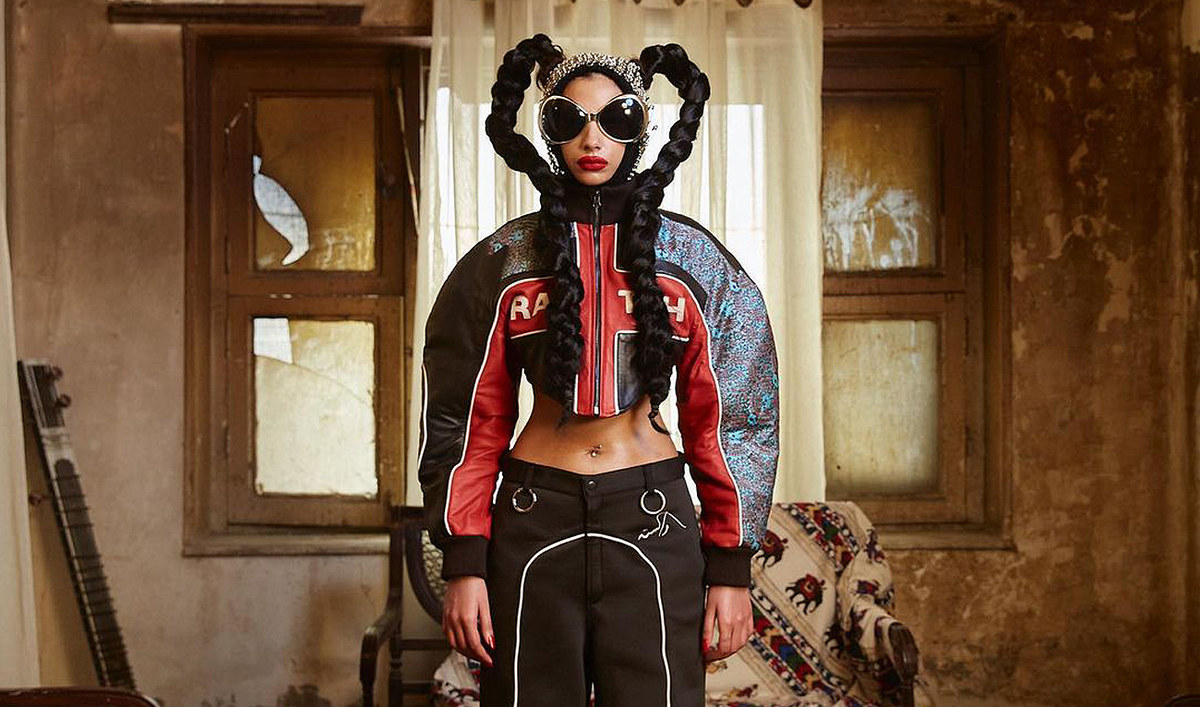


This handout picture, released by Pakistani fashion label Rastah on January 29, 2023, features the latest collection "inspired by concepts of conflict, desire and the human condition" that will be showcased at the London Fashion Week. (Photo courtesy: Instagram/ Rastah Official)

Zain Ahmad, the label’s creative director, said they will be taking guests on a “narrative exploration” of their 2023 Spring/Summer Collection, titled Volume IX, at the London Fashion Week.

“The concept behind the collection is deeply personal and revolves around feelings of desire and conflict. How often we let ourselves be consumed by the material world, knowing full well that it serves little to no purpose, yet we carry on with this pursuit,” he told Arab News.

“This is apparent in the use of chaotic prints and embroideries that are juxtaposed among each other.”

The brand brought to life the “unique,” lived experiences of the creative director and his design team as South Asians in a vastly globalized world, according to Zain. It was an attempt to carve their own identity whilst staying true to their heritage and roots.

“Having lived in various parts of the world, identity has always been a difficult question to answer, since the home has always been Pakistan,” he shared.

Ahmad said Rastah had already curated a market abroad and more than half of the brand’s sales came from the global north, including the United States, the United Kingdom and Canada.

“These markets are also rapidly growing, and the interesting thing is that it’s not just South Asians who are buying. This is so important in regard to Rastah’s chances of successfully scaling further,” he said.

The co-founder said his team always wondered if it was possible to buy clothes that weren’t entirely traditional, but had their roots in tradition, something that could be worn and appreciated in cities like New York and London. Since then, Ahmad said, the brand had evolved with a greater focus on luxury and an emphasis on design sensibility.

“I really don’t even consider ourselves a streetwear brand per se anymore given that our designs are a lot more elevated and technical now, even though those elements of streetwear still exist,” he said.

For the upcoming showcase in London, Zain said, the brand’s goal was to educate attendees on the various artisanal techniques they utilize and walk them through their process, which at times takes up to 10 days for a single piece.

The clothing label is also having a pop-up shop in London on Feb 17-21 after over three years, through which they aim to “engage” and show love to their community.


Sotheby’s ‘Origins II’: Local heroes go under the hammer 

Updated 15 January 2026
Follow

Sotheby’s ‘Origins II’: Local heroes go under the hammer 

  • Regional highlights from Sotheby’s ‘Origins II’ auction, which takes place Jan. 31 in Diriyah 

DUBAI: Here are some of the regional highlights from Sotheby’s ‘Origins II’ auction, which takes place Jan. 31 in Diriyah.

Mohamed Siam 

‘Untitled (Camel Race)’ 

Siam is described by Sotheby’s as “one of the most significant voices of the Kingdom’s second generation of modern artists.” His “highly discernible visual aesthetic,” the auction catalogue states, references European cubists and Italian Futurism, using “multiple overlapping planes to create an endless sense of movement” — an approach that “fragments visual reality, enabling the viewer to experience multiple viewpoints simultaneously.” This work from the late 1980s “shrewdly captures through a fractured, shifting perspective two camel riders in an enthralling, head-to-head race.” It marks Siam’s auction debut and is expected to fetch between $70,000 and $90,000.  


Abdulhalim Radwi 

‘Untitled (Hajj Arafah)’ 

The Makkah-born artist is one of Saudi modernism’s most significant figures. His “multifaceted practice was shaped by a profound engagement with regional heritage and the evolving aesthetic currents of the 20th century,” the catalogue notes. This 1967 oil painting is hailed by Sotheby’s as “a vibrant example of Radwi’s practice (at the time), depicting a bustling arrangement of tented structures rendered in his characteristic Cubist-inflected idiom. The tightly interlocking forms, rhythmic repetitions, and cool, airy palette evoke the temporal architecture of the Hajj pilgrimage, distilled into a kaleidoscopic composition that celebrates the textures and visual poetry of life in Makkah.” 


Mohammed Al-Saleem 

‘Untitled’ 

Another of the Kingdom’s modern-art pioneers, Al-Saleem was born in 1939 in Al-Marat province. His work, Sotheby’s says, “is celebrated for its distinct visual language, a style which the artist coined ‘Horizonism.’ Drawing inspiration from the shifting sands and gradating skyline of Riyadh as seen from the desert, as well as the intensity of the Saudi sun, Al-Saleem reimagined his beloved landscape through the prism of abstraction.” In works such as this 1989 oil painting, he “replaced the traditional horizon line with stylized forms resembling organic forms and Arabic calligraphy … a fusion of modernist abstraction and cultural identity.” 


Taha Al-Sabban  

‘Untitled’ 

This mixed-media-on-canvas work from 2005 typifies the Makkah-born artist’s modernist approach, which, Sotheby’s states “has been described as both an act of conservation and a homage to the nature and culture of his homeland.” The artist “used expressive color and form to preserve local memory — palm groves, open waters, and traditional architecture — while transforming the traditional cityscape into ascending, abstracted rhythms.” His work is often described as “nostalgic,” but the Al-Sabban is quoted by the Al-Mansouria Foundation as saying: “Although I am acutely aware of the passage of time, my aim is not nostalgia; instead I seek to capture the moment and reveal the life in the world.” 


Zeinab Abd El-Hamid 


‘Untitled (Shisha Shop)’ 

This 1987 watercolor is the work of one of Egypt’s most significant female artists of the modern era who belonged, Sotheby’s says “to a generation of artists who came of age during the cultural reawakening that followed Egypt’s independence.” Abd El-Hamid, the catalogue states, “painted with a refined sensibility, grounded in her belief in humanity’s ability to transcend hardship. She did not seek to romanticize the past, but to distill its forms and emotions into something enduring. Her work carries a sense of nostalgia for a rhythm of life rooted in shared dignity and poetic structure … rooftops, cafés, and courtyards become vessels of memory, harmony, and inner light.” 


Samia Halaby 

‘Copper’ 

Central to the Palestinian artist’s practice was the belief that “abstraction, like any visual language, is shaped by social forces and reflects the movements of working people and revolutionary ideas,” Sotheby’s states. This 1976 oil painting combines Halaby’s exploration of the diagonal as “a dynamic formal element” and of the reflective properties of metals. The work “eschews traditional linear perspective in favor of a compositional strategy that flattens and destabilizes the viewer’s gaze. Halaby achieves a sense of spatial infinity — not through illusion, but through repetition and variation.” 


Mahmoud Sabri 

‘Demonstration’ 

The Iraqi painter’s career, Sotheby’s says, was unique among his peers in his homeland. “He simultaneously explored Arab and European cultures, studied the history of painting, and created his own unique art language and style.” That language arrived after this particular oil painting from the early Sixties, a time in which “Sabri often returned to the subject of revolutionary martyrdom and probably referring to the events of the 1963 coup d’état.” In the foreground, a group of women surround a bereaved mother, who is weeping for her murdered son.