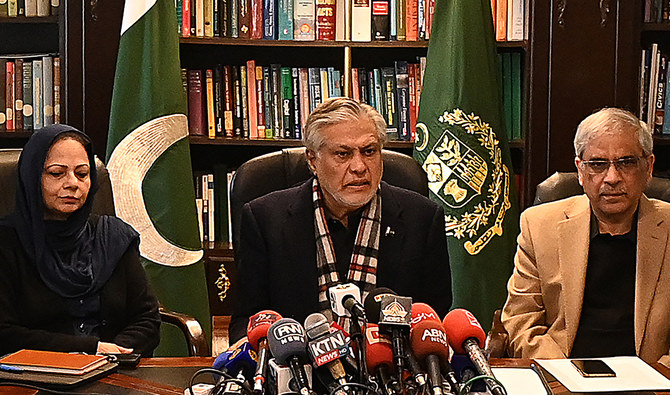

ISLAMABAD: An International Monetary Fund (IMF) mission to Pakistan concluded talks on a stalled bailout program without the announcement of a staff-level agreement as Finance Minister Ishaq Dar said all issues were “settled,” but hinted at the imposition of new taxes.
The IMF mission led by Nathan Porter visited Islamabad from Jan. 31 to Feb. 9 to hold discussions under the ninth review of the IMF’s $7 billion Extended Fund Facility (EFF) arrangement signed in 2019.
The release of the latest tranche of $1.1 billion, which was expected to be paid out last December, is necessary to prevent Pakistan from defaulting on external debt obligations. The country’s $350 billion economy is also facing a balance-of-payments crisis, with foreign exchange reserves dipping to less than three weeks of import cover.
A successful IMF deal will also unlock other crucial funding from governments and multilateral bodies. But the fiscal adjustments demanded by the deal are likely to fuel record high inflation, which hit 27.5 percent year-on-year in January.
“We will have to impose Rs170 billion fiscal measures, taxes and we are trying our best that no such tax is imposed which directly, indirectly it does, but does not directly burden a common man,” Dar told reporters on Friday morning.
In a statement on Friday, the IMF said it welcomed Pakistan’s commitment to implement policies “needed to safeguard macroeconomic stability.”
“Considerable progress was made during the mission on policy measures to address domestic and external imbalances,” the statement said, listing key priorities such as strengthening the fiscal position with permanent revenue measures and reduction in untargeted subsidies, scaling up social protection to help those affected by last summer’s record-breaking floods, allowing the exchange rate to be market determined to gradually eliminate the foreign exchange shortage and enhancing energy provision by preventing further accumulation of circular debt and ensuring the viability of the energy sector.
“The timely and decisive implementation of these policies along with resolute financial support from official partners are critical for Pakistan to successfully regain macroeconomic stability and advance its sustainable development,” the IMF said.
“Virtual discussions will continue in the coming days to finalize the implementation details of these policies.”
Dar also told reporters that after the latest talks, “all matters were settled.”
“Extensive discussions took place on power, gas sector, fiscal side, monetary side,” he said.
The finance minister said Pakistan had received the IMF’s Memorandum of Economic and Financial Policies (MEFP), containing economic and fiscal targets under the ninth review of the program.
“We have received the MEFP draft at 9am this morning. We will completely go through it over the weekend and then we will obviously have a virtual meeting with them [IMF] on Monday,” Dar said.
“And then we will take that forward, which obviously takes a few days. After the MEFP will be finalized, you know, after that there is their own internal process then a board meeting is held and finally you have the disbursement after approval in that.”