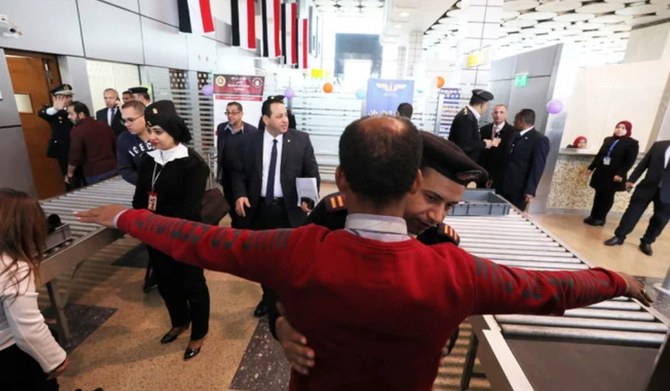
CAIRO: Customs officers at Sharm El-Sheikh International Airport recently foiled an attempt to smuggle Egyptian cash into the country in violation of several laws.
The seizure happened during inspection procedures for passengers who arrived from Uzbekistan on FlyEgypt flight FT402 from Tashkent.
Customs officers stopped a passenger, who was dragging a bag with his hand and carrying another on his shoulder, while trying to pass through the arrival hall.
The passenger denied when asked if he wanted to disclose goods to customs. He was then asked to put the bags on an X-ray scanner, and the presence of opaque densities that resembled banknotes was noticed.
Further inspection of the passenger’s luggage revealed the presence of 203,000 Egyptian pounds ($6,655), in violation of several laws.
Separately, security services at Cairo International Airport seized a Dakahlia Governorate resident who was trying to smuggle out illegal drugs.
The traveler was found to be in possession of 1,182 tablets of the drug Tamol inside seven drug packages hidden inside one of his bags.
He admitted during investigations that he was carrying the seized items with the aim of smuggling them out of Egypt.
Customs also foiled an attempt by an Egyptian passenger to smuggle in a quantity of medical tools and supplies for orthopedic surgeries.
An inspection of the bags of the passenger, who arrived from Bahrain, revealed the presence of 325 medical tools and supplies for orthopedic and artificial bones.

Customs at Sharm El-Sheikh foil attempt to smuggle Egyptian currency
https://arab.news/jk2zc
Customs at Sharm El-Sheikh foil attempt to smuggle Egyptian currency
- The seizure happened during inspection procedures for passengers who arrived from Uzbekistan
- The passenger denied when asked if he wanted to disclose goods to customs
Lebanon finance minister defends tax hike after outcry
- Jaber said the wage hike would cost the state $620 million, hence the decision to raise taxes was made to “preserve financial balance”
- The decision was not unanimous, with Energy Minister Joe Saddi saying he had “objected”
BEIRUT: Lebanon’s finance minister defended on Tuesday his government’s decision to raise taxes to finance a hike in public sector wages, which sparked an outcry from a major union and a protest that briefly blocked a Beirut artery.
The cabinet’s decision the day before aimed to increase by sixfold rock-bottom wages and pension payments for hundreds of thousands of civil servants and retirees in a country still reeling from a devastating economic crisis that started in 2019.
In addition to the crisis, Lebanon is also suffering the aftereffects of a recent war between Iran-backed Hezbollah and Israel, with the international community conditioning aid on public reforms.
The new decision raises the value-added tax (VAT) to 12 percent, from 11 percent before, and adds 300,000 Lebanese pounds (around $3.30) per 20-liter can of gasoline.
Finance Minister Yassin Jaber said in a press conference on Tuesday that the wage hike would cost the state $620 million, hence the decision to raise taxes was made to “preserve financial balance, because any imbalance would lead us to a crisis.”
The decision was not unanimous, with Energy Minister Joe Saddi saying he had “objected... to approving any tax increases at this stage.”
Lebanon has around 320,000 public servants, including 120,000 security forces members, according to Jaber.
Their salaries have shrunk due to the severe depreciation of the Lebanese pound’s value over the past six years.
Under the decision, public sector wages would increase to about 28 percent of their value before the 2019 crisis, Walid Geagea, head of the Public Sector Employees Association, told AFP.
But Geagea rejected the government’s move, saying “you give us a sixfold increase and it goes away (by paying for) fuel and taxes.”
Bassam Tlais, head of Federations and Unions of the Land Transport Sector, said in a statement they “support improving wages, but we refuse to place this additional burden on citizens and the transport sector.”
“Our demand is to find fair alternatives that don’t burden people financially.”
Taxi drivers briefly blocked a road in central Beirut earlier on Tuesday to protest the decision.
Senior financial adviser Michel Kozah told AFP that the cabinet’s move “will create inflation,” adding that “the central bank will be forced to increase the money in circulation.”