

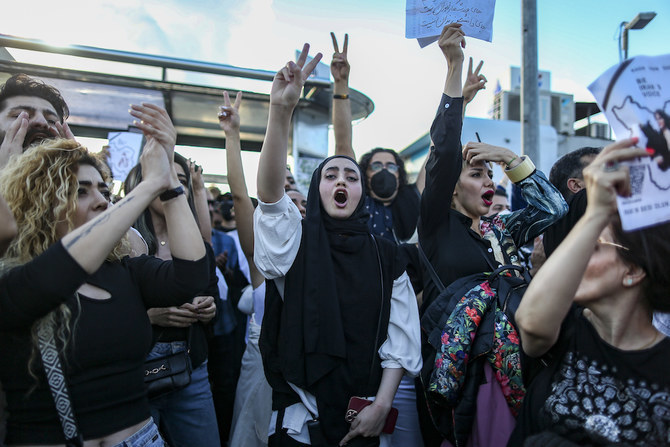

DUBAI: Iranian state prosecutors stand accused of covering up rapes by two members of the Islamic Revolutionary Guard Corps.
According to an internal judicial document, the IRGC members allegedly raped two women, ages 18 and 23, in a van in Tehran last September, The Guardian newspaper reported on Wednesday. They had been detained during the protests that began that month following the death of Mahsa Amini after she was arrested by Iran’s “morality police.” The women were accused of acting suspiciously and their phones were examined for any evidence that they had taken part in the protests.
The judicial document was reportedly initially leaked to news channel Iran International by hacktivist group Edalat-e Ali (Ali’s Justice). It is the first internal document to surface and expose a specific case of this kind, although activists have long suspected that some female detainees were sexually abused by security officials during the protests.
Dated Oct. 13, 2022, the document was written by Mohammad Shahriari, the deputy prosecutor and head of the prosecutor’s office in Tehran, and addressed to Ali Salehi, the general and revolution prosecutor. A report on a collection of witness statements, it states that two named women were assaulted by two named male security officials.
The case came to the attention of prosecutors after one of the IRGC officers called one of the victims after the assault. She recorded the conversation and filed a complaint. The officer initially denied the charges but later changed his story to claim the women had consented to sex. He reportedly was detained, with his father, at their home in Tehran. The other accused officer was arrested separately and taken to a police intelligence unit prison.
The report details how the two men eventually admitted having intercourse with the women, which the document describes as rape. The first officer said they had detained the two women near a gas station while deployed on Sattarkhan Street in western Tehran. The officers initially took them to the Revolutionary Guard’s headquarters but left when they were told it was not possible to process the accused women there.
The document continues: “Considering the problematic nature of the case, the possibility of the leaking of this information into social media and its misrepresentation by enemy groups, it is recommended that the necessary order (is) issued for it to be filed top secret.
“Since no complaint has been registered and the defendants have been dismissed, the accused should be dismissed without mentioning their names.”
It added the case should be closed without any reference to the military institution involved.


