

Saudi special ops forces to participate in five-day Pakistan naval exercise from Friday

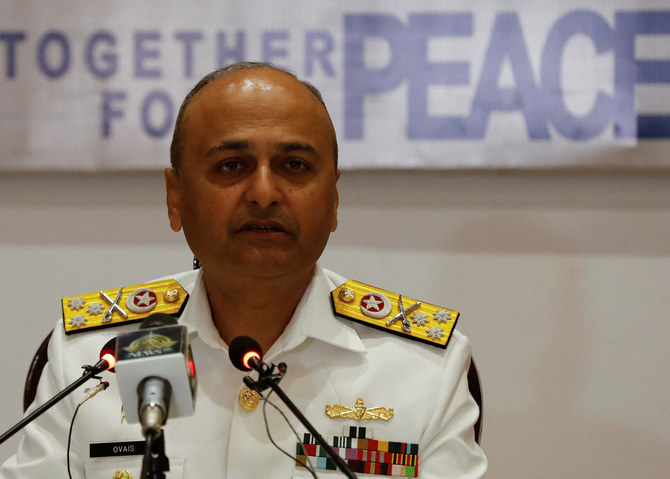
Commander Pakistan Fleet Vice Admiral Ovais Ahmed Bilgrami, addresses a news briefing to host Pakistan Navy's 8th Multinational Exercise AMAN-23 under the slogan of "Together for Peace", in Karachi, Pakistan, February 8, 2023. (Photo courtesy: REUTERS)
Short Url
Updated 08 February 2023
Follow

Saudi special ops forces to participate in five-day Pakistan naval exercise from Friday

  • Around fifty countries are patriating in the multinational maritime exercise
  • Exercise is held every two years to provide platform to exchange maritime expertise

KARACHI: A Saudi special forces team will be participating in a five-day multinational military exercise led by Pakistan in the Arabia Sea this week, a Pakistan navy official said on Wednesday.

The Pakistan Navy conducts the AMAN (peace) multinational maritime exercise every two years since 2007.

The eighth edition of the exercise, called AMAN-23, will start on Friday with ships, aircrafts, Special Operation Forces, Explosive Ordnance Disposal (EOD) Marines teams and observers from over 50 countries. 

“From Saudi Arabia, a team of special operation forces is participating in the Multinational Maritime Exercise this year,” Commander Pakistan Fleet Vice Admiral Ovais Ahmed Bilgrami told reporters at a press briefing. 

“Teams from Kuwait and Oman are also participating.”

The Navy said the exercise was divided into the harbor and sea phases. The harbor phase involves activities such as seminars, operational discussions, professional demonstrations, international get togethers and pre-sail planning of evolutions at sea.

The sea phase would include tactical maneuvers, exercises related to maritime security such as anti-piracy and counterterrorism, search and rescue, gunnery firings and air defense exercises.

The highlight of the sea phase would be an International Fleet Review, to be witnessed by national and foreign dignitaries.

Commander Pakistan Fleet said that the principal purpose of the exercise was to provide a forum to understand other nations’ maritime concepts and operational cultures, enhance interoperability as well as identify ways to combat common threats at sea.

“The occasion also helps foster friendships, bridging gaps and making it possible for countries from far and wide to operate together in pursuance of shared objectives,” Bilagram said, adding that as a maritime nation, Pakistan had “substantial stakes” in keeping the seas safe and secure:

“Our interests are based on three major factors. Firstly, our extraordinary dependence on the seas for trade, secondly, operationalization of the CPEC [China Pakistan Economic Corridor] project and thirdly, our strategic location astride the global energy highway.”

Cumulatively, Bilgrami said, these realities made maritime stability a “vital national security interest.”

“We realize the importance of maritime security not only for Pakistan but for all other countries whose prosperity and progress are tied to the seas,” the naval officer said. “While we talk of security and stability at sea, let us be mindful of the threats and challenges that we face in the maritime domain, ranging from piracy, terrorism, narco-arms trafficking to climate change.”

Bilgrami said the vastness of the seas made it “extremely difficult” for any one nation to deal with the diverse challenges alone.

“This calls for collective effort to make sure the seas remain safe and secure for all of us to use and benefit from Pakistan Navy is therefore a firm believer in the concept of Collaborative Maritime Security and has been actively participating in Maritime Security and Counter Piracy Operations along with other partner navies since 2004,” he said.

Since 2018, Pakistan Navy has been undertaking Regional Maritime Security Patrols through which its ships maintain a presence in vital sea areas in the Indian Ocean Region, he said.


Pakistan has ruled out military operation in northwestern Tirah Valley

Updated 4 sec ago
Follow

Pakistan has ruled out military operation in northwestern Tirah Valley

  • Residents in northwestern Tirah Valley fled their homes this month fearing a military operation against militants
  • Defense minister says army conducting intelligence-based operations in area, residents’ migration “routine” practice

Islamabad: Defense Minister Khawaja Asif on Tuesday clarified that the military was not conducting a military operation in the northwestern Tirah Valley, saying that the ongoing residents’ migration from the area was a routine practice that has been going on for several years. 

The defense minister’s clarification came as residents of Tirah Valley in Pakistan’s northwestern Khyber Pakhtunkhwa (KP) province bordering Afghanistan fled their homes this month, fearing a planned military operation by the army against militants, particularly the Tehreek-e-Taliban Pakistan (TTP) group. 

Pakistan’s information ministry on Sunday issued a clarification that the armed forces were not involved in the “depopulation” of the valley. It pointed to a notification from the provincial Khyber Pakhtunkhwa Relief, Rehabilitation and Resettlement Department in December which demanded the release of funds, reportedly Rs4 billion [$14.24 million], for the voluntary movement of people from Tirah Valley. 

Speaking to reporters at a news conference alongside Information Minister Attaullah Tarar and Special Assistant to the PM for Information and KP Affairs Ikhtiar Wali Khan, Asif said the last military operation in the area was conducted several years ago. He said the military had decided that intelligence-based operations (IBOs) were more effective than military operations as they resulted in lower civilian casualties. 

“So over a long period of time, the army gave up [military] operation in favor of IBOs,” Asif said. “For many years this practice has been continuing. Hence, there is no question of an operation there.”

The defense minister described the migration of residents from Tirah Valley as a “routine” practice due to the harsh cold. 

He criticized the provincial government, led by the Pakistan Tehreek-e-Insaf (PTI) party for not serving the people of the area, accusing it of not building any schools, hospitals, or police stations in Tirah Valley.

Asif said around 400-500 TTP members lived in the valley with their families, alleging that hemp was being harvested there on over 12,000 acres of land. He said that while hemp is also used for medicinal and construction purposes, its dividends were going to militants and politicians. 

“All of this hemp is harvested there and the dividends from it either go to the people associated with politics or the TTP,” the minister said.

“We have initiated the process to stop this so that the people benefit from this harvest and so that schools and hospitals are constructed there.”

The minister said that a district-level jirga or tribal council met representatives of the KP government on Dec. 11, 24 and 31 to decide matters related to the residents’ migration in the area. 

Holding up the KP Relief, Rehabilitation and Resettlement Department notification, Asif said:

“In the presence of this notification, in the presence of this tribal council and in the presence of all of these things, where do you see the army?“

The minister accused the provincial government of deflecting its “failures” in the province to the armed forces or to a military operation that did not exist. 

The migration has exposed tensions between the provincial government and the military establishment over the use of force in the region.

KP Law Minister Aftab Alam Afridi said earlier this month that the provincial government will not allow a military operation to take place in the area, arguing that past military campaigns had failed to deliver lasting stability.