

Pakistan among most vulnerable nations as glacial lake floods threaten communities

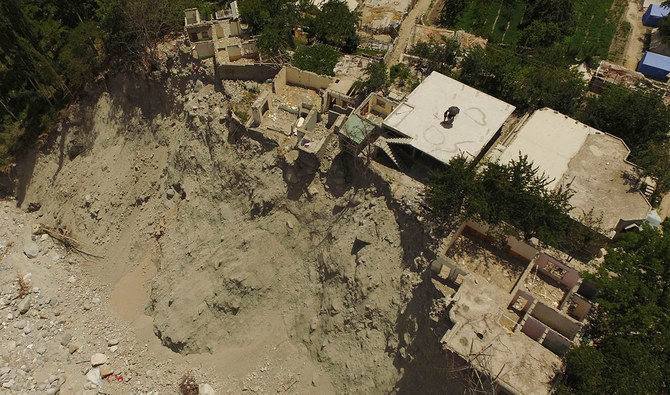
This aerial picture taken on June 9, 2022, shows collapsed and damaged houses caused by a lake outburst because of a melting glacier, in Hassanabad village of Pakistan's Gilgit-Baltistan region. (Photo courtesy: AFP)
Short Url
Updated 08 February 2023
Follow

Pakistan among most vulnerable nations as glacial lake floods threaten communities

  • Melting mountain glaciers pose a growing flood risk to some 15 million people around the world
  • Collectively, the world’s glaciers lost about 332 gigatons of ice a year between 2006 and 2016

Melting mountain glaciers pose a growing flood risk to some 15 million people around the world, researchers said in a report published on Tuesday, with communities in Asia facing the biggest danger.

Runoff from melting glaciers often pools in shallow lakes, held back by rocks and debris. The risk comes when a lake overfills, bursting through its natural barrier and sending a torrent of water rushing down mountain valleys.

Scientists have assessed for the first time how many people globally are at risk from these floods, finding that more than half of vulnerable populations live in India, Pakistan, China, and Peru.

Danger is highest, they report in a study published in the journal Nature Communications, when a large number of people live near a lake.

“Our work does not just focus on the size or number of glacier lakes — no disaster is natural — it is the presence of people, especially vulnerable people, in the landscape that causes a disaster,” said Stuart Dunning, a physical geographer at Britain’s Newcastle University, and a co-author of the study.

Collectively, the world’s glaciers lost about 332 gigatons of ice a year between 2006 and 2016. Since 1990, the number and volume of glacial lakes worldwide have each increased by about 50 percent.

In the high mountains of Asia, some 9 million people live near more than 2,000 glacial lakes. In 2021, more than 100 people were killed in India in an outburst flood in its northern mountains.

HEATING UP THE HIMALAYAS

Compared with mountain glaciers in the Alps and North America, Asia’s icy places are not as well monitored — most lack long-term observations of how they have changed over time.

The best-studied glacier in the Himalayas is north India’s Chhota Shigri, which has 20 years of mass balance measurements — the difference between how much ice a glacier gains and loses in a year.

In 2022, India suffered blistering temperatures and near the end of the year, scientists headed into the Himalayas to measure Chhota Shigri’s mass.

Their findings, shared with Reuters, revealed the best-studied glacier in the Himalayas had experienced its worst year on record; Chhota Shigri lost three times as much mass in 2022 compared with its 2002 to 2022 yearly average.

“The impacts are already visible as the glacier is thinning and retreating,” said Farooq Azam, a glaciologist at the Indian Institute of Technology Indore who monitors Chhota Shigri. This will be “impactful to downstream water availability in near future,” he said.

Satellite observations also show that the glaciers in the Himalayas are in a state of overall decline.

“The ice is really melting significantly during the last decades — mass loss is accelerating,” said Tobias Bolch, a glaciologist with Graz University of Technology in Austria.

From 1990 to 2015, glacier coverage in the Himalayas shrank by about 11 percent, according to July 2022 study.

During the same time period, Himalayan glacial lakes increased by about 9 percent in number, and 14 percent in area. More than 200 lakes now pose a very high hazard to Himalayan communities, according to 2022 research.


Pakistan, global crypto exchange discuss modernizing digital payments, creating job prospects 

Updated 05 December 2025
Follow

Pakistan, global crypto exchange discuss modernizing digital payments, creating job prospects 

  • Pakistani officials, Binance team discuss coordination between Islamabad, local banks and global exchanges
  • Pakistan has attempted to tap into growing crypto market to curb illicit transactions, improve oversight

ISLAMABAD: Pakistan’s finance officials and the team of a global cryptocurrency exchange on Friday held discussions aimed at modernizing the country’s digital payments system and building local talent pipelines to meet rising demand for blockchain and Web3 skills, the finance ministry said.

The development took place during a high-level meeting between Finance Minister Muhammad Aurangzeb, Pakistan Virtual Assets Regulatory Authority (PVARA) Chairman Bilal bin Saqib, domestic bank presidents and a Binance team led by Global CEO Richard Teng. The meeting was held to advance work on Pakistan’s National Digital Asset Framework, a regulatory setup to govern Pakistan’s digital assets.

Pakistan has been moving to regulate its fast-growing crypto and digital assets market by bringing virtual asset service providers (VASPs) under a formal licensing regime. Officials say the push is aimed at curbing illicit transactions, improving oversight, and encouraging innovation in blockchain-based financial services.

“Participants reviewed opportunities to modernize Pakistan’s digital payments landscape, noting that blockchain-based systems could significantly reduce costs from the country’s $38 billion annual remittance flows,” the finance ministry said in a statement. 

“Discussions also emphasized building local talent pipelines to meet rising global demand for blockchain and Web3 skills, creating high-value employment prospects for Pakistani youth.”

Blockchain is a type of digital database that is shared, transparent and tamper-resistant. Instead of being stored on one computer, the data is kept on a distributed network of computers, making it very hard to alter or hack.

Web3 refers to the next generation of the Internet built using blockchain, focusing on giving users more control over their data, identity and digital assets rather than big tech companies controlling it.

Participants of the meeting also discussed sovereign debt tokenization, which is the process of converting a country’s debt such as government bonds, into digital tokens on a blockchain, the ministry said. 

Aurangzeb called for close coordination between the government, domestic banks and global exchanges to modernize Pakistan’s payment landscape.

Participants of the meeting also discussed considering a “time-bound amnesty” to encourage users to move assets onto regulated platforms, stressing the need for stronger verifications and a risk-mitigation system.

Pakistan has attempted in recent months to tap into the country’s growing crypto market, crack down on money laundering and terror financing, and promote responsible innovation — a move analysts say could bring an estimated $25 billion in virtual assets into the tax net.

In September, Islamabad invited international crypto exchanges and other VASPs to apply for licenses to operate in the country, a step aimed at formalizing and regulating its fast-growing digital market.