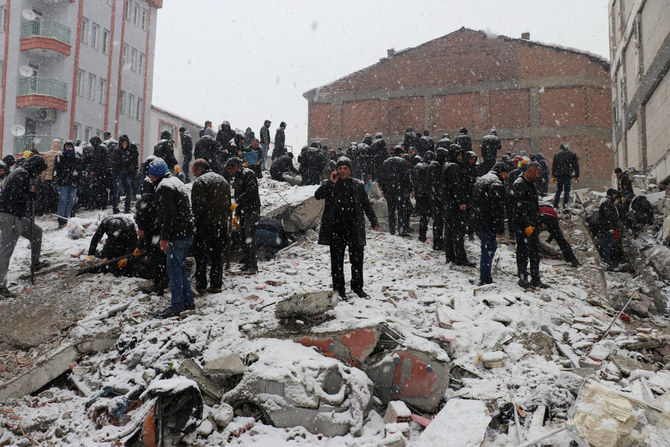
AL-MUKALLA: Rescuers are trying desperately to reach three Yemeni families buried under earthquake rubble in a southern Turkish city, authorities said on Tuesday.
The disaster that killed thousands in Syria and Turkiye on Monday has also left at least 50 Yemenis injured and their property destroyed.
A spokesperson for the Yemen Students Union in Turkiye, Anas Al-Mazabi, told Arab News that a woman had been pulled from the wreckage of a building as rescuers continued attempts to save three Yemeni families buried under debris in Malatya in the south of the country.
No deaths have been reported among at least 300 Yemenis living in earthquake-hit centers in Turkiye.
The Yemeni Embassy and the union have set up emergency facilities and hotlines, and asked Yemenis to report any missing relatives or friends.
Al-Mazabi said that a special operations center is monitoring information and maintaining contact with Yemenis trapped in regions devastated by the earthquake.
An aid team has been sent to Hatay province and an evacuation team to Iskenderun to help Yemenis, he added.
Hotlines have been swamped with calls from anxious Yemenis in Turkiye and Yemen searching for relatives and friends after earthquake-affected regions experienced Internet and mobile phone blackouts.
“We attempted to comfort them about the situation and (told them) that if their children do not respond, it is because communication has been disrupted and does not imply that their circumstances are awful,” Al-Mazabi said.
Official Yemeni media said that Rashad Al-Alimi, president of the Presidential Leadership Council, and other council members phoned the Yemeni Ambassador to Turkiye, Mohammed Saleh, for an update on the situation facing Yemenis and ordered him to offer all required help.
Thousands of Yemenis, including politicians, tribal leaders, military personnel and journalists, fled to Turkiye and nearby countries after the Iran-backed Houthis took control in Yemen in 2014.
Hundreds of Yemeni students attend Turkish institutions around the country.
Separately, Al-Alimi reiterated his council’s commitment to helping a UN mission establish peace in Yemen and secure a comprehensive agreement to end the war.
During a meeting with UN Yemen envoy Hans Grundberg in Aden, Al-Alimi called for greater international pressure on the Houthis to comply with efforts to end the war.
Grundberg landed in the city on Tuesday as he embarked on a fresh mission to push for a renewal of the UN-brokered truce that collapsed in October and to persuade Yemeni factions to embrace a peace agreement.
The UN envoy’s arrival in Yemen follows a visit to Riyadh, where he discussed peace efforts, and economic and humanitarian operations with the GCC Secretary General Jasem Al-Budaiwi and the Saudi Ambassador to Yemen Mohammed Al-Jabir.
Attempts to restore peace in Yemen suffered a severe blow in October when the Houthis refused to extend the UN-brokered truce or open roads to the besieged city of Taiz.
The militia also launched drone attacks on oil installations in southern Yemen in an attempt to force the Yemeni government to share oil profits and pay public workers in regions they control.


![]()

3 Yemeni families buried under quake rubble in Turkiye
Short Url
https://arab.news/6m5dj
3 Yemeni families buried under quake rubble in Turkiye
- No deaths have been reported among at least 300 Yemenis living in earthquake-hit centers in Turkiye
- The Yemeni Embassy and the union have set up emergency facilities and hotlines


Latest updates


Recommended


© 2026 SAUDI RESEARCH & PUBLISHING COMPANY, All Rights Reserved And subject to Terms of Use Agreement.