

Pakistan, IMF initiate policy-level talks on bailout amid deadlock over fiscal gap, new taxes

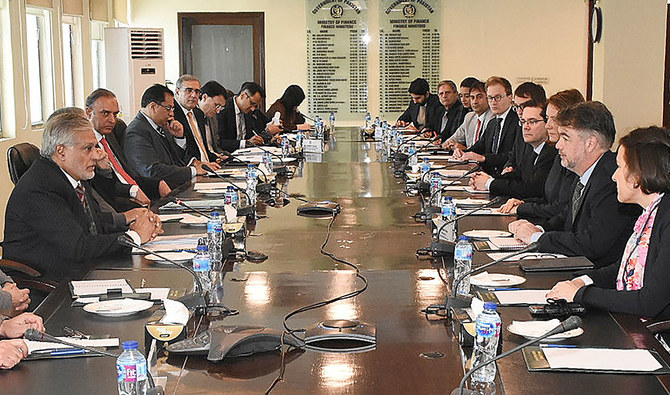
This handout photograph released by the Pakistan Press Information Department (PID) on January 31, 2023, shows Pakistan’s Finance Minister Ishaq Dar (L) meeting with a International Monetary Fund (IMF) review mission led by IMF mission official Nathan Porter (2R) at the Finance Ministry in Islamabad. (AFP)
Short Url
Updated 07 February 2023
Follow

Pakistan, IMF initiate policy-level talks on bailout amid deadlock over fiscal gap, new taxes

  • Successful talks with the IMF will unlock more than $1 billion in funding to cash-strapped Pakistan 
  • Economist says the government will have to jack up electricity and gas prices to ink the agreement 

ISLAMABAD: The Pakistani government and the International Monetary Fund (IMF) on Tuesday initiated policy-level talks to bridge differences on data regarding the budget deficit, taxation and measures required to overcome fiscal gaps, particularly in the energy sector. 

The IMF mission has been in Islamabad since January 31 following the government’s request to negotiate resumption of Pakistan’s $7 billion loan program, which has been stalled since November last year. 

In the first four days, the global lender and the government held technical talks, in which Pakistani officials shared the fiscal statistics, including development budget, external financing and energy sector data, with the IMF mission for its perusal. 

“The differences with the IMF still persist over numbers regarding the fiscal gap and need for new taxation through a mini-budget, but hopefully we will overcome it,” a finance ministry official with the knowledge of talks told Arab News, on the condition of anonymity. 

Islamabad is struggling to get the loan program revived to receive a tranche of more than $1 billion to stave off a balance-of-payments crisis after the nation’s foreign exchange reserves dropped to $3 billion, just enough to provide 18-day cover for imports. 

The official said the government was willing to generate an additional revenue of around Rs450 billion ($1.6 billion), but the IMF was pushing it for at least Rs840 billion ($3 billion) additional revenue to overcome the primary deficit. 

“We have agreed with the IMF in principle to slash our development budget too,” he said. 

Pakistan’s development budget is expected to be reduced to over Rs400 billion ($1.4 billion) this fiscal year from Rs727 billion. 

“The discussions on withdrawal of subsidy and measures to abolish energy sector debt will be held in the next two days,” the official said, hoping the two sides would reach an agreement on all issues by February 9. 

The Pakistani finance ministry and the IMF country representative did not respond to Arab News’s requests for comment. 

Pakistan is struggling to quell default fears in the domestic and international markets with the $1.1 billion bailout tranche as the South Asian country witnesses a decades-high inflation and depreciation in the national currency. 

The Pakistani currency has depreciated by more than Rs100 against the US dollar since January last year due to external repayment pressure, while inflation jumped to 27.5 percent year-on-year in January. 

Economists say it is imperative for the government to secure a staff-level agreement with the IMF by Thursday to complete the 9th revenue of $7 billion to ensure dollar inflows from multilateral partners, friendly countries and other bilateral sources to shore up the country’s foreign reserves. 

“As slippages from the budgeted amounts are considerable, adjustments in the prices of electricity and gas as well as in the fiscal sector would need to be done to ink this agreement,” Dr. Khaqan Najeeb, a former adviser to the finance ministry, told Arab News. 

“Some expenditure cuts would also be required to ensure that the primary deficit comes back to the agreed amount with the IMF.” 

Najeeb, however, hoped the IMF would be sympathetic to the plight of the people suffering from last year’s floods and double-digit inflation. 


Pakistan opposition to continue protest over ex-PM Khan’s health amid conflicting reports

Updated 16 February 2026
Follow

Pakistan opposition to continue protest over ex-PM Khan’s health amid conflicting reports

  • Pakistan’s government insists that the ex-premier’s eye condition has improved
  • Khan’s personal doctor says briefed on his condition but cannot confirm veracity

ISLAMABAD: Pakistan’s opposition alliance on Monday vowed to continue their protest sit-in at parliament and demanded “clarity” over the health of jailed former prime minister Imran Khan, following conflicting medical reports about his eye condition.

The 73-year-old former cricket star-turned-politician has been held at the high-security Adiala prison in Rawalpindi since 2023. Concerns arose about his health last week when a court-appointed lawyer, Barrister Salman Safdar, was asked to visit Khan at the jail to assess his living conditions. Safdar reported that Khan had suffered “severe vision loss” in his right eye due to central retinal vein occlusion (CRVO), leaving him with just 15 percent sight in the affected eye.

On Sunday, a team of doctors from various hospitals visited the prison to examine Khan’s eye condition, according to the Adiala jail superintendent, who later submitted his report in the court. On Monday, a Supreme Court bench led by Chief Justice Yahya Afridi observed that based on reports from the prison authorities and the amicus curiae, Khan’s “living conditions in jail do not presently exhibit any perverse aspects.” It noted that Khan had “generally expressed satisfaction with the prevailing conditions of his confinement” and had not sought facilities beyond the existing level of care.

Having carefully perused both reports in detail, the bench observed that their general contents and the overall picture emerging therefrom are largely consistent. The opposition alliance, which continued to stage its sit-in for a fourth consecutive day on Monday, held a meeting at the parliament building on Monday evening to deliberate on the emerging situation and discuss their future course of action.

“The sit-in will continue till there is clarity on the matter of [Khan's] health,”  Sher Ali Arbab, a lawmaker from Khan's Pakistan Tehreek-e-Insaf (PTI) party who has been participating in the sit-in, told Arab News, adding that PTI Chairman Gohar Ali Khan and Opposition Leader in Senate Raja Nasir Abbas had briefed them about their meeting with doctors who had visited Khan on Sunday.

Speaking to reporters outside parliament, Gohar said the doctors had informed them that Khan’s condition had improved.

“They said, 'There has been a significant and satisfactory improvement.' With that satisfactory improvement, we also felt satisfied,” he said, noting that the macular thickness in Khan’s eye had reportedly dropped from 550 to 300 microns, a sign of subsiding swelling.

Gohar said the party did not want to politicize Khan’s health.

“We are not doctors, nor is this our field,” he said, noting that Khan’s personal physician in Lahore, Dr. Aasim Yusuf, and his eye specialist Dr. Khurram Mirza had also sought input from the Islamabad-based medical team.

“Our doctors also expressed satisfaction over the report.”

CONFLICTING ACCOUNTS

Despite Gohar’s cautious optimism, Khan’s personal physician, Dr. Yusuf, issued a video message on Monday, saying he could neither “confirm nor deny the veracity” of the government’s claims.

“Because I have not seen him myself and have not been able to participate in his care... I’m unable to confirm what we have been told,” Yusuf said.

He appealed to authorities to grant him or fellow physician, Dr. Faisal Sultan, immediate access to Khan, arguing that the ex-premier should be moved to Shifa International Hospital in Islamabad for specialist care.

Speaking to Arab News, PTI’s central information secretary Sheikh Waqas Akram said Khan’s sister and their cousin, Dr. Nausherwan Burki, will speak to media on Tuesday to express their views about the situation.

The government insists that Khan’s condition has improved.

“His eye [condition] has improved and is better than before,” State Minister Talal Chaudhry told the media in a brief interaction on Monday.

“The Supreme Court of Pakistan is involved, and doctors are involved. What medicine he receives, whether he needs to be hospitalized or sent home, these decisions are made by doctors. Neither lawyers nor any political party will decide this.”