Pope Francis wraps up South Sudan trip, urges end to ‘blind fury’ of violence

(AFP)
Short Url
Updated 05 February 2023
Follow

Pope Francis wraps up South Sudan trip, urges end to ‘blind fury’ of violence

JUBA: Pope Francis wound up a peace mission to South Sudan on Sunday urging the people to make themselves immune to the “venom of hatred” to achieve the peace and prosperity that have eluded them through years of bloody ethnic conflicts.
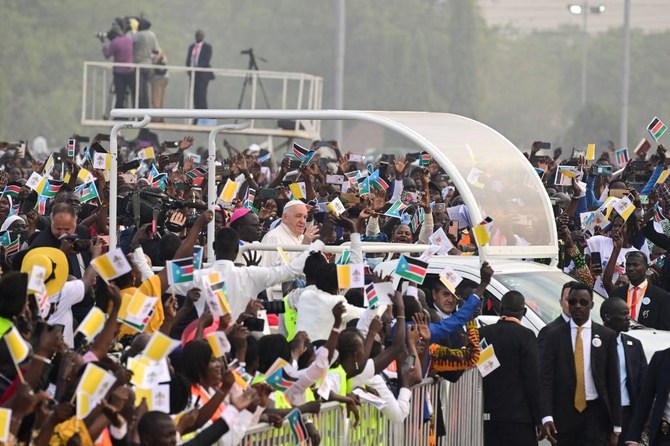
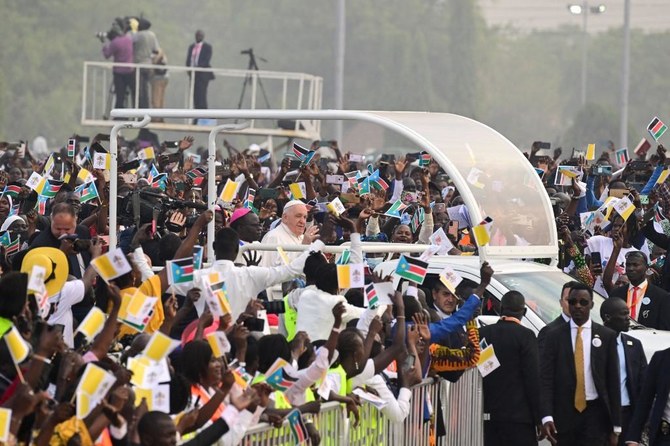
Francis presided at an open-air Mass on the grounds of a mausoleum for South Sudan’s liberation hero John Garang, who died in a helicopter crash in 2005 before the predominantly Christian country broke away from Muslim Sudan in 2011.
The 86-year-old pope wove his homily around the themes that have dominated his trip to the world’s newest nation — reconciliation and mutual forgiveness for past wrongs. The crowd sang, drummed and ululated as Francis entered the dusty area.
He begged the crowd of about 70,000 people to shun the “blind fury of violence.”
Two years after independence, South Sudan plunged into a civil war that killed 400,000 people. Despite a 2018 peace deal between the two main antagonists, bouts of fighting have continued to kill and displace large numbers of civilians.
At the end of the service, in a farewell address shortly before heading to the airport to fly home, the pope thanked the people of South Sudan for the affection they showed him.
“Dear brothers and sisters, I return to Rome with you even closer to my heart,” he told them. “Never lose hope. And lose no opportunity to build peace. May hope and peace dwell among you. May hope and peace dwell in South Sudan!“
The pope has had a longstanding interest in South Sudan. In one of the most remarkable gestures of his papacy, he knelt to kiss the feet of the country’s previously warring leaders during a meeting at the Vatican in 2019.
Archbishop of Canterbury Justin Welby, leader of the global Anglican Communion, and Iain Greenshields, Moderator of the General Assembly of the Church of Scotland, accompanied the pope during his visit to South Sudan.
The “pilgrimage of peace” was the first time in Christian history that leaders of the Catholic, Anglican and Reformed traditions conducted a joint foreign visit.
HOPE OF A TURNING POINT
Earlier on his Africa trip, the pope visited Democratic Republic of Congo, home to the continent’s largest Roman Catholic community, where he celebrated Mass for a million people and heard harrowing stories from people harmed by war in the eastern part of the country.
Among the worshippers at Sunday’s Mass in the South Sudanese capital Juba was Ferida Modon, 72, who lost three of her children to conflict.
“I want peace to come to South Sudan. Yes, I believe that his visit will change the situation. We are now tired of conflict,” she said. “We want God to listen to our prayers.”
Jesilen Gaba, 42, a widow with four children, said: “The fact that the three Churches united for the sake of South Sudan, this is the turning point for peace. I want the visit to be a blessing to us. We have been at war, we have lost many people.”
Francis made another appeal for an end to the tribalism, financial wrongdoing and political cronyism at the root of many of the country’s problems.
He urged the people to build “good human relationships as a way of curbing the corruption of evil, the disease of division, the filth of fraudulent business dealings and the plague of injustice.”
South Sudan has some of the largest crude oil reserves in sub-Saharan Africa but a UN report in 2021 said the country’s leaders had diverted “staggering amounts of money and other wealth” from public coffers and resources.
The government dismissed the report and has denied accusations of widespread corruption.


Greenland prepares next generation for mining future

Updated 8 sec ago
Follow

Greenland prepares next generation for mining future

SISIMIUT: At the Greenland School of Minerals and Petroleum, a dozen students in hi-viz vests and helmets are out for the day learning to operate bulldozers, dump trucks, excavators and other equipment.
The Greenlandic government is counting on this generation to help fulfill its dream of a lucrative mining future for the vast Arctic territory coveted by US President Donald Trump.
Founded in 2008, the school, based in El-Sisimiut in the southwest of the island, offers students from across Greenland a three-year post-secondary vocational training.
Apart from their practical classes, the students, aged 18 to 35, also learn the basics of geology, rock mechanics, maths and English.
Teacher Kim Heilmann keeps a watchful eye on his students as they learn to maneuver the heavy equipment.
“I want them to know it’s possible to mine in Greenland if you do it the right way,” he told AFP.
“But mostly the challenge is to make them motivated about mining,” he added.
The remote location of Greenland’s two operational mines, and the ensuing isolation, puts many people off, the school’s director Emilie Olsen Skjelsager said.
A Danish autonomous territory, Greenland gained control over its raw materials and minerals in 2009.
The local government relies heavily on Danish subsidies to complement its revenues from fishing, and is hoping that mining and tourism will bring it financial independence in the future so that it can someday cut ties with Denmark.
“The school was created because there is hope for more activities in mining, but also to have more skilled workers in Greenland for heavy machine operating and drilling and blasting, and exploration services,” Olsen Skjelsager said.
By the end of their studies, some of the students — “a small number, maybe up to five” — will go on to work in the mines.
The rest will work on construction sites.

- Lack of skills -

Greenland is home to 57,000 people, and has historically relied on foreign workers to develop mining projects due to a lack of local know-how.
“We have some good people that can go out mining and blasting and drilling and all that kind of stuff,” explained Deputy Minister of Minerals Resources, Jorgen T Hammeken-Holm.
“But if you have a production facility close to the mining facility, then you need some technical skills in these processing facilities,” he said.
“There is a lack of educated people to do that.”
Going forward, geologists, engineers and economists will be needed, especially as Greenland’s traditional livelihoods of hunting and fishing are expected to gradually die out as professions.
The students’ tuition is paid by the Greenland government, which also gives them a monthly stipend of around 5,000 kroner ($800).
Inside the school, a glass case displays some of the minerals that lie — or are believed to lie — under Greenland, including cryolite, anorthosite and eudialyte, which contains rare earth elements essential to the green and digital transitions.
“New mine sites have been searched (for) all over Greenland,” said Angerla Berthelsen, a 30-year-old student who hopes to find a job in the mining sector one day.
There are “lots of possibilities” in Greenland, he said, sounding an optimistic note.

- Doubts over deposits -

But questions remain about Greenland’s actual resources, with the existence and size of the deposits still to be confirmed.
According to the Geological Survey of Denmark and Greenland (GEUS), Greenland is home to 24 of the 34 critical raw materials identified by the EU as essential for the green and digital transitions.
“A large variety of geological terrains exists, which have been formed by many different processes. As a result, Greenland has several types of metals, minerals and gemstones,” it says in a document on its website.
“However, only in a few cases have the occurrences been thoroughly quantified, which is a prerequisite for classifying them as actual deposits,” it stressed.
Deputy minister Hammeken-Holm said it was “more or less a guess” for now.
“Nobody knows actually.”
In addition, the island — with its harsh Arctic climate and no roads connecting its towns — currently doesn’t have the infrastructure needed for large-scale mining.
There are currently only two operational mines on the island — one gold mine in the south, and one for anorthosite, a rock containing titanium, on the west coast.