

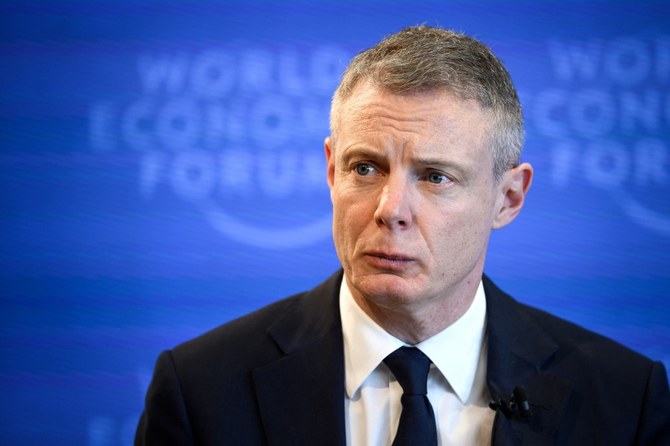
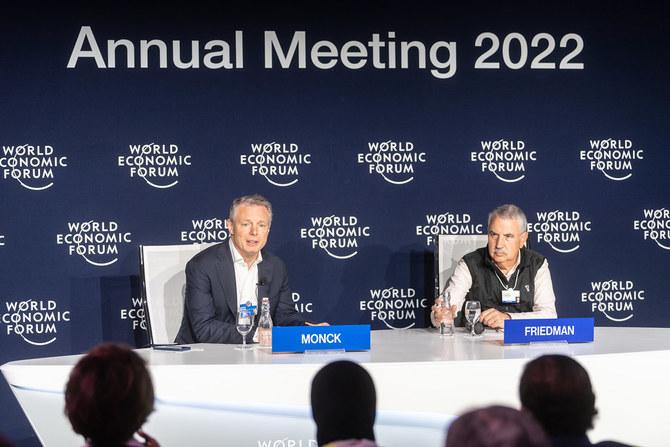
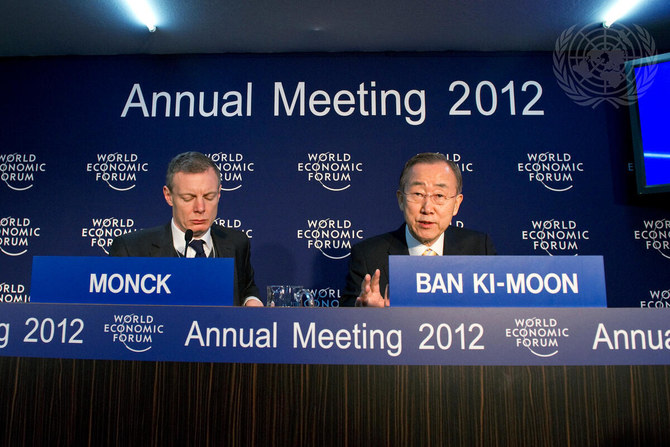
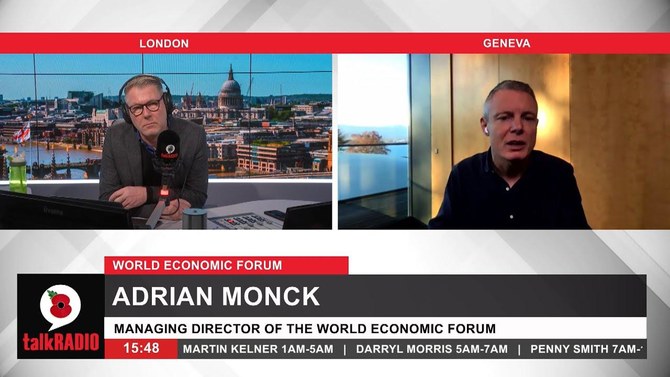


LONDON: After over 13 years of leading public and social engagement at the World Economic Forum, Adrian Monck announced on Friday that he is leaving his role as managing director of the international organization for public-private cooperation.
“From creating a global storytelling platform, to putting refugees center stage in Davos, and in helping guide the institution through a global pandemic, I am leaving the forum both fortunate and grateful — especially to all of you,” Monck wrote in a LinkedIn post addressing his colleagues.
The seeds Monck has planted through his work with the WEF will continue to grow and be remembered, namely by former colleagues and media figures acquainted with his endeavors.
“Adrian Monck created a global storytelling platform that was able to put the important — and often overlooked — stories before world leaders, reminding them of their ultimate mission,” Hassan M. Fattah, ex-New York Times correspondent in Iraq and former editor-in-chief of UAE’s The National newspaper, told Arab News.
“He brought passion to his role but also imparted empathy and authenticity amid the noise.
“But many of us know him as a fearless journalist who innovated the storytelling format in broadcast and print and brought out compelling stories.”

Former Editor-in-Chief of The National Hassan Fattah.
Monck has redefined the forum and its annual Davos meeting for the digital age, building the organization’s global media presence, establishing a social media following that exceeds 30 million and spans LinkedIn to TikTok, and reaching about a million email subscribers.
“Arguably, Adrian is the man who gave the word ‘forum’ in World Economic Forum its true meaning during his tenure over the past decade,” said Faisal J. Abbas, editor-in-chief of Arab News.
“Adrian opened up the deliberately reclusive WEF to more journalists than ever before, including those who were skeptical of it. He also fought for and created its own media operation and digital presence, an investment which paid off handsomely during the pandemic when Davos lived on only because the set up was there to conduct it virtually.”
Monck’s career started as a journalist in 1988, working for CBS News, ITN, where he was the managing editor of Five News, and Sky.

Formative Content head Gay Flashman
“Adrian showed incredible foresight all those years ago, when he created his vision for the publishing platform and quality content juggernaut that the World Economic Forum has become,” said Gay Flashman, who runs Formative Content and has worked with Monck’s team at the forum since 2014.
“As a former news journalist he recognized the power of a strategy that enabled the forum to communicate directly with its audiences in a truly unique way,” she told Arab News.
“From long form thought leadership to short snackable content, this approach to content is ubiquitous today, but was groundbreaking when he started his team.”
Al Arabiya news channel’s head of business section Jamil El-Hage, who manages the channel’s annual coverage and sessions at the WEF, told Arab News that Monck, with whom he had a personal as well as professional relationship, played a key role in advancing the forum’s relations with Middle Eastern media.
He described Monck as “very understanding and caring of the region,” hoping that the next person would maintain these strong relations.
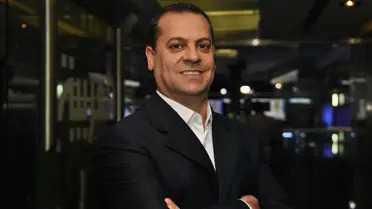
Al Arabiya's Head of Business Jamil El-Hage.
In addition to leading the forum’s media and communications activities, Monck oversees the Foundation of Young Global Leaders and the Global Shapers Community.
Prior to joining the forum in 2009 as head of communications and media, Monck worked in academia, heading City University of London’s Department of Journalism during the period from 2005 to 2009.
He co-authored “Crunch Time: How Everyday Life is Killing the Future” with award-winning journalist Mike Hanley in 2007, and wrote “Can You Trust the Media?” in 2008.
Monck is a supporter of applying British television regulations to the press and online media, advocating “regulation that insists on accuracy, fairness and, crucially, impartiality,” in a Press Gazette piece in July 2004.
Nevertheless, he has been a strong advocate of press freedom, while at the same time encouraging media firms to “avoid misleading ‘both-sides-ism.’”
In a 2022 World Association of News Publishers article, he urged editors and reporters to “push back against politicians and political commentators who bring fringe falsehoods into the mainstream public discourse. After all, neutrality does not mean abandoning fact-based journalism.”
Monck added: “Fact-based journalism is vital to protecting free speech as disinformation often tarnishes forward-thinking debate.”
Monck was also president of Britain’s Media Society during the years 2005 and 2006, and a member of multiple influential bodies, including the British Academy Film Awards and the Royal Television Society.
In his WEF departure message, Monck wrote: “As a child in a remote English coastal town I could never have imagined the people, the places and the projects this remarkable organization would open up for me.
“That opportunity is thanks to Klaus. For everyone at the forum, working here means a chance to continually reimagine and reinvent the organization, helping it to stay relevant and true to its mission. And that’s a wonderful gift.”
Although Monck has not revealed his next endeavor, former colleagues and friends trust that he still has a lot to offer.
“We can all be grateful for the impact he has made on the lives he has touched with his energy, his caring and his tenacity,” Fattah said.
“I look forward to his next undertaking which I’m sure will be no less important.”
Flashman said: “We will miss his wit, dry humor and razor-sharp intellect; his team will miss him for all of those traits, plus his kindness and unswerving support.”

keywords


