

Pakistan minister asks world if ‘economic interests’ alone will decide fate of Kashmiris

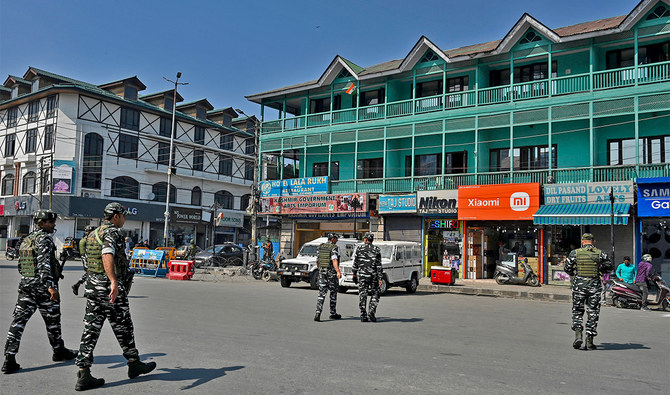
Indian paramilitary troopers patrol along a street in Srinagar on October 4, 2022, during India's Home Minister Amit Shah's visit to Jammu and Kashmir. (AFP/File)
Short Url
Updated 05 February 2023
Follow

Pakistan minister asks world if ‘economic interests’ alone will decide fate of Kashmiris

  • The statement comes as Pakistan observes Kashmir Solidarity Day to express solidarity with Kashmiris
  • Ahsan Iqbal calls out the world for its ‘double standards’ on Russia’s annexation of Ukraine and Kashmir 

ISLAMABAD: Pakistan’s Planning Minister Ahsan Iqbal on Saturday criticized the international community for its role toward the resolution of the Kashmir conflict, questioning if “economic interests” alone would decide the fate of Kashmiris. 

Iqbal’s statement came ahead of the Kashmir Solidarity Day, which Pakistan observes every year on the February 5 to express solidarity with the people of Indian-administered Kashmir. 

The Muslim-majority Himalayan region of Kashmir has been a flashpoint between Pakistan and India since their independence from the British rule in 1947. Both Pakistan and India rule parts of the Himalayan territory, but claim it in full and have fought two of their four wars over the disputed region. 

However, many in Pakistan believe the world’s lukewarm response to the resolution of Kashmir dispute has much to with India’s economic growth over the past years, which allows New Delhi to ignore international conventions. 

“Unfortunately, India feels that it can ignore the international conventions, it can violate the fundamental rights of people in Jammu and Kashmir and it can use its brutal force because it is an attractive market for other countries,” Iqbal told Arab News in an exclusive interview. 

“We have to decide whether economics alone will decide the fate of humanity or fundamental rights, law, justice, self-determination and democratic values have any place. If we will only settle for dollars and cents and commercial and economic interests, then this world will become very brutal.” 

Ties between bitter rivals India and Pakistan stand frozen since August 5, 2019, when New Delhi revoked Kashmir’s special status, taking away the territory’s autonomy and dividing it into three federally administered territories. 

Pakistan calls the revocation of Kashmir’s autonomy part of New Delhi’s alleged attempts to change the demography of the region, and has demanded the world fraternity take notice of it. 

Iqbal, however, called out the international community for its “double standards” on Russia’s annexation of Ukraine and the Kashmir issue.

“It is quite an irony that on the one hand the whole western world is fighting a war against annexation… of the eastern parts in Ukraine and they are not willing to compromise on the geography and on the area which has been annexed by Russia, but in Kashmir the international community easily feels it convenient to ignore the annexation by India,” he said. 

“These are double standards. And when such double standards are exercised it gives rise to extremism. If we want to see a world which is peaceful, we have to find peaceful ways to resolve conflicts.” 


Pakistani consortium acquires 75 percent stake in PIA in major privatization move

Updated 4 sec ago
Follow

Pakistani consortium acquires 75 percent stake in PIA in major privatization move

  • Around 90 percent of $482 million bid amount will be reinvested into PIA to fund fleet expansion and improve services
  • The airline’s sale is a central pillar of Pakistan’s broader economic reform agenda under a $7 billion IMF bailout 

ISLAMABAD: Pakistan on Tuesday concluded the long-awaited privatization of its loss-making national flag carrier, the Pakistan International Airlines (PIA), with Arif Habib Group emerging as the winning bidder in a process the government says will end decades of state-funded bailouts and help revive the loss-making airline.

The consortium, led by Arif Habib Group, secured a 75 percent stake in PIA for Rs135 billion ($482 million) after several rounds of bidding, valuing the airline at Rs180 billion ($643 million).

The sale marks the South Asian country’s most aggressive attempt in decades to reform the debt-ridden carrier, which has accumulated more than $2.8 billion in financial losses.

Following the announcement of successful bidder, Muhammad Ali, chairman of the Pakistan Privatization Commission, said the biggest advantage fo the sale would be that the government will not have to fund the airline.

“It will have new planes and all Pakistanis, who want to travel around the world directly, which we go through transits via different airports today, all of that will be improved, service quality will be better and overall, there will be an impact on employment and GDP [gross domestic product] growth in the country,” he said.

“[We] had to make it at least Rs120-125 billion [investment]. That is why I am very happy to have Rs135 billion [$482 million] bid, out of which 92 percent will go to the company [PIA]. So, around Rs125 billion [$446 million] investment will be made in the company. So, what our target was for the investment, planes, today there are 18 planes, after 4 years, we are looking at 38-40 planes.”

Ali said they hoped the number of passengers traveling through PIA annually would rise to 7 million from the existing 4 million over the next 4 years.

Once considered among Asia’s leading carriers, PIA struggled with chronic mismanagement, political interference, overstaffing, mounting debt and operational issues that led to a 2020 ban on flights to the European Union, United Kingdom and the United States (US) after a pilot licensing scandal. The EU and the UK lifted the bans, providing fresh momentum to the carrier that still remains barred from flying to the US.

Arif Habib, chairman of Arif Habib Group, said they are committed to restoring the airline’s fortunes through fresh capital, fleet expansion and improved management.

“PIA is our national organization. It has seen good days in the past,” Habib told Arab News. “I hope that this new capital will go into the company and the airline’s problems will be solved.”

He said the airline’s fleet would be expanded significantly.

“In the first phase, there will be 38 aircraft and then it will be expanded to 65 aircraft. Depending upon the demand, we will further increase the number of aircraft,” he said, adding that the group would “give confidence to the existing employees and take full advantage of their expertise.”

The airline currently employs 6,480 staff, according to PIA spokesman Abdullah Hafeez Khan.

Government officials say the structure of the privatization deal was designed to prioritize the airline’s revival rather than immediate fiscal gains for the state.

“I hope that PIA will revive in the future. We’ll go back to the glory days,” Ali said.

Under the agreement, the new management is required to invest up to Rs125 billion [$446 million] in the airline, including the acquisition of new aircraft.

Ali clarified the airline’s name would remain unchanged.

“PIA’s name cannot be changed. It will remain Pakistan International Airlines,” he said.

Under the transaction, the government will retain a 25 percent stake, worth around Rs45 billion ($160 million), in the airline.

Ali, however, said the winning bidder has 90 days to decide if it wants to buy the remaining 25 percent share from the government.

Addressing employee concerns, Ali said no staff member would be laid off for at least one year and that existing pay, perks and compensation structures would remain unchanged during this period. Decisions on longer-term staffing will be made later, he added.

Pakistan had prequalified four investor groups in July, but Fauji Fertilizer Company, part of a military-backed conglomerate, withdrew before ahead of the bidding process.

The airline’s sale is a central pillar of Pakistan’s broader economic reform agenda under a $7 billion bailout agreed last year with the International Monetary Fund (IMF).