

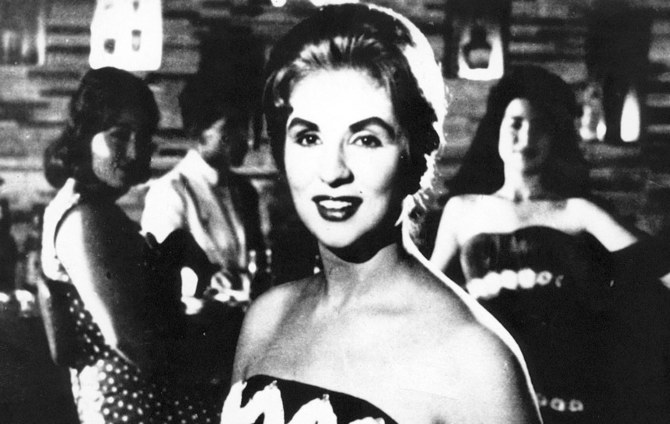

DUBAI: “Empress of Lebanese Song,” “Sabbouha” and “Al-Shahroura” (The Singing Bird). These are just some of the nicknames given to the Lebanese singer and actress Sabah, whose remarkable career spanned seven decades.
Sabah was born Jeanette Georges Feghali in November 1927 in Bdadoun near Mount Lebanon. She was the youngest of three daughters. Her family life was troubled — her father reportedly bullied and neglected her, and even tried to steal her earnings from her early movies. She once told an interviewer that she was crying one day because she hadn’t had any food and one of her uncles told her parents “that I had a beautiful voice when I sobbed.” Her traumatic childhood only got worse when her brother murdered their mother because he believed she was having an affair.

Sabah in the 1958 film 'La Rue de L'Amour.' (Image credit: Abboudi Bou Jawde)
It was her talent that offered her a way out. Sabah started singing aged four, and released her first song in 1940, aged just 13.
Five years later, she starred in her first movie, the Egyptian film “El-Qalb Luh Wahid” (The Heart Has Its Reasons) and adopted her character’s name — Sabah (morning). Still a teenager, she quickly became famous across the Arab world. She went on to star in almost 100 movies and release more than 50 albums, becoming internationally famous — performing in Paris, London, Sydney and New York. She reportedly had around 3,500 songs in her repertoire and carried on performing well into her eighties, finally retiring in 2010 due to illness. She died in Lebanon on Nov. 26, 2014, at the age of 87.
Egyptian filmmaker Ahmed Shafik made “El-Shahrourah,” a TV drama based on her life (Sabah was played by Lebanese singer and actress Carole Samaha), which aired in Ramadan in 2011. For background, Shafik talked with Sabah for hours about her life.
“I grew up listening to Sabah. She is a great artist, a great singer, a great actress. It was an incredible feeling the first time I went to meet her,” Shafik told Arab News.

A picture from the late 1960s (R to L) Sabah with Egyptian actresses Leila Taher and Maryam Fakhreddine shooting a movie in Alexandria. (AFP)
“The (show) was based on her words. We — (writer) Fedaa El-Shandawily and I — sat with her in the hotel she stayed in until she died, and we would visit her daily. When the show was written, we read the episodes for her and it was exactly what she said,” he continued. “Her life was full of suspense and a lot of drama. At times, Sabah would tell us stories and cry, and at times she would recall memories and laugh.”
After the show aired, Sabah’s family reportedly filed lawsuits against the production house. But, according to Shafik, none of the cases came to trial because he had the recordings of his interviews with Sabah.
“Sabah herself did not file a lawsuit,” he noted. “Sabah cared for her professional career and did not care for her personal life, her family.”
The singer married 10 times and was rumored to be in multiple relationships throughout her life. “She was trying to find stability and make a family. Most of the men in her life wanted the rich and famous Sabah — not a family,” Shafik said.
In 2021, Sabah was among the Arab female artists featured in the Arab World Institute’s six-month exhibition, “Arab Divas, from Umm Kulthum to Dalida.” Maïa Tahiri, CEO of glob.art, the cultural platform that helped support the exhibition, told Arab News, “Umm Kulthum, Warda Al-Jazairia, Asmahan, Fayrouz, Sabah, Dalida … (these women) have influenced not only several generations but have created a bridge across cultures. It was very moving to see daughters with their mothers and grandmothers at the exhibition, sharing their memories and ideas, rocked by the famous songs of these incredible women who contributed so much to the Golden Age of the Arab world.
“Sabah is an icon, not just in the Middle East or the Arab World,” Tahiri added. “The fact that she acted in almost 100 movies and interpreted approximately 3,500 songs explains her global fame… Her freedom, her frankness and her love for fashion also explain the fascination people still have when it comes to her.”
Tahiri said that throughout her lustrous career, Sabah remained faithful to her dressmaker, William Khoury. “Even though she mostly performed in Egypt, it was extremely important to her to have her stage costumes made in her homeland, Lebanon. The exhibition put forward a large panel of Sabah’s outfits, revealing her appreciation for boldness,” she said.
That boldness carried over from her risqué dress sense to her personality. Lebanese radio presenter Chady Maalouf, who met Sabah many times between 2001 and her death in 2014, told Arab News, “Dealing with Sabah meant dealing with a very professional star, whether in punctuality, commitment or frankness and clarity in the answers.”

Sabah with the Lebanese couturier William Khoury in 1974. (Image credit: Madonna Khoury)
Sabah, he said, “was one of the first to carry the Lebanese dialect — through her songs — to Egypt and the Arab world, bringing it closer to the Arab public at a time when the Egyptian dialect was dominant in the world of singing and acting.”
Maalouf’s favorite interview with the star was his first, recorded in her house at the time in Hazmieh. “Sabah was always elegant, even at home,” he said. “The dominant color of the furniture and curtains was turquoise. She showed me some of her (ornaments) after our interview. One was a gift from Fayrouz and Assi Rahbani, and another piece was from the Egyptian actress Soheir Ramzi.”

Sabah performing in Alexandria in 2003. (AFP)
An interview in 2006 he recalled “was one of the few times I saw Sabah sad. She had tears in her eyes, because our meeting coincided with an Israeli attack on Lebanon, and rumors were circulating in the press that she was celebrating her birthday when the country was being bombed.”
The conversation that has stuck with Maalouf the most, though, was when he asked Sabah why she didn’t move to the US where her daughter, son and two grandchildren lived.
“She replied: ‘I love them all very much, but there I will feel that I’ve become merely a grandmother and forget my glory, and that I am Sabah. I love myself and don’t like to be insignificant.’ Then she added, ‘I’m not selfish, but I love the artist in me,’” Maalouf said.
“I believe that this phrase really sums up her life: Janet Feghali loved Sabah and lived for Sabah. And she did it well.”


