

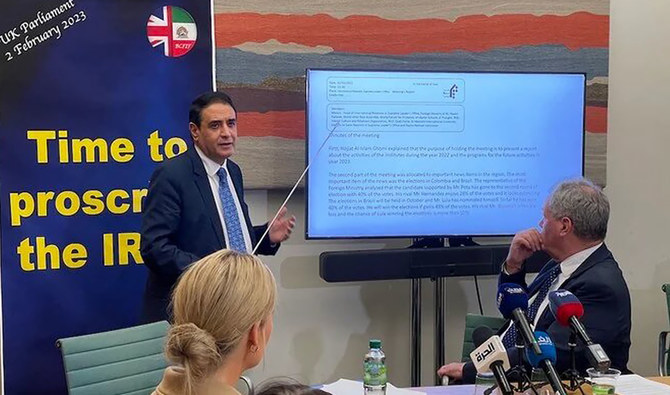

LONDON: Iran poses a “clear and present danger” and immediate action must be taken to proscribe the Iranian Revolutionary Guards as a terrorist organization in the UK, according to a parliamentarian.
“Every day we delay, we give them the opportunity to expand their operations, to carry out other nefarious activities,” Bob Blackman, MP for Harrow East, told Arab News. “We’ve seen evidence of some of the organizations in the United Kingdom that are operating under direct control of the IRGC.”
He said that this was “a serious threat to our homeland security, so it’s key that we have to address it and prompt action is required.”
Blackman said that the British government has already proscribed Hezbollah in Lebanon and Hamas in the Gaza Strip as terrorist organizations and they “are funded and supported by the IRGC.” The things the regime has done and is doing have been listed, and these are sufficient for it to be proscribed.
The US has done it, other European countries are working on it and “we need to encourage our allies to work jointly with us so they cannot operate anywhere else in the world, but that’s the key challenge,” he added.
Although it has received cross-party support as a matter of national interest and security, the UK has failed to proscribe them so far, and “the only reason why the government, I think, are hesitating over that is that ends negotiations, and if it ends negotiations, well, fine. I don’t mind that,” Blackman said.
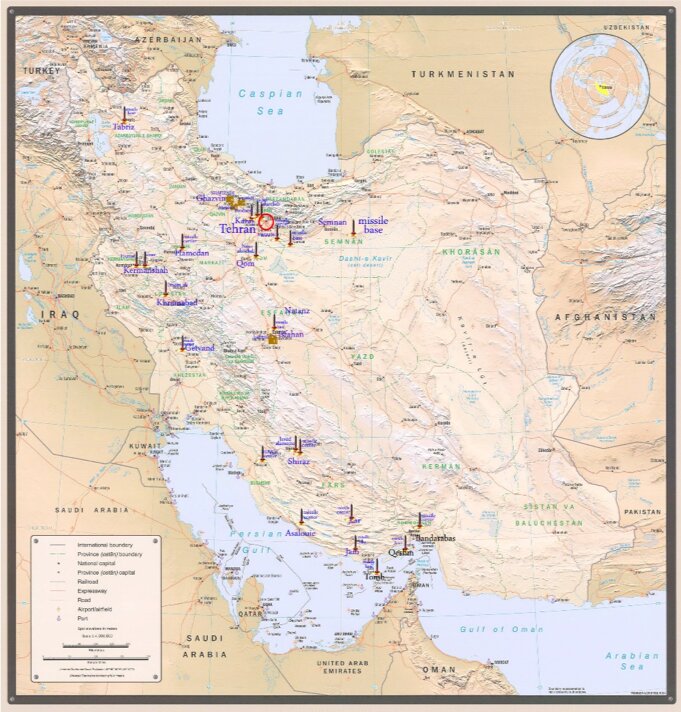
Map of locations of Iranian regime missile sites across the country. (Photo courtesy: NCRI)
Talks to revive a 2015 nuclear deal with Iran, which was scrapped by then-president, Donald Trump, in 2018, have been deadlocked since September.
“There are no negotiations going on because obviously the IRGC activities and the activities of the regime in Iran is suppressing their people with a position whereby thousands have been arrested, hundreds have been killed, and many face potential execution for the mere crime of protesting against the regime. There’s no time to negotiate on that basis,” he said.
Blackman believes negotiations are a mistake in the first place as there has been evidence that Iran was in violation of its obligations under the current treaty, and talks cannot be held under those circumstances.
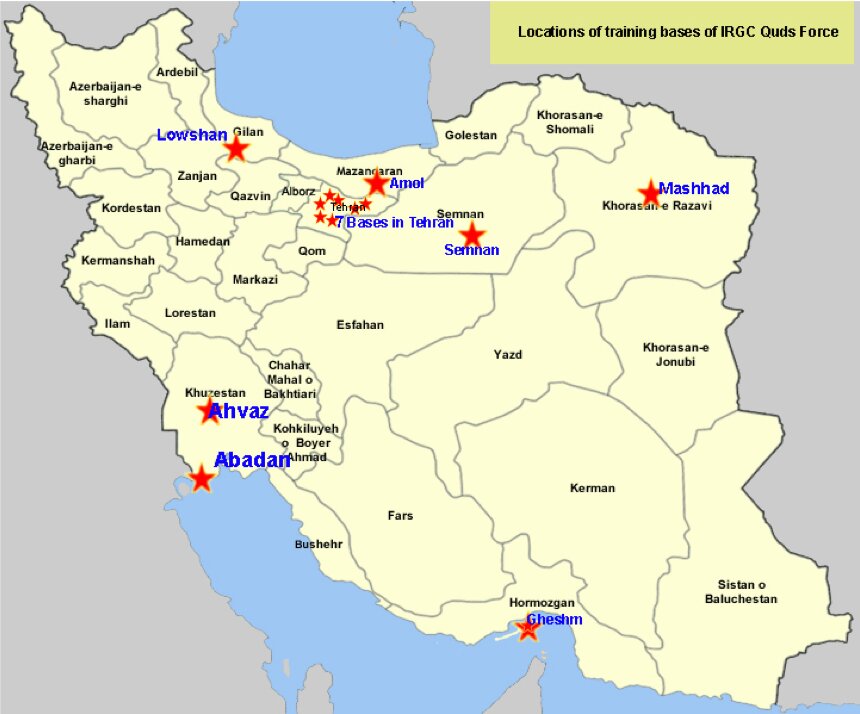
The map of locations of training bases of IRGC Quds Force. (Photo vourtesy: NCRI)
“What we do have to do is prevent them from getting a nuclear weapon at all costs. That of course, does mean at all costs. We cannot get them to a point where they’ve got a nuclear weapon and can threaten the region with potential nuclear war. That would just be a complete disaster for everyone in the region and possibly beyond.”
He called for imposing stronger sanctions against individuals to “bring this regime to its knees” because it did not respond to negotiations.
Blackman said that the UK government’s rationale must also be that there are dual nationals and British citizens in Iran, and urged them to leave because they could be captured and used as hostages, which has happened already.
“We’re seeing all sorts of nefarious activities, interference in elections in other countries, terrorist plots which have been foiled not only across the Middle East but also in Europe and in the UK itself, as well as now cyberattacks which are proven to be going on, attacking the House of Commons and the Houses of Parliament generally, for the sole purpose, obviously, of disrupting our data and causing us damage overall.
“That just demonstrates that these people are not to be trusted one iota and therefore need to be proscribed,” he said.
Blackman was speaking on the sidelines of a press conference organized by the National Council of Resistance of Iran’s UK office on Thursday to reveal new information about the terrorist activities of the IRGC and the need to proscribe them. He said they have held numerous negotiations with the UK Foreign Office and will now speak with the Home Office, as it was up to them to make the decision.
Hossein Abedini, deputy director of the NCRI’s UK representative office, said they are in touch with many MPs in different parties and there is a strong British committee supporting Iranian freedom in parliament, which has been very active in different debates.
He highlighted to reporters the ways in which the IRGC was an army of terror and oppression, and suppressing the Iranian people, along with their training and military bases and major garrisons around the country and in the capital, Tehran
Abedini shared a classified document in Farsi obtained by the NCRI of minutes of a meeting at the International Directorate of the office of Iran’s Supreme Leader Ali Khamenei on May 31, 2022, where representatives of eight terrorist and extremist organizations of the regime participated.
Among the minutes, one representative from the Quds Force — one of five branches of the IRGC — reported bringing a 55-member military delegation from Venezuela to Iran in 2022, “which shows the dimensions of the IRGC’s intervention in a Latin American country,” an English explanation of the document provided by the NCRI said.
Abedini called for the London-based Islamic Center of England, which is under the supervision of the International Directorate Khamenei’s Office and headed by Mullah Seyed Hashem Mousavi, to be closed down as it had agents around the UK that aimed to spread the regime’s propaganda.
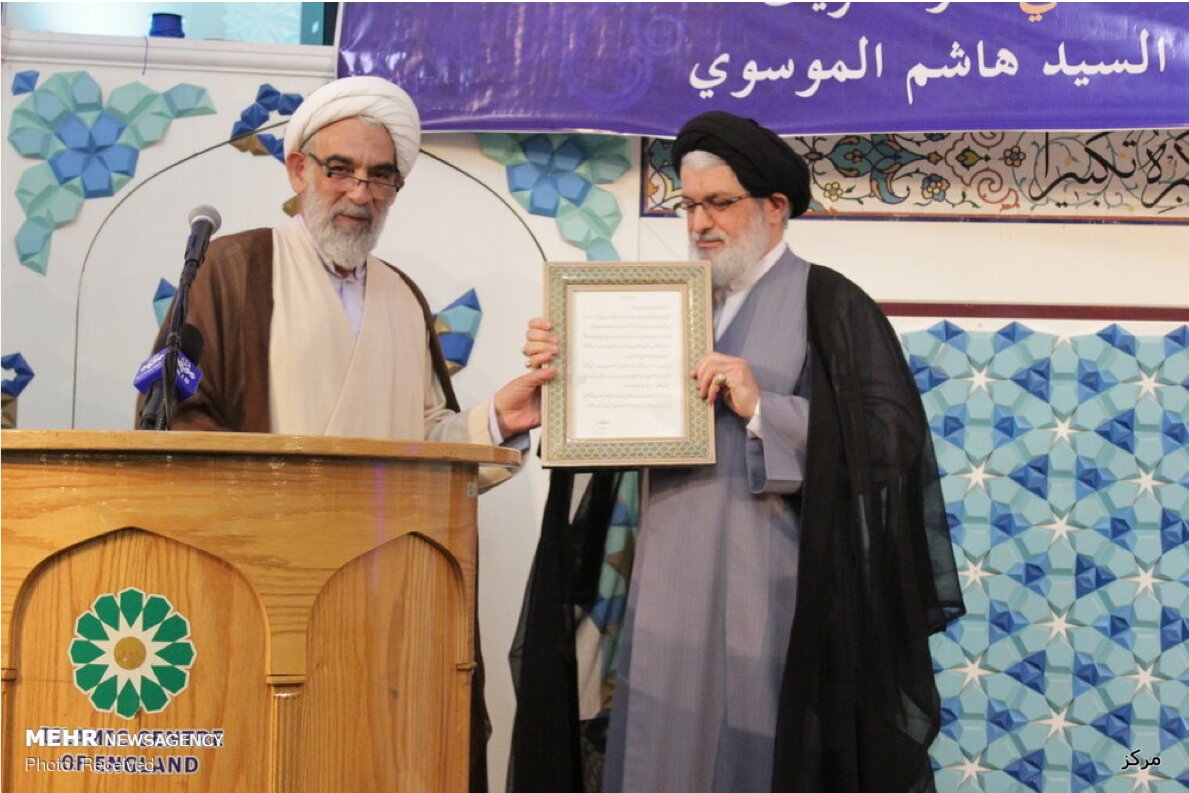
Appointment of Seyed Hashem Moussavi as the head of the Islamic Center of England in London by the international director of Khamenei’s Office Mohsen Qomi. (Photo courtesy: NCRI)
On the recent execution of Alireza Akbari, an Iranian-British national who was a former Iranian deputy defense minister, Abedini said that this could add weight to the UK’s decision to proscribe the IRGC.
“That clearly shows that the regime is panicking, and it clearly shows that they are really in a very critical situation. I think it certainly will add, but it’s a political decision, so the UK, if the members of Parliament continue to put pressure, we will reach that point,” he added.


