

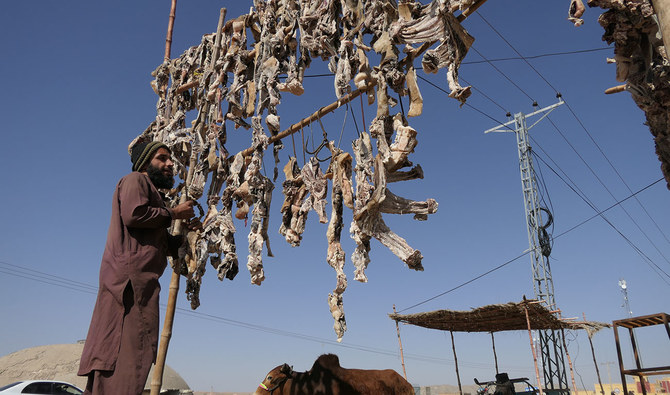

YARO, BALOCHISTAN: At the crowded Yaro Bazar in the southwestern Pakistani district of Pishin, large chunks of cured meat hang in the hundreds on wooden stands outside roadside stores through the winter months.
The dried lamb meat is called Landhi, a winter delicacy in Pashtun cuisine, and is popular in Afghanistan and southwestern Pakistan, including Pishin District in Balochistan province, which remains in the grip of biting cold from January to at least April.
To make Landhi, Pashtun tribesmen in Balochistan slaughter a healthy lamb, remove its fur and roast it on a fire until the fat melts into the meat. The meat is then marinated in salt and herbs and left overnight until all the moisture in it dries up, after which it is hung out to dry in the sun for at least two weeks.
Once ready, it is hung up outside shops to attract customers, who come in the hundreds from all parts of Balochistan province and beyond. A kilogram of Landhi can sell for up to Rs2,300 rupees ($8.43).
“The demand for Landhi has increased a lot this year, more than ten times what I had imagined,” Qutratullah Khan, a butcher in Yaro who sells the meat jerky, told Arab News.

Local tribesmen stands at a butcher shop in Pakistan’s Balochistan province to buy Landhi on February 2nd 2023. (AN Photo)
He speculated that demand had increased because of the unusually cold weather this year:
“In previous seasons, I barely sold 10 lambs a day, but this season I have been selling 20 to 25 lambs regularly.”

The dried Landhi piece {fatty meat) hangs in sunlight at a butcher shop in Pakistan’s Balochistan province on February 2nd 2023. (AN Photo)
Pakistan, a country of more than 220 million people, is among the worst affected nations from climate change. Last summer unprecedented floods killed more than 1700 people and submerged a third of the country, and erratic weather conditions have pushed temperatures below -7°C in many areas of Balochistan this winter season, breaking a 16-year record.
“After 16 years, the mercury dropped down to -7.5°C in Quetta and other northern areas of Balochistan in January, which is a clear sign of climate change,” Mukhtar Ahmed Magsi, a deputy director at the Quetta regional meteorological center, told Arab News.
“The cold season is getting severe against our expectations and it might persist in the next season as well.”
But the colder it gets, the more Landhi people want. And it is not just Pashtuns who seek the meat, but also people of other ethnicities.

Customers stands inside a butcher shop to buy Landhi in Pakistan’s Balochistan province on February 2nd 2023. (AN Photo)
“Imagine, I have come from Quetta [to Pishin] to get Landhi,” customer Faisal Ahmed told Arab News. “I am Sindhi myself, I hail from Jacobabad, Sindh, and now I am living in Quetta but despite being Sindhi, we eat Landhi.”
“This is a tradition, it’s the custom of a place, so Sindhis also eat it, Punjabis also eat it, Pashtuns also eat it,” Ahmed said. “All brothers come together to eat this.”
This winter season, Khan, the butcher, said he had received a number of orders from Islamabad, Lahore and Karachi where the special variety of meat had become a wanted delicacy.
“People love to make curry with fatty Landhi pieces to keep their bodies warm during snowfall and chilly weather,” he said. “In urban areas, people have started cooking Karahi [meat curry] and Kabuli Pulao [rice] with Landhi.”
Pishin Resident Gulbaz Khan said he was at Yaro Bazaar to buy Landhi for friends and relatives living in the eastern Punjab province.
“This meat is good, it’s warm, it’s good for health. It’s a fantastic thing, if you make a stew with Landhi, it’s a great thing. It has a great taste. You don’t even need to use oil to make it.”
Then laughing, he added:
“I am taking it to Lahore. There are friends there, they said, ‘Bring Landhi, how is this meat, we have seen it on Facebook.’ So, I have bought five kilograms.”


