


WASHINGTON/BEIJING: US Secretary of State Antony Blinken postponed a visit to China that had been expected to start on Friday after a suspected Chinese spy balloon was tracked flying across the United States in what Washington called a “clear violation” of US sovereignty.
The Pentagon said on Thursday it was tracking a high-altitude surveillance balloon over the continental United States. Officials said military leaders considered shooting it down over Montana on Wednesday but eventually recommended against this to President Joe Biden because of the safety risk from debris.
White House spokesperson Karine Jean-Pierre said Biden was briefed on the balloon flight on Tuesday and there was an administration “consensus that it was not appropriate to travel to the People’s Republic of China at this time.”
China on Friday expressed regret that an “airship” used for civilian meteorological and other scientific purposes had strayed into US airspace.
Jean-Pierre said the US administration was aware of China’s statement “but the presence of this balloon in our airspace, it is a clear violation of our sovereignty as well as international law. It is unacceptable this occurred.”
On Friday, Pentagon spokesman Brig. Gen. Patrick Ryder said the balloon had changed course and was floating eastward at about 60,000 feet (18,300 meters) above the central United States and demonstrating a capability to maneuver. He said it would likely be over the country for a few more days.
Commercial forecaster AccuWeather said the balloon would potentially leave United States into the Atlantic on Saturday evening. Mike Rounds, a Republican member of the Senate Armed Services Committee, told Fox News it would be good to recover the balloon “one way or another” to see “if it was designed to actually collect data or if it was designed to test our response capabilities.”
The Pentagon’s disclosure about the balloon’s maneuverability directly challenges China’s assertion about it being blown off course.
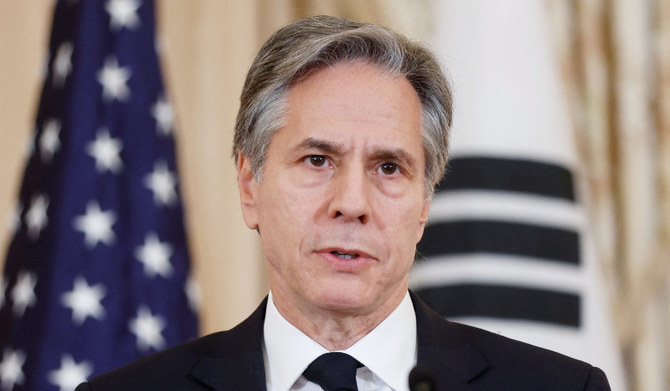
At a news conference with South Korea’s visiting foreign minister on Friday, Blinken said he had told Wang Yi, director of China’s Central Commission for Foreign Affairs, that the incident on the eve of his trip was an “irresponsible act” by China, but Washington remained committed to engagement and he would visit when conditions allowed.
Blinken said he would not put a date on when he might go to China and the focus was on resolving the current incident. “The first step is ... getting the surveillance asset, out of our air space,” he said, adding that Washington would maintain open lines of communication with China.
The Republican chairman of the House of Representatives Foreign Affairs Committee, Michael McCaul, said the balloon should never have been allowed in US airspace and could have been shot down over water.
“I am calling on the Biden administration to quickly take steps to remove the Chinese spy balloon from US airspace,” he said in a statement.
Blinken said, however, that he told Wang that “the United States is committed to diplomatic engagement with China and that I plan to visit Beijing when conditions allow.”
LOST OPPORTUNITY?
A White House official said the administration had briefed staff of the so-called Gang of 8, which brings together Republican and Democratic leaders from the Senate and House, on Thursday afternoon.
The official said such balloon surveillance activity had “been observed over the past several years, including in the prior administration – we have kept Congress briefed on this issue.”
The postponing of Blinken’s trip, which had been agreed to in November by Biden and Chinese President Xi Jinping, is a blow to those who saw it as an overdue opportunity to stabilize an increasingly fractious relationship. The last visit by a US secretary of state was in 2017.
China is keen for a stable US relationship so it can focus on its economy, battered by the now-abandoned zero-COVID policy and neglected by foreign investors alarmed by what they see as a return of state intervention in the market.
In recent months Chinese leader Xi has met with world leaders, seeking to re-establish ties and settle disagreements.
Daniel Russel, the top US diplomat for Asia under former President Barack Obama, said he did not see a strategic rationale for canceling the trip and stressed the importance of maintaining high-level engagement with China.
“In as much as the US has much bigger fish to fry with the Chinese than a surveillance balloon, the Biden team may be inclined to pick up where they left off after a decent interval,” he said.
Sino-US relations have soured significantly in recent years, particularly following then-US House Speaker Nancy Pelosi’s visit to Taiwan in August, which prompted dramatic Chinese military drills near the self-ruled island.
LIMITED INTELLIGENCE VALUE
The Pentagon’s Ryder told reporters on Thursday the balloon was at an altitude well above commercial air traffic and did not present a military or physical threat to people on the ground. One US official added it was assessed to have “limited additive value from an intelligence collection perspective.”
Another official said on Thursday the flight path would carry the balloon over a number of sensitive sites, but did not give details. Malmstrom Air Force Base in Montana is home to 150 intercontinental ballistic missile silos.
Ryder declined on Friday to say where precisely the balloon was, but as he spoke, the National Weather Service in Kansas City said on Twitter it had received multiple reports across northwestern Missouri of a large balloon.
China has often complained about surveillance by the United States, including its deployment of ships or planes near Chinese military exercises.


