

Pakistan’s UN envoy apologizes for comments on Pashtun culture in women education comments

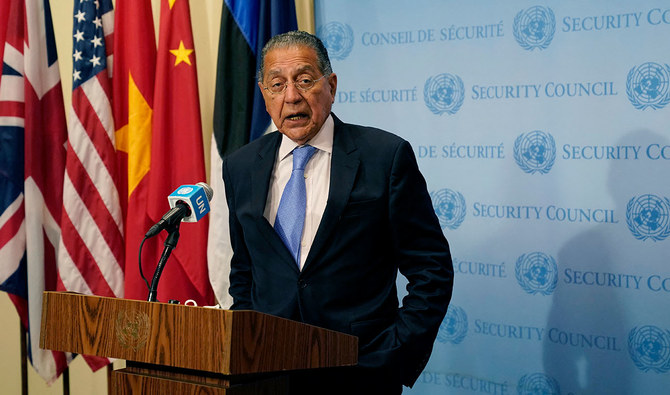
Pakistan's ambassador to the United Nations Munir Akram speaks outside a UN security council meeting on Afghanistan on August 16, 2021 at the United Nations in New York. (Photo courtesy: AFP)
Short Url
Updated 03 February 2023
Follow

Pakistan’s UN envoy apologizes for comments on Pashtun culture in women education comments

  • Munir Akram called keeping women at home ‘distinctive cultural reality’ of Afghanistan, Pashtuns
  • Pakistani envoy to the UN says he ‘misspoke’ his words as he had deep respect for Pashtun culture

ISLAMABAD: Pakistan’s envoy to the United Nations, Munir Akram, on Friday apologized for his comments about the Pashtun culture which drew flak on social media after he termed the Afghan Taliban government’s ban on women’s education and work a “distinctive cultural reality” of Afghanistan.

The Pakistani diplomat briefed member states on two high-level UN visits to Afghanistan on Thursday and said the Taliban’s decision to bar women from seeking education and employment did not stem from religious beliefs but was an aspect of the Pashtun culture that required women to stay at home and had remained unchanged for hundreds of years.

Akram’s statement was widely criticized on social media by both Pakistanis and Afghans, with Afghanistan’s ambassador to Sri Lanka asking the UN to “immediately refute this piece of disinformation” and saying Pashtun girls had been attending schools and universities since time immemorial.

In response to the criticism, Akram issued an apology, saying his words “did not accurately reflect Pakistan’s position.”

“My apologies for the hurt caused by my comments at the humanitarian briefing on Afghanistan,” he wrote on Twitter. “I [misspoke] & my words did not accurately reflect Pakistan’s position.”

“I have deep respect for Pashtun culture,” he continued. “Denying women & girls access to education is neither Islamic nor Pashtun culture.”


Earlier, Akram said he meant “no disrespect” to the Pashtun culture which was “highly progressive and deserves all respect across the world,” the state-owned Associated Press of Pakistan (APP) news agency quoted him as saying.

The Pakistani envoy said he had referred to a “peculiar perspective” of a small minority, which had resulted in restrictions on Afghan women, according to the report.

The restrictions were “not consistent with Islam and the Sharia, which provides all rights to women, including to work and education,” he added.

Last year, the interim Taliban government in Afghanistan provoked anger in many parts of the world when it issued edicts banning women from attending universities and secondary schools. The Afghan government also ordered local and foreign aid organizations to ban women from working in their offices.

Afghanistan’s Taliban rulers justified the move by saying some women had not adhered to their interpretation of the Islamic dress code.


Pakistani, Bangladeshi officials discuss trade, investment and aviation as ties thaw

Updated 28 December 2025
Follow

Pakistani, Bangladeshi officials discuss trade, investment and aviation as ties thaw

  • Pakistan and Bangladesh were once one nation, but they split in 1971 as a result of a bloody civil war
  • Ties between Pakistan, Bangladesh have warmed up since last year and both nations have resumed sea trade

ISLAMABAD: Pakistan's High Commissioner to Bangladesh Imran Haider on Sunday met Chief Adviser Muhammad Yunus in Dhaka, the latter's office said on, with the two figures discussing trade, investment and aviation.

Pakistan and Bangladesh were once one nation, but they split in 1971 as a result of a bloody civil war, which saw the part previously referred to as East Pakistan seceding to form the independent nation of Bangladesh.

Ties between Pakistan and Bangladesh have warmed up since former prime minister Sheikh Hasina’s ouster as a result of a student-led uprising in August 2024. Relations remain frosty between Dhaka and New Delhi over India’s decision to grant asylum to Hasina.

Pakistan has attempted to forge closer ties with Bangladesh in recent months and both South Asian nations last year began sea trade, followed by efforts to expand government-to-government commerce.

"During the meeting, both sides discussed ways to expand cooperation in trade, investment, and aviation as well as scaling up cultural, educational and medical exchanges to further strengthen bilateral relations between the two South Asian nations," Yunus's office said in a statement on X.

In 2023-24 Pakistan exported goods worth $661 million to Bangladesh, while its imports were only $57 million, according to the Trade Development Authority of Pakistan. In Aug. this year, the Pakistani and Bangladeshi commerce ministries signed a memorandum of understanding to establish a Joint Working Group on Trade, aiming to raise their bilateral trade volume to $1 billion in the financial year that began in July.

The Pakistani high commissioner noted that bilateral trade has recorded a 20 percent growth compared to last year, with business communities from both countries actively exploring new investment opportunities, according to the statement.

He highlighted a significant increase in cultural exchanges, adding that Bangladeshi students have shown strong interest in higher education opportunities in Pakistan, particularly in medical sciences, nanotechnology, and artificial intelligence. Haider also said that Dhaka-Karachi direct flights are expected to start in January.

"Chief Adviser Professor Muhammad Yunus welcomed the growing interactions between the two countries and emphasized the importance of increased visits as well as cultural, educational and people-to-people exchanges among SAARC (South Asian Association for Regional Cooperation) member states," the statement read.

"Professor Yunus also underscored the need to further boost Bangladesh–Pakistan trade and expressed hope that during Mr. Haider’s tenure, both countries would explore new avenues for investment and joint venture businesses."