

Messi has doubts about playing 2026 World Cup at age 39

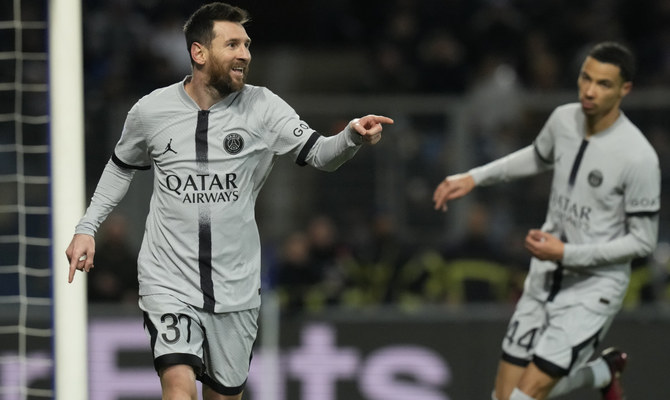
PSG's Lionel Messi after scoring his side's second goal during the French League One soccer match between Montpellier and Paris Saint-Germain at the State La Mosson stadium in Montpellier Wednesday. (AP)
Short Url
Updated 03 February 2023
Follow

Messi has doubts about playing 2026 World Cup at age 39

  • Messi told newspaper Olé in an interview published Thursday that he’d regularly said his age would make it difficult to play another World Cup

BUENOS AIRES: Lionel Messi may be in doubt as to whether he’ll be still playing for Argentina at the 2026 World Cup but he’s sure about one thing: He wants Lionel Scaloni to stay on as head coach until then, regardless.

The 35-year-old Messi led Argentina to the title in Qatar last December and wasn’t entirely sure if his fifth trip to the World Cup would be his last. The next edition will take place in Mexico, Canada and the US when Messi is 39.

Messi told newspaper Olé in an interview published Thursday that he’d regularly said his age would make it difficult to play another World Cup.

“I love playing soccer, I love what I do and while I am feeling well and feel I am fit and continue to enjoy it, I will do it. But it seems to be too much until the next World Cup,” he told the newspaper. “I have to see where my career goes, what I will do. It depends on many things.”

In the near future, he suggested he wants to play in next year’s Copa America in the US to help Argentina defend their title.

“I will stay a little longer, I have to enjoy this,” he said.

Scaloni is negotiating an extension of his contract with the Argentinian soccer federation and Messi thinks the coach should remain on the job.

“He is very important for the national team,” Messi said. “To continue with this process would be spectacular.”

Asked what it was like returning to his club Paris Saint Germain after Argentina beat France on penalties to win the World Cup, Messi said he didn’t have deep discussions about it with his teammate Kylian Mbappe, the French striker.

“One doesn’t want to speak and bring the topic of the final,” Messi said, recalling his own experience after losing the 2014 World Cup final to Germany in Brazil. “I was also on the other side, I lost a World Cup final and I didn’t want to talk about it.”

“Truth is there is no problem with Kylian, quite on the contrary,” Messi said.

Messi is set to play for Argentina in friendlies to be scheduled in Buenos Aires in March to celebrate the team’s third World Cup title with their fans.


Football returns to Gaza pitch scarred by war and loss

Updated 11 sec ago
Follow

Football returns to Gaza pitch scarred by war and loss

  • Fans gather to cheer the first football tournament in two years in the ruins of Gaza City’s Tal Al-Hawa district
  • 'No matter what happened in ‌terms of destruction and genocidal war, we continue with playing,' Gazan footballer says
On a worn-out five-a-side pitch in a wasteland of ruined buildings and rubble, Jabalia Youth took on Al-Sadaqa in the Gaza Strip’s first organized football tournament in more ​than two years.
The match ended in a draw, as did a second fixture featuring Beit Hanoun vs Al-Shujaiya. But the spectators were hardly disappointed, cheering and shaking the chain-link fence next to the Palestine Pitch in the ruins of Gaza City’s Tal Al-Hawa district.
Boys climbed a broken concrete wall or peered through holes in the ruins to get a look. Someone ‌was banging on ‌a drum.
Youssef Jendiya, 21, one ‌of ⁠the ​Jabalia Youth ‌players from a part of Gaza largely depopulated and bulldozed by Israeli forces, described his feeling at being back on the pitch: “Confused. Happy, sad, joyful, happy.”
“People search for water in the morning: food, bread. Life is a little difficult. But there is a little left of the day, when you can come and play ⁠football and express some of the joy inside you,” he said.
“You come to the ‌stadium missing many of your teammates... killed, ‍injured, or those who ‍traveled for treatment. So the joy is incomplete.”
Four months since a ‍ceasefire ended major fighting in Gaza, there has been almost no reconstruction. Israeli forces have ordered all residents out of nearly two-thirds of the strip, jamming more than 2 million people into a sliver of ​ruins along the coast, most in makeshift tents or damaged buildings.
The former site of Gaza City’s 9,000-seat ⁠Yarmouk Stadium, which Israeli forces levelled during the war and used as a detention center, now houses displaced families in white tents, crowded in the brown dirt of what was once the pitch.
For this week’s tournament the Football Association managed to clear the rubble from a collapsed wall off a half-sized pitch, put up a fence and sweep the debris off the old artificial turf.
By coming out, the teams were “delivering a message,” said Amjad Abu Awda, 31, a player for Beit Hanoun. “That no matter what happened in ‌terms of destruction and genocidal war, we continue with playing, and with life. Life must continue.”