

Earthquake jolts Islamabad, adjacent Pakistani cities — USGS

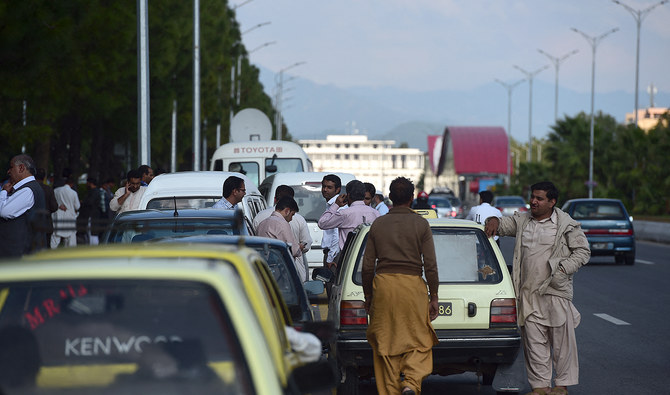
In this file photo taken on October 26, 2015, people gather outside the buildings after earthquake tremors felt in Islamabad. (Photo courtesy: AFP/File)
Short Url
Updated 29 January 2023
Follow

Earthquake jolts Islamabad, adjacent Pakistani cities — USGS

  • This is the 3rd time in a month Islamabad, parts of Khyber Pakhtunkhwa felt tremors
  • The residents of Islamabad share their experience on Twitter, calling it a ‘massive jolt’

ISLAMABAD: A magnitude 4.4 earthquake jolted the Pakistani capital of Islamabad and nearby cities on Sunday, the United States Geological Survey (USGS) said, with many residents of the capital describing it as a “massive jolt” on Twitter.

According to the USGS, the earthquake struck at around 12:45pm Pakistan time, with its epicenter located 25.5 kilometers away from the capital at a depth of 32.4 kilometers.

However, Sabir Khan, a senior meteorologist at the National Seismic Monitoring Center (NSMC) in Islamabad said the magnitude of the earthquake was recorded 6.3 on the Richter scale, the state-run APP news agency reported.

No casualties have so far been reported in its wake.

“Stay safe Pakistan! It was a massive jolt,” Zubair Faisal Abbasi, an Islamabad resident, wrote o Twitter.

“Quite strong shaking in Islamabad #earthquake,” said Sana Jamal, another Islamabad resident.

This was the third time in a month that the Pakistani capital experienced tremors.

On January 19, several parts of Punjab and Khyber Pakhtunkhwa provinces were shaken when a 5.6-magnitude quake hit Islamabad, Charsada, Peshawar, Nowshera, Mardan, and Shabqadar, the National Seismic Monitoring Center (NSMC) said.

Tremors were felt in Islamabad and parts of KP on January 5 as well.


Pakistan reports first wild polio case of 2026 despite vaccination campaigns

Updated 05 March 2026
Follow

Pakistan reports first wild polio case of 2026 despite vaccination campaigns

  • Four-year-old girl infected in Sindh’s Sujawal district as virus persists in high-risk areas
  • Pakistan conducted last nationwide campaign in January, vaccinating over 45 million children

ISLAMABAD: Pakistan reported its first wild poliovirus case of the year, health authorities said on Thursday, underscoring the persistence of the disease in high-risk areas despite ongoing vaccination campaigns.

The latest infection was confirmed in a four-year-old girl in Sujawal district of the southern Sindh province, according to the Regional Reference Laboratory for Polio Eradication at the National Institute of Health in Islamabad.

Polio is a highly contagious viral disease that can cause permanent paralysis, mainly in children under the age of five. Pakistan and neighboring Afghanistan are the only two countries in the world where the disease remains endemic.

“The case was reported through the polio surveillance network and confirmed by the Regional Reference Laboratory for Polio Eradication at the National Institute of Health, Islamabad,” the statement said.

“The Polio Eradication Initiative is already analyzing the best response to tackle and prevent further transmission.”

In 2026, Pakistan conducted a nationwide polio campaign in January that vaccinated more than 45 million children, while the next national campaign is planned for April.

Since 1994, Pakistan has cut polio cases by 99.8 percent through vaccination efforts, reducing infections from an estimated 20,000 in the early 1990s to 31 in 2025.

Pakistan reported 31 polio cases in 2025. Southern Khyber Pakhtunkhwa accounted for more than half of the country’s polio cases in 2025, with 17 of the 31 infections reported from the region.

According to health authorities, 74 cases were reported in 2024.

More than 200 polio workers and police officers assigned to protect polio teams have been killed in Pakistan since the 1990s, according to health and security officials.

Militants often falsely claim the vaccination campaigns are part of a Western plot to sterilize Muslim children.

The vaccination campaigns are also undermined by parental refusals in remote regions.