

India raises defense budget to $72.6 billion amid tensions with China, Pakistan

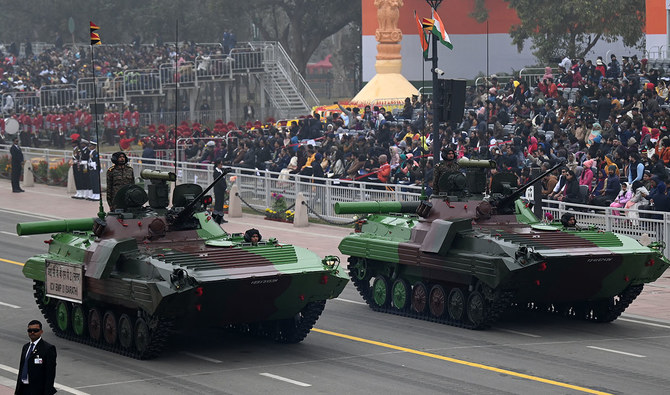
Indian armed forces ICV BMP II (Sarath) tanks take part in India’s 74th Republic Day parade in New Delhi on January 26, 2023. (AFP)
Short Url
Updated 01 February 2023
Follow

India raises defense budget to $72.6 billion amid tensions with China, Pakistan

  • India employs 1.38 million people in its armed forces with large numbers deployed along borders with China and Pakistan
  • South Asian giant plans to spend nearly $3 billion for naval fleet construction and $7 billion for air force procurements

NEW DELHI: India proposed on Wednesday 5.94 trillion rupees ($72.6 billion) in defense spending for the 2023-24 financial year, 13 percent up from the previous period’s initial estimates, aiming to add more fighter jets and roads along its tense border with China.

Finance Minister Nirmala Sitharaman allocated 1.63 trillion rupees for defense capital outlays — an expenditure that would include new weapons, aircraft, warships and other military hardware, as she unveiled nearly $550 billion of total federal spending in the annual budget for 2023-24 starting in April.

She said 2.77 trillion rupees would be devoted to military salaries and benefits in 2023-24, 1.38 trillion on pensions for retired soldiers, and further amounts for miscellaneous items.

Sitharaman also revised the defense budget for the current financial year ending in March to 5.85 trillion rupees from earlier estimates of 5.25 trillion.

In the past few years, Prime Minister Narendra Modi has ramped up spending to modernize the military, while underlining his government’s commitment to boosting domestic production to supply forces deployed along two contentious borders.

Laxman Behera, a defense expert at government-funded Jawaharlal Nehru University in New Delhi, said the hike in the defense budget was “reasonable but not sufficient,” considering requirements for military modernization.

“The government has tried to allocate reasonable funds for defense forces while balancing other priorities during the pre-election budget,” he said, noting India needed more funds in view of growing friction with China along disputed borders.

The total Indian defense budget, estimated at about 2 percent of GDP, is still lower than China’s 1.45 trillion yuan ($230 billion) in allocations for 2022, which New Delhi sees as posing a threat to neighbors including India and Japan.

“The overall increase in the armed forces’ budget is as anticipated, but likely lower than what they asked for to beef up operational capabilities,” said Amit Cowshish, former financial adviser for acquisitions at the Defense Ministry.

India plans to spend near 242 billion rupees ($3 billion) for naval fleet construction and 571.4 billion rupees ($7 billion) for air force procurements including more aircraft, the latest budget document showed.

The South Asian giant employs 1.38 million people in its armed forces, with large numbers deployed along borders with nuclear-armed rivals China and Pakistan.

Although the defense budget allocations fell short of military expectations, they are likely to grow as the economy recovers from two years of pandemic curbs, according to Behera.

India and China share a 3,500-kilometer (2,100-mile) frontier that has been disputed since the 1950s. The two sides went to war over it in 1962.

At least 24 soldiers were killed when the armies of the Asian giants clashed in Ladakh, in the western Himalayas, in 2020 but tensions eased after military and diplomatic talks.

A fresh clash erupted in the eastern Himalayas in December last year but no deaths were reported.


Displaced Sudanese escape RSF siege in southern Kordofan

Fighters of the paramilitary Rapid Support Forces (RSF) drive an armoured vehicle in southern Khartoum, on May 25, 2023. (AFP)
Updated 4 sec ago
Follow

Displaced Sudanese escape RSF siege in southern Kordofan

  • Some women haul water from a single well, pouring it into plastic buckets to cook, wash, and clean with, while others wait in a long line outside a makeshift health clinic, little more than a large canvas tent

GEDAREF, Sudan: When paramilitary Rapid Support Force fighters closed in on the Sudanese border town and oil field of Heglig, paraplegic Dowa Hamed could only cling to her husband’s back as they fled, “like a child,” she said
Now, the 25-year-old mother of five — paralyzed from the waist down — lies shell-shocked on a cot in the Abu Al-Naga displacement camp, a dusty transit center just outside the eastern city of Gedaref, nearly 800 km from home.
But her family’s actual journey was much longer, crossing the South Sudan border twice and passing from one group of fighters to another, as they ran for their lives with their children in tow alongside hundreds of others.
“We fled with nothing,” Hamed said. “Only the clothes on our backs.”
Hamed and her family are among tens of thousands of people recently uprooted by fighting in southern Kordofan — the latest front in the war between Sudan’s army and the Rapid Support Forces that erupted in April 2023.
Since capturing the army’s last stronghold in Darfur in October, the RSF and their allies have pushed deeper into neighboring Kordofan, an oil-rich agricultural region divided into three states: West, North, and South.
In recent weeks, the paramilitary group has consolidated control over West Kordofan, seized Heglig — home to Sudan’s largest oil field — and tightened its siege on Kadugli and Dilling in South Kordofan, where hundreds of thousands now face mass starvation.
On the night of Dec. 7, the inhabitants of Heglig — many of them the families of oil technicians, engineers, and soldiers stationed at the field — got word that an attack would happen at dawn.
“We ran on foot, barefoot, without proper clothes,” said Hiyam Al-Hajj, 29, a mother of 10 who says she had to leave her mother and six siblings behind as she ran around 30 km to the border.
“The RSF chased us to the border. The South Sudan army told them we were in their country and they would not hand us over,” she said.
They were sheltered in South Sudan’s Unity State, but barely fed.
“Those who had money could feed their children,” Al-Hajj said. “Those who did not went hungry.”
They spent nearly four weeks on the move, trekking long distances on foot and spending nights out in the open, sleeping on the bare ground.
“We were hungry,” she said. “But we did not feel the hunger; all we cared about was our safety.”
Eventually, authorities in South Sudan put them in large trucks that carried them back across the border to army-controlled territory, where they could head east, away from the front lines.
Hamed, who was paralyzed during childbirth, said that “during the truck rides, my body ached with every movement.”
But not everyone made it to Gedaref.
Between the canvas tents of the Abu Al-Naga camp, 14-year-old Sarah is struggling to care for her little brother alone.
In South Sudan, their parents had put them on one of the trucks, “then they said the truck was full and promised they would get on the next one.”
But weeks on, the siblings have received no word as to where their mother and father might be.
Inside the tents, children and mothers sleep on the ground, huddled together for warmth, while outside, children dart across the cracked soil, dust clinging to their bare feet.
According to camp director Ali Yehia Ahmed, 240 families, or around 1,200 people, are now taking refuge at Abu Al-Naga.
“The camp’s space is very small,” Ahmed said, adding that food was in increasingly short supply.
Food is distributed from a single point, forcing families to wait for limited rations.
Some women haul water from a single well, pouring it into plastic buckets to cook, wash, and clean with, while others wait in a long line outside a makeshift health clinic, little more than a large canvas tent.
Asia Abdelrahman Hussein, the minister of social welfare and development of Gedaref State, said shelter was one of the most urgent needs, especially during the winter months.
“The shelters are not enough. We need support from other organizations to provide safe housing and adequate shelter,” she said.
In one of the tents, Sawsan Othman Moussa, 27, said how she had been forced to flee three times since fighting broke out in Dilling.
Now, though she might be safe, “every tent is cramped, medicine is scarce, and during cold nights, we suffer.”