

In rural Indonesia, women join climate action in fight for survival

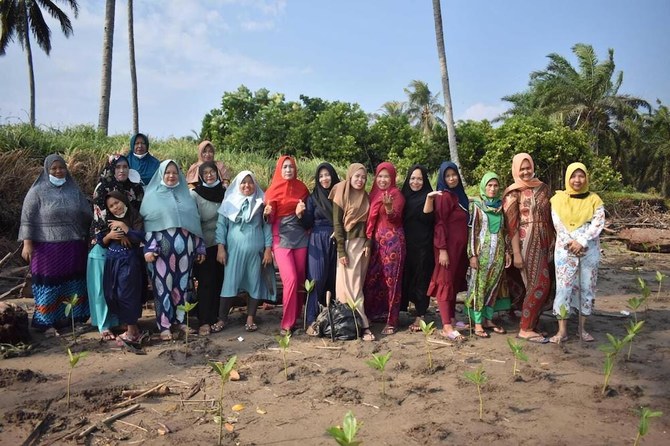
The women of Pondok Kelapa village in Indonesia’s Bengkulu province pose for a photo during a mangrove-planting event near their homes. In 2020, they formed a group to advocate for government climate resilience assistance. (Indonesian Forum for the Environment)
Short Url
Updated 01 February 2023
Follow

In rural Indonesia, women join climate action in fight for survival

  • Nearly half of coastal cities, districts in Indonesia are at risk of tidal flooding by 2050
  • Indonesia is one of the most vulnerable countries in terms of risks posed by climate change

JAKARTA: For the past few years, Rania has been constantly living in fear of the day she and her family would have to abandon their home when everything they own falls into the ocean. 

Life and livelihood in Rania’s village, Pondok Kelapa in Bengkulu province on the western coast of Indonesia’s Sumatra Island, have been increasingly affected by erosion. 

Environmentalists estimate that seawater has already entered 30 m into the mainland since 2011 and the pace at which it reclaims more is increasing. 

The village has been also losing its main source of livelihood, fisheries, as tidal waves destroy marine vegetation and fish habitats, leaving many men jobless and trapping the whole community in a poverty cycle. 

“Where we live is being eroded by the waves. Tidal floods are greatly affecting our lives,” Rania, 47, told Arab News. 

“We are trying our best, but some children don’t go to school. Some of them have had to leave because there’s simply not enough money.” 

Pondok Kelapa is not the only place affected, as coastal erosion and tidal flooding are threatening many more communities in the archipelagic nation of 270 million. 

A recent study by Indonesia’s biggest daily, Kompas, showed that nearly 200 out of about 500 coastal cities and districts are at risk of being submerged by 2050, as the country is one of the most vulnerable in terms of risks posed by the changing climate.

In Rania’s village of 4,300 people, women have decided to fight back. 

In 2020, she and over 20 other village women formed a group to advocate for government climate resilience assistance to build a seawall and help the community adapt to the rapidly changing conditions with proper infrastructure. 

“Because of climate change, seawater has increasingly eroded our place in Pondok Kelapa,” she said. 

“Now the women are stepping up and trying to confront this issue. Who knows, maybe the government will respond to us ladies.” 

Action is urgently needed not only in Pondok Kelapa but along the coast of the whole Bengkulu province, according to the Indonesian Forum for the Environment, a non-governmental organization, which is part of the Friends of the Earth International network. 

“A number of villages are in danger of sinking because of coastal erosion and tidal flooding…These tidal floods in Bengkulu province are very hard to predict, and they have impacted the earnings of fishermen and subsequently affected their livelihood,” Dodi Faisal, who heads the forum’s advocacy in the province, told Arab News. 

“It’s very worrying. The provincial and local governments have yet to take any concrete action.” 

Masmarawati, another member of Rania’s group, said she hopes action will come soon.

“We can still survive in the village for now,” she said. 

“But what about next year? In five years? What’s going to happen to our children and grandchildren?” 


Islamist militants show ‘unprecedented coordination’ in Burkina Faso attacks

Updated 19 February 2026
Follow

Islamist militants show ‘unprecedented coordination’ in Burkina Faso attacks

  • The assaults were on several towns in the north and east including Bilanga, Titao, Tandjari and Nare
  • The operations targeted military detachments, civilian convoys and market areas

DAKAR: Islamist militants have killed dozens of soldiers and civilians and overrun an army detachment over the past week in coordinated attacks across multiple regions of Burkina Faso, according to internal reports by two diplomatic missions reviewed by Reuters.
The operations by Al Qaeda–linked Jama’at Nusrat Al-Islam wal-Muslimin show the JNIM is increasingly able to mobilize across large swathes of territory at one time, said the reports, which described a list of locations and places that came under assault.
Burkina Faso’s military rulers seized power in a coup in 2022, promising to improve security. But militants’ attacks have increased in the ⁠West African country ⁠as state forces battle an insurgency that has spread across the Sahel from Mali.
The assaults were on several towns in the north and east including Bilanga, Titao, Tandjari and Nare, the diplomatic reports said. One also described an assault in the eastern city of Fada N’Gourma and flagged another in the northern Ouahigouya area.
“These attacks, which were almost simultaneous and spread across several provinces, demonstrate unprecedented ⁠coordination between militants and the junta’s inability to contain the assaults,” said one of the internal reports, which put the death toll at more than 180.
The other gave no toll but said the incidents appeared coordinated and involved several hundred militants serving JNIM and possibly Daesh affiliates.
The operations targeted military detachments, civilian convoys and market areas, it said.
JNIM has said it killed scores of troops from the Burkinabe army in attacks in the past week, US-based SITE Intelligence Group said on Monday.
Burkina authorities did not respond to a request for comment on the assaults or casualty reports.

INJURED GHANAIANS RETURN HOME
In the northern town of ⁠Titao, militants attacked ⁠an army base and set a market on fire, the internal reports said.
Nearly 80 soldiers and pro-government militia members were killed, one said. The other said about 10 civilians were killed there.
The dead civilians included eight tomato traders, Ghana’s foreign ministry said on Tuesday.
SITE quoted a media unit for JNIM as saying the insurgents had seized military vehicles, guns and other possessions in the assaults. More than a decade of insurgencies in the Sahel has displaced millions and engendered economic collapse, with violence pushing further south toward West Africa’s coast.
JNIM claimed nearly 500 attacks in Burkina Faso in 2025 and nearly 300 in Mali, SITE’s director, Rita Katz, said in a social media post on LinkedIn.