

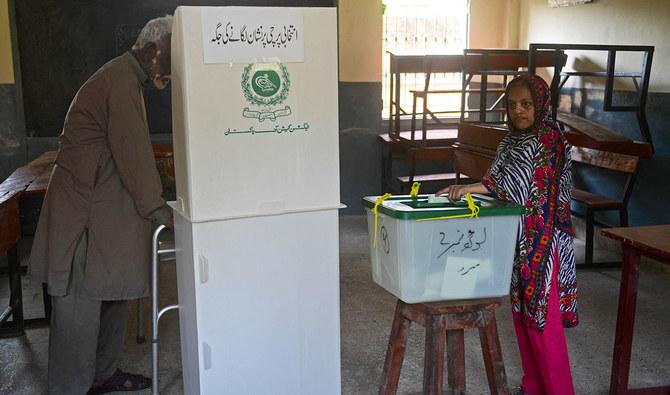

ISLAMABAD: The general elections in Pakistan’s Punjab and Khyber Pakhtunkhwa provinces should be held within 90 days after the dissolution of the assemblies as per the constitution, election and constitutional experts said on Wednesday, warning that a violation would be ‘extra constitutional.’
Former prime minister Imran Khan’s Pakistan Tehreek-e-Insaf (PTI) party dissolved both the provincial assemblies last month in a bid to force the federal government led by Prime Minister Shehbaz Sharif to announce early national elections. The federal government has rejected Khan’s demand, saying elections would be held on time in October.
The governors of Punjab and KP have not announced dates for general elections in their respective provinces yet though the assemblies were dissolved on Jan. 14 and 18, respectively.
On Monday, in comments made in parliament, Federal Law Minister Azam Nazir Tarar hinted at the possibility of extending the terms of the caretaker governments in the KP and Punjab, unleashing debate over whether such a move would be legal.
“This would be extra constitutional, to not hold general elections in Punjab and KP within 90 days of the dissolution of these assemblies,” Ali Zafar, a lawyer who is a PTI senator and represents the party in its legal cases, told Arab News.
“We have moved the Lahore High Court for directions to the governor and Election Commission of Pakistan for announcement of a date for the elections in Punjab,” he said. “The violation of the constitution can only be expected during martial law.”
Article 224 of the constitution says that when the National Assembly or a provincial assembly is dissolved, “a general election to the assembly shall be held within a period of ninety days after the dissolution.”
The ECP has also written separate letters to the Punjab and KP governors to announce dates for elections in their respective provinces, so that the regulator could start the electoral process, which requires at least 54 days to complete.
In response, KP Governor Hajji Ghulam Ali has advised the election commission to consult with law enforcement agencies before fixing an election date, given what he called an ‘alarming law and order situation in the province.’
“The Election Commission of Pakistan should consult and take into confidence the relevant institutions/LEA [law enforcement agencies] as well as political parties to ensure that conduct of general elections in a fair, free and peaceful manner in the province is possible,” the KP Governor said in a letter to the regulator.
Militancy has been on the rise in Pakistan in recent weeks and Peshawar, the capital of KP province, was hit this week by one of the deadliest attacks in recent memory, as a suicide bomber struck a mosque inside a police compound, killing over 100 people, at least 97 of them from police.
In his comments in parliament this week on the day of the Peshawar attack, Law Minister Tarrar said the constitution allowed for an extension in the tenure of a caretaker setup “in case of law and order or economic issues.”
He cited past examples of election delays due to floods in 1988 and the assassination of former Prime Minister Benazir Bhutto in 2007, which resulted in a change in the dates for the 2008 general elections.
Currently, Pakistan is in the grips of a deep economic crisis amid its biggest ever currency devaluation and a rash of emergency spending cuts, offering the clearest sign yet that the nuclear-armed nation faces the risk of a default unless it receives massive external support.
Tarrar and State Minister for Law and Justice Senator Shahadat Awan did not respond to attempts to seek comment for this story.
Election experts said the federal government wanted to delay the elections in Punjab and KP provinces, but there was no provision for it in the constitution.
“The constitution is very clear on holding the elections, so technically the government or even the election commission cannot delay them by just giving any excuse,” Rashid Chaudhry, deputy-director programs at the Free and Fair Election Network (FAFEN) in Islamabad, told Arab News.
He said it would be “unprecedented” to delay the elections in the provinces: “There is no room for it in the constitution.”
Chaudhry said a timeline was not given in the constitution about the election schedule, but a clear deadline of “within 90 days” was mentioned, which “must be respected.”
“It is beyond our imagination as to how the constitutional provision can be violated by the election commission,” he said, adding that the superior judiciary should intervene to ensure elections were held within the specific timeframe.
Concurring with Chaudhry, Ahmed Bilal Mehboob, president of the Pakistan Institute of Legislative Development and Transparency (PILDAT), said the election commission, not the federal government, was the relevant authority to decide on election dates.
“We cannot rule out a delay in the elections at the moment especially after the deadly Peshawar blast in which around hundred police personnel have been killed,” he told Arab News. “The election commission has already delayed local government elections in Islamabad and other territories following a request by the government.”
Constitutional experts said the federal government and the election commission would have to provide “solid reasons” if they decided to delay the elections.
“It is a constitutional requirement to hold the elections, so they cannot just violate it without any valid reason,” Justice (retired) Shaiq Usmani told Arab News.
However, he said the federal government and election commission could stave off the consequences of violating the constitution by citing Article 254, which states:
“When any act or thing is required by the constitution to be done within a particular period and it is not done within that period, the doing of the act or thing shall not be invalid or otherwise ineffective by reason only that it was not done within that period.”


