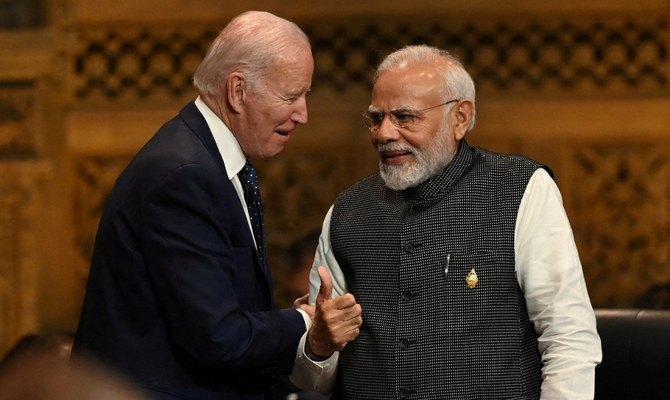
WASHINGTON: The White House is launching a partnership with India on Tuesday that President Joe Biden hopes will help the countries compete against China on military equipment, semiconductors and artificial intelligence.
Washington wants to deploy more Western mobile phone networks in the subcontinent to counter China’s Huawei Technologies, to welcome more Indian computer chip specialists to the United States and to encourage companies from both countries to collaborate on military equipment like artillery systems.
The White House faces an uphill battle on each front, including US restrictions on military technology transfer and visas for immigrant workers, along with India’s longstanding dependence on Moscow for military hardware.
Biden’s national security adviser, Jake Sullivan, and his Indian counterpart, Ajit Doval, are meeting with senior officials from both countries at the White House on Tuesday to launch the US-India Initiative on Critical and Emerging Technologies.
“The larger challenge posed by China — its economic practices, its aggressive military moves, its efforts to dominate the industries of the future and to control the supply chains of the future have had a profound impact on the thinking in Delhi,” said Sullivan.
New Delhi has frustrated Washington by participating in military exercises with Russia and increasing purchases of the country’s crude oil, a key source of funding for Russia’s war in Ukraine. But Washington has held its tongue, nudging the country on Russia while condoning India’s more hawkish stance on China.
On Monday, Sullivan and Doval participated in a Chamber of Commerce event with corporate leaders from Lockheed Martin Corp, Adani Enterprises and Applied Materials Inc.
While India is part of the Biden administration’s signature Asian engagement project Indo-Pacific Economic Framework (IPEF), it has opted against joining the IPEF trade pillar negotiations.
The initiative also includes a joint effort on space and high-performance quantum computing.
General Electric Co, meanwhile, is asking the US government for permission to produce jet engines with India that would power aircraft operated and produced by India, according to the White House, which says a review is underway.

US, India partnership targets arms and AI to compete with China
https://arab.news/6qu9z
US, India partnership targets arms and AI to compete with China
- Washington wants to deploy more Western mobile phone networks in the subcontinent to counter China’s Huawei Technologies, to welcome more Indian computer chip specialists to the United States
Israel defends Somaliland move at UN amid concerns over Gaza motives
- Some states question if recognition part of a bid to relocate Palestinians or establish military bases
- US President Donald Trump's peace plan for Gaza states: "No one will be forced to leave Gaza, and those who wish to leave will be free to do so and free to return"
- US accuses Security Council of double standards after Western countries recognized Palestinian state
UNITED NATIONS: Israel defended on Monday its formal recognition of the self-declared Republic of Somaliland, but several countries at the United Nations questioned whether the move aimed to relocate Palestinians from Gaza or to establish military bases.
Israel became the first country to recognize Somaliland as an independent and sovereign state on Friday.
The 22-member Arab League, a regional organization of Arab states in the Middle East and parts of Africa, rejects “any measures arising from this illegitimate recognition aimed at facilitating forced displacement of the Palestinian people or exploiting northern Somali ports to establish military bases,” Arab League UN Ambassador Maged Abdelfattah Abdelaziz told the UN Security Council.
“Against the backdrop of Israel’s previous references to Somaliland of the Federal Republic of Somalia as a destination for the deportation of Palestinian people, especially from Gaza, its unlawful recognition of Somaliland region of Somalia is deeply troubling,” Pakistan’s Deputy UN Ambassador Muhammad Usman Iqbal Jadoon told the council.
Israel’s UN mission did not immediately respond to a request for comment on the remarks or address any of them in its statement at the council meeting. In March, the foreign ministers of Somalia and Somaliland said they had not received any proposal to resettle Palestinians from Gaza.
US President Donald Trump’s peace plan for Gaza states: “No one will be forced to leave Gaza, and those who wish to leave will be free to do so and free to return.”
Israel’s coalition government, the most right-wing and religiously conservative in its history, includes far-right politicians who advocate the annexation of both Gaza and the West Bank and encouraging Palestinians to leave their homeland.
Somalia’s UN Ambassador Abukar Dahir Osman said council members Algeria, Guyana, Sierra Leone and Somalia “unequivocally reject any steps aimed at advancing this objective, including any attempt by Israel to relocate the Palestinian population from Gaza to the northwestern region of Somalia.”
SOMALILAND VS PALESTINIAN STATE
Somaliland has enjoyed effective autonomy — and relative peace and stability — since 1991 when Somalia descended into civil war, but the breakaway region has failed to receive recognition from any other country.
“It is not a hostile step toward Somalia, nor does it preclude future dialogue between the parties. Recognition is not an act of defiance. It is an opportunity,” Israel’s Deputy UN Ambassador Jonathan Miller told the council.
In September, several Western states, including France, Britain, Canada and Australia announced they would recognize a Palestinian state, joining more than three-quarters of the 193 UN members who already do so.
Deputy US Ambassador to the UN Tammy Bruce said: “This council’s persistent double standards and misdirection of focus distract from its mission of maintaining international peace and security.”
Slovenia’s UN Ambassador Samuel Zbogar disputed her argument, saying: “Palestine is not part of any state. It is illegally occupied territory ... Palestine is also an observer state in this organization.”
He added: “Somaliland, on the other hand, is a part of a UN member state and recognizing it goes against ... the UN Charter.”
Israel said last week that it would seek immediate cooperation with Somaliland in agriculture, health, technology and the economy. The former British protectorate hopes Israeli recognition will encourage other nations to follow suit, increasing its diplomatic heft and access to global markets.