

As rescuers pick through rubble of Peshawar attack, families of victims ‘buried alive’ under grief

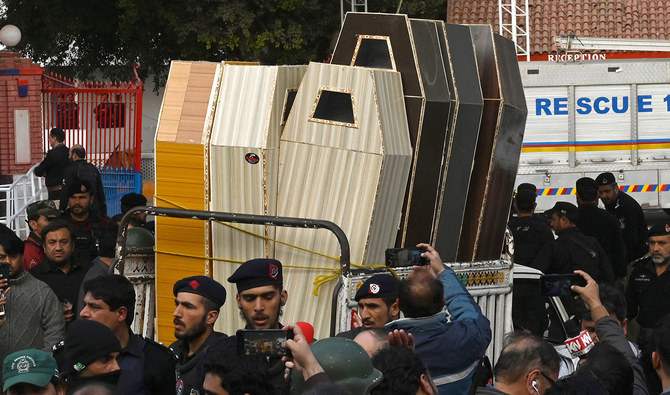
A vehicle transports caskets for bodies of the victims who died in a mosque blast inside the police headquarters in Peshawar on January 30, 2023. (Photo courtesy: AFP)
Short Url
Updated 31 January 2023
Follow

As rescuers pick through rubble of Peshawar attack, families of victims ‘buried alive’ under grief

  • Militant attacks are on the rise but Monday’s bombing at mosque inside police compound was the deadliest in recent memory
  • Police constable Muhammad Naeem, killed in the mosque attack, lost his father to a suicide bombing four decades ago

SWABI: Late on Monday night, school teacher Amir Ali wondered how he would convey the news to the family of Muhammad Naeem that the police constable had been killed in a deadly suicide bombing at a Peshawar mosque.

The news was so much harder to bear as Naeem had been inspired to join the law enforcement agency to honor the memory of his late father in uniform, who also died in a suicide attack over four decades ago.

Militant attacks against Pakistani security forces have risen since November last year, and Monday’s attack at a mosque located inside a police compound was the deadliest in recent memory, killing more than 90 people as they offered afternoon prayers.

“Last night, amid a shadow of grief, no one was ready to tell the family about the tragic news that Muhammad Naeem had died in the bomb blast,” Ali, who is related to the slain policeman, told Arab News on Tuesday.
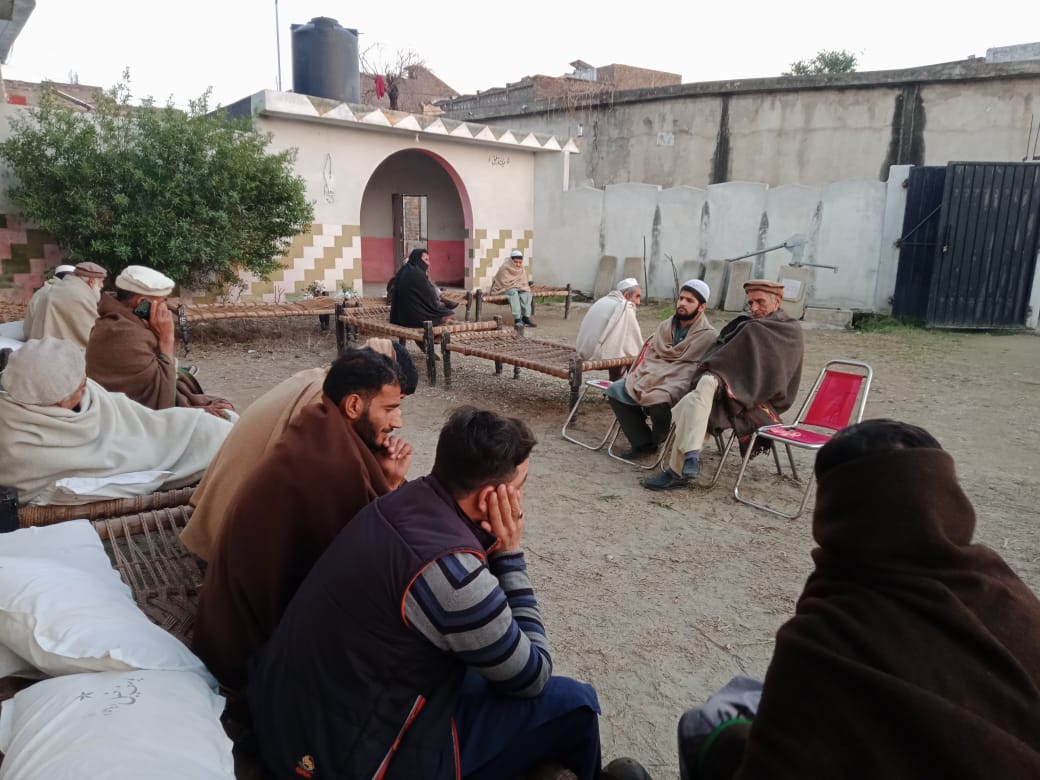


Villagers gather for prayers for the departed soul of Muhammad Naeem, a police constable who died in a mosque blast in Peshawar, at the residence of slain police officer in Swabi district of Khyber Pakhtunkhwa province, on January 31, 2023. (AN Photo)

He said Naeem was in his late 40s and his death had come as a “huge shock” to people in his native town of Swabi since he was the only son of of the late police officer Hajji Raheem, killed in a blast at Pishtakhara Police Station in Peshawar in 1980.

Naeem, who joined the police force about 16 years ago, is survived by a widow, two sons, and three daughters.

“I heard about the blast in Peshawar but didn’t believe that my father was among the dead,” Naeem’s 15-year-old son, Maaz Naeem, said. “But when our relatives started whispering to each other, I suspected that my father was killed.”

Naeem had left home to be back at work in Peshawar only a day before the blast, Maaz said.

“Now we are repenting that we should have forced him to stay back for one more day,” he added. “My grandmother is shattered. She was also screaming due to the shock of losing her son.”

“I don’t know how to express my grief. I have nothing to share but I lost my friend and father.”


File photo of Muhammad Naeem, a police constable from Swabi district of Khyber Pakhtunkhwa province, who died in a mosque blast in Peshawar. (Photo credit: Amir Ali)

Bahar Ali, the elder brother of Iftikhar Ali, another police officer killed in the attack, told Arab News the incident was “unbearable” for his family.

“We are poor people and we were proud of him after he joined the police,” he said, referring to his 28-year-old brother. “It is almost like the sky has collapsed and we have been buried alive under it.”

Ali said he had dialed his late brother’s cell phone number soon after the he heard news of the blast but found it powered off. That was when he rushed to Lady Reading Hospital in Peshawar where the dead and the wounded were being taken.

“I found the body of my brother at 10pm last night,” Ali said.

The slain officer, who joined the Khyber Pakhtunkhwa police in 2011, is survived by two daughters and a widow.

“His wife is unable to speak or eat ever since she has heard about her husband’s death,” Ali said. “We don’t know who to blame or how to mourn his untimely loss.”


At ECO meeting, Pakistan proposes ‘Regional Innovation Hub’ to curb natural disasters

Updated 21 January 2026
Follow

At ECO meeting, Pakistan proposes ‘Regional Innovation Hub’ to curb natural disasters

  • Pakistan hosts high-level 10th ECO Ministerial Meeting on Disaster Risk Reduction in Islamabad
  • Innovation hub to focus on early warning technologies, risk informed infrastructure planning

ISLAMABAD: Pakistan has proposed to set up a “Regional Innovation Hub on Disaster Risk Reduction” that focuses on early warning technologies and risk informed infrastructure planning, the Press Information Department (PID) said on Wednesday, as Islamabad hosts a high-level meeting of the Economic Cooperation Organization (ECO).

The ECO’s 10th Ministerial Meeting on Disaster Risk Reduction (DRR) is being held from Jan. 21-22 at the headquarters of the National Disaster Management Authority (NDMA) in Pakistan’s capital. 

The high-level regional forum brings together ministers, and senior officials from ECO member states, representatives of the ECO Secretariat and regional and international partner organizations. The event is aimed to strengthen collective efforts toward enhancing disaster resilience across the ECO region, the PID said. 

“Key agenda items include regional cooperation on early warning systems, disaster risk information management, landslide hazard zoning, inclusive disaster preparedness initiatives, and Pakistan’s proposal to establish a Regional Innovation Hub on Disaster Risk Reduction, focusing on early warning technologies, satellite data utilization, and risk-informed infrastructure planning,” the statement said. 

The meeting was attended by delegations from ECO member states including Pakistan, Türkiye, Azerbaijan, Iran, Kyrgyzstan, Tajikistan, Turkmenistan and Uzbekistan. Representatives of regional and international organizations and development partners were also in attendance.

Discussions focused on enhancing regional coordination, harmonizing disaster risk reduction frameworks, and strengthening collective preparedness against transboundary and climate-induced hazards impacting the ECO region, the PID said. 

ECO members states such as Pakistan, Türkiye, Afghanistan and others have faced natural calamities such as floods and earthquakes in recent years that have killed tens of thousands of people. 

Heavy rains triggered catastrophic floods in Pakistan in 2022 and 2025 that killed thousands of people and caused damages to critical infrastructure, inflicting losses worth billions of dollars. 

Islamabad has since then called on regional countries to join hands to cooperate to avert future climate disasters and promote early warning systems to avoid calamities in future.