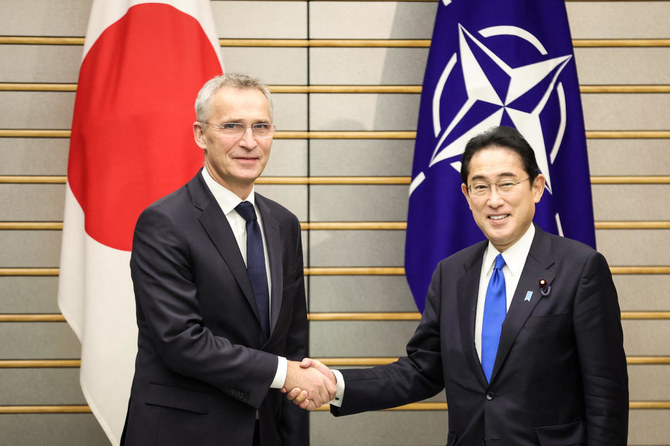
TOKYO: NATO chief Jens Stoltenberg and Japanese premier Fumio Kishida pledged on Tuesday to strengthen ties, saying Russia’s invasion of Ukraine and its growing military co-operation with China had created the most tense security environment since World War Two.
The comments came in a statement issued during Stoltenberg’s trip to Japan following a visit to South Korea on which he urged Seoul to increase military support to Ukraine and gave similar warnings about rising tension with China.
“The world is at a historical inflection point in the most severe and complex security environment since the end of World War II,” the two leaders said in the statement.
It also raised concerns about Russia’s nuclear threats, joint military drills between Russia and China near Japan, and North Korea’s development of nuclear weapons.
Stoltenberg told reporters a Russian victory in Ukraine would embolden China at a time when it is building up its military, “bullying its neighbors and threatening Taiwan.”
He added, “This war is not just a European crisis, but the challenge to the world order.
“Beijing is watching closely, and learning lessons that may influence its future decisions. What is happening in Europe today could happen in East Asia tomorrow.”
While the North Atlantic Treaty Organization groups 30 countries in Europe and North America, Stoltenberg has said its members are affected by global threats.
Kishida and South Korean President Yoon Suk-yeol became the first leaders from their countries to attend a NATO summit last year, joining as observers.
China has previously criticized NATO’s efforts to expand its alliances in Asia. Russia, which calls its invasion of Ukraine a “special operation,” has repeatedly cast NATO’s expansion as a threat to its security.
Late last year, Japan unveiled sweeping plans to beef up its defense capabilities, changes once unthinkable for a pacifist country that will make it the third-biggest military spender after the United States and China.
Bolstering its co-operation with NATO in areas from maritime security and arms control to cyberspace and disinformation will further help to respond to the changing strategic environment, the statement added.
The meeting comes as Japan prepares to host the annual Group of Seven (G7) summit in May, when Russia’s invasion of Ukraine is expected to be a major topic of discussion.
Kishida is considering visiting Kyiv in February to reinforce his support for Ukraine in the conflict, domestic media have said.


![]()

Japan and NATO to further strengthen cooperation — joint statement
Short Url
https://arab.news/n3mqx
Japan and NATO to further strengthen cooperation — joint statement
- Security environment is most tense since World War Two -leaders
- Concern voiced over Russia’s nuclear threats, drills with China


Latest updates


© 2026 SAUDI RESEARCH & PUBLISHING COMPANY, All Rights Reserved And subject to Terms of Use Agreement.