Turkiye’s Erdogan signals Finland’s NATO bid may be considered over Sweden

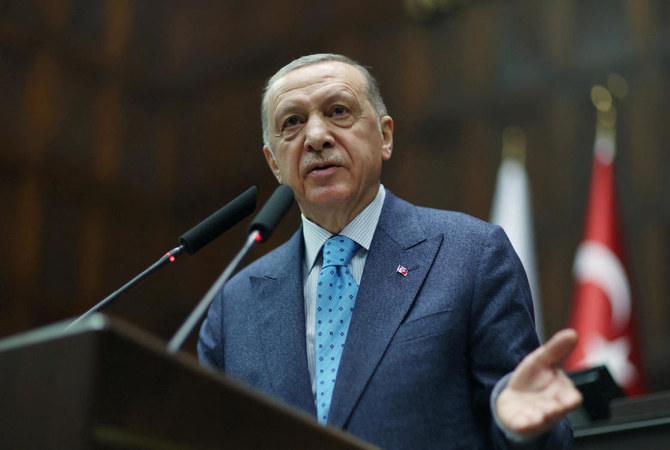
Turkish President Tayyip Erdogan addresses lawmakers of his AK Party during a meeting in parliament in Ankara, Turkey. (File/Reuters)
Short Url
Updated 29 January 2023
Follow

Turkiye’s Erdogan signals Finland’s NATO bid may be considered over Sweden

  • Turkiye suspended NATO talks with Sweden and Finland last week after a protest in Stockholm in which a far-right politician burned a copy of the Qur’an

ANKARA: Turkish President Tayyip Erdogan signalled on Sunday that Ankara may agree to Finland joining NATO ahead of Sweden, amid growing tensions with Stockholm.
“We may deliver Finland a different message (on their NATO application) and Sweden would be shocked when they see our message. But Finland should not make the same mistake Sweden did,” Erdogan said in a televised speech aired on Sunday.
Sweden and Finland applied last year to join NATO following Russia’s invasion of Ukraine and need all member countries’ approval to join. Turkiye and Hungary are yet to ratify the Nordic countries’ membership.
Turkiye says Sweden, in particular, harbors what Ankara says are militants from the banned Kurdistan Workers Party (PKK), which took up arms against the Turkish state in 1984.
“We gave Sweden a list of 120 persons and told them to extradite those terrorists in their country. If you don’t extradite them, then sorry about that,” Erdogan said, referring to Turkiye’s agreement with Sweden and Finland last June over their NATO application.
Turkiye suspended NATO talks with Sweden and Finland last week after a protest in Stockholm in which a far-right politician burned a copy of the Qur’an.
Swedish Prime Minister Ulf Kristersson said his country wanted to restore NATO dialogue with Turkiye, but Turkish Foreign Minister Mevlut Cavusoglu said on Thursday it was meaningless to restart talks.
Cavusoglu also said there was “no offer to evaluate Sweden’s and Finland’s NATO membership separately.”


Syria’s Sharaa grants Kurdish Syrians citizenship, language rights for first time, SANA says

Updated 7 sec ago
Follow

Syria’s Sharaa grants Kurdish Syrians citizenship, language rights for first time, SANA says

  • The decree for ⁠the first time grants Kurdish Syrians rights, including recognition of Kurdish identity as part of Syria’s national fabric
  • It designates Kurdish as a national language alongside Arabic and allows schools to teach it

DAMASCUS: Syria’s President Ahmed Al-Sharaa issued a decree affirming the rights of the Kurdish Syrians, formally recognizing their language and restoring citizenship to all Kurdish Syrians, state news agency SANA reported on Friday.
Sharaa’s decree came after fierce clashes that broke out last week in the northern city of Aleppo, leaving at least 23 people dead, according to Syria’s health ministry, and forced more than 150,000 to flee the two Kurdish-run pockets of the city.
The clashes ended ⁠after Kurdish fighters withdrew.
The violence in Aleppo has deepened one of the main faultlines in Syria, where Al-Sharaa’s promise to unify the country under one leadership after 14 years of war has faced resistance from Kurdish forces wary of his Islamist-led government.
The decree for ⁠the first time grants Kurdish Syrians rights, including recognition of Kurdish identity as part of Syria’s national fabric. It designates Kurdish as a national language alongside Arabic and allows schools to teach it.
It also abolishes measures dating to a 1962 census in Hasaka province that stripped many Kurds of Syrian nationality, granting citizenship to all affected residents, including those previously registered as stateless.
The decree declares Nowruz, the ⁠spring and new year festival, a paid national holiday. It bans ethnic or linguistic discrimination, requires state institutions to adopt inclusive national messaging and sets penalties for incitement to ethnic strife.
The Syrian government and the Kurdish-led Syrian Democratic Forces (SDF), that controls the country’s northeast, have engaged in months of talks last year to integrate Kurdish-run military and civilian bodies into Syrian state institutions by the end of 2025, but there has been little progress.