

At least 50 killed in two separate transport incidents in Pakistan 

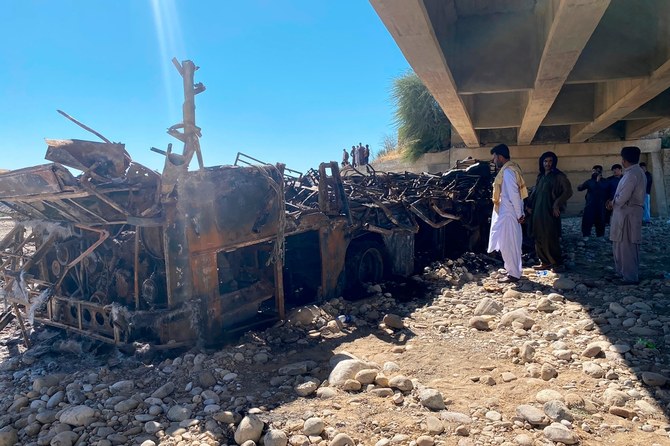
People look at the burnt wreckage of a bus after an accident in Bela, Lasbela, Balochistan, Pakistan, Sunday, Jan. 29, 2023. (AP Photo)
Short Url
Updated 30 January 2023
Follow

At least 50 killed in two separate transport incidents in Pakistan 

  • A passenger bus fell into a ravine and caught fire in Balochistan’s Bela area, killing at least 40 people 
  • In second mishap, 10 children were killed after their ferry capsized in country’s northwest on Sunday 

KARACHI: At least 50 people were killed in two separate transport disasters in Pakistan on Sunday, officials said, renewing a debate about poor transport safety protocols in the South Asian country.  

In the first incident, a passenger bus fell into a ravine and later caught fire in the Bela area of Pakistan’s southwestern Balochistan province, where road accidents claim thousands of lives annually.   

Balochistan, a mountainous, desert region bordering Afghanistan and Iran, is Pakistan’s largest but most impoverished province, with a staggering 40,000-km network of road infrastructure.   

According to the motorway police, 6,000 to 8,000 people die each year in accidents across the Balochistan province, mainly on single-lane roads that have infamously come to be known as “killer highways.”   

“A bus going from Quetta to Karachi plunged into a ravine and caught fire at around 3 a.m.,” Hamza Anjum Nadeem, the Bela assistant commissioner, told Arab News. “At least 39 bodies have been recovered and a search for others is underway.”  

Anjum later confirmed the death of another passenger, taking the count to 40. Of these, 38 dead bodies were being moved to the southern port city of Karachi, 177 km away from Bela, for medico-legal formalities, Karachi Police Surgeon Dr. Summaiya Syed told Arab News.  

Balochistan is the epicenter of the $64 billion China-Pakistan Economic Corridor, a road and infrastructure development plan, which aims to ultimately provide the shortest route for Chinese cargo headed for the Middle East, Africa and Central Asia. 

Major roads are slated for construction under the CPEC, including the road from Balochistan’s Khuzdar district to the Chinese-funded, deep-water port of Gwadar. But for now, the absence of dual carriageways, inadequate training of drivers, and a lack of highway patrols mean thousands continue to die on these roads each year.

In another incident, 10 children died when their boat capsized in Tanda Dam lake near Kohat in the country’s northwest, according to police.  

All of the dead recovered so far were aged between 7 and 14 years, local police official Mir Rauf told the AFP news agency. Rauf said 11 children had been rescued from the water, with six in critical condition. The boat was carrying between 25 and 30 students on a day trip from a local madrassa when it overturned.  

“A rescue operation is underway,” Rauf said. Mass drownings are common in Pakistan when aged and overloaded vessels lose their stability and pitch passengers into the water. In July, 18 women drowned when an overcrowded boat carrying a wedding party across the Indus river in Punjab province capsized.  

The South Asian country also has poor road safety controls, and thousands of lives are lost to road crashes each year, particularly in the southwestern Balochistan province.  

According to the National Road Safety Strategy 2018-2030, a report administered by the Asian Development Bank that cited police data, 6,548 people died at the scene of an accident on Pakistan’s roads in 2016. Of these, 355 fatalities happened on national highways and 6,003 on provincial roads.  

At least seven people were killed and 15 others were injured after a passenger bus collided with a truck in Balochistan’s Killa Saifullah district this month. In June last year, 22 people were killed when a passenger bus veered off a narrow road and fell into a ravine in the same district.


Trump renews push to annex Greenland

Updated 10 sec ago
Follow

Trump renews push to annex Greenland

  • President Donald Trump doubled down Sunday on his claim that Greenland should become part of the United States, despite calls by Denmark’s prime minister to stop “threatening” the territory
COPENHAGEN: President Donald Trump doubled down Sunday on his claim that Greenland should become part of the United States, despite calls by Denmark’s prime minister to stop “threatening” the territory.
Washington’s military intervention in Venezuela has reignited fears for Greenland, which Trump has repeatedly said he wants to annex, given its strategic location in the Arctic.
While aboard Air Force One en route to Washington, Trump reiterated the goal.
“We need Greenland from the standpoint of national security, and Denmark is not going to be able to do it,” he said in response to a reporter’s question.
“We’ll worry about Greenland in about two months... let’s talk about Greenland in 20 days.”
Over the weekend, the Danish prime minister called on Washington to stop “threatening its historical ally.”
“I have to say this very clearly to the United States: it is absolutely absurd to say that the United States should take control of Greenland,” Prime Minister Mette Frederiksen said in a statement.
She also noted that Denmark, “and thus Greenland,” was a NATO member protected by the agreement’s security guarantees.
’Disrespectful’
Trump rattled European leaders by attacking Caracas and grabbing Venezuelan president Nicolas Maduro, who is now being detained in New York.
Trump has said the United States will now “run” Venezuela indefinitely and tap its huge oil reserves.
Asked in a telephone interview with The Atlantic about the implications of the Venezuela military operation for mineral-rich Greenland, Trump said it was up to others to decide.
“They are going to have to view it themselves. I really don’t know,” Trump was quoted as saying.
He added: “But we do need Greenland, absolutely. We need it for defense.”
Hours later, former aide Katie Miller, the wife of Trump’s most influential adviser, drew ire by posting an image of Greenland in the colors of the US flag, captioning it “SOON.”
Greenland’s Prime Minister Jens-Frederik Nielsen called Miller’s post “disrespectful.”
“Relations between nations and peoples are built on mutual respect and international law — not on symbolic gestures that disregard our status and our rights,” he wrote on X.
But he also said “there is neither reason for panic nor for concern. Our country is not for sale, and our future is not decided by social media posts.”
Allies?
Stephen Miller is widely seen as the architect of much of Trump’s policies, guiding the president on his hard-line immigration policies and domestic agenda.
Denmark’s ambassador to the United States, Jesper Moeller Soerensen, offered a pointed “friendly reminder” in response to Katie Miller’s post that his country has “significantly boosted its Arctic security efforts” and worked together with Washington on that.
“We are close allies and should continue to work together as such,” Soerensen wrote.
Katie Miller was deputy press secretary under Trump at the Department of Homeland Security during his first term.
She later worked as communications director for then-vice president Mike Pence and also acted as his press secretary.