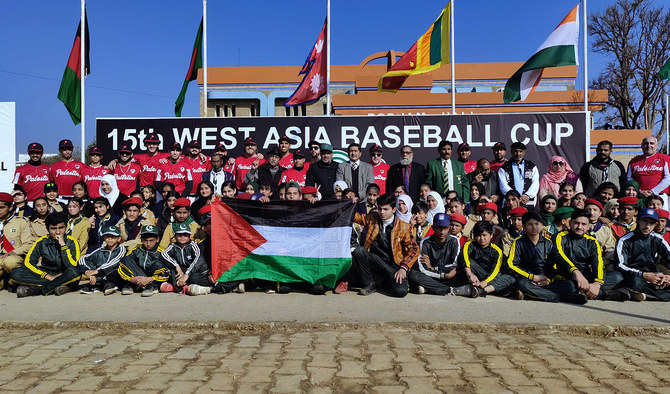
ISLAMABAD: The Palestinian baseball team, which is currently in Pakistan to participate in the 15th West Asia Cup, aims to uplift the Palestinian people through sports, its members said on Friday, as they called for “freedom of movement” in the occupied Palestinian territories.
The seven-nation event, organized by the Pakistan Baseball Federation (PBF), is being held at the Pakistan Sports Complex in Islamabad from January 27 till February 1. Apart from the host Pakistan, teams from Palestine, Nepal, Sri Lanka, Bangladesh, India and Afghanistan are participating in the event.
For most of the Palestinians, nothing comes easily, be it survival in the occupied territories or fulfilling their aspirations. However, the Palestinian baseball players, who are making their international debut, say they are “excited” to be a part of the tournament.
“We are using sports to uplift our people and show that there is humanity in our people. Our people deserve to be represented well, you know, our people deserve to have sports, freedom of movement,” Nader Ihmoud, a second baseman and designated hitter, told Arab News.
Israel’s occupation of the Palestinian territories since 1948 has been a major issue and has had consequences for the Palestinians in every field.
To participate in the West Asia Cup, Palestinian players from the Gaza Strip and the United States came together to form a team. The squad, which was formed two and a half years ago but has been facing difficulties in practicing together, was invited to the tournament by the Baseball Federation of Asia.
“Most of our players are in the US and half in Gaza and imagine we can’t practice together. We should be able to practice together wherever we need but we can’t because of the occupation does what it does,” said Ihmoud, who lives in the US.
“You can ask Gaza people [teammates] how hard it was for them to come to this tournament. It should be very easy for me to travel to Gaza and play with my teammates but it’s not.”
Tariq Suboh, the Palestinian catcher, said with this tournament the team want to do their part to put Palestine on the international sports stage with an impact. “We want the world to know our community for athletics,” he maintained.
“The players have not been able to properly practice because of the community’s financial constraints and distances [from one state to another] but together we are ready to showcase our passion,” Suboh added.
“We hope this [tournament] is the start of a bright future of baseball in Palestine.”
The PBF has partnered with Baseball United, first-ever professional baseball league that helps develop the game across the Middle East and South Asia, to host the West Asia Cup, an official World Baseball Softball Confederation (WBSC) tournament.
In a country where cricket is the most popular sport — played, watched and loved by people — Shah has been carrying forward the legacy of his father, the late Syed Khawar Shah, to promote baseball by representing Pakistan in several international tournaments.
The baseball governing body, founded in 1992, has been conducting several international tournaments including Asian Baseball Cup and Asian Baseball Championship.
In October last year, the Pakistani team represented the country at World Baseball Classic (WBC) Qualifiers in Panama City, bringing a game in spotlight with the rare participation, but lost the opening match against Argentina.
This was also the first time Pakistan scored a run in the WBC since its participation in 2016.
Speaking to Arab News, PBF President Syed Fakhar Ali Shah said the sports body aims to help participants play an international league being organized by Baseball United in Dubai in November.
“They [Baseball United] are saying they might give $5,000 to each player if they join the league,” Shah added.

With West Asia Cup debut, Palestine team hopes to nurture sports talent at home
https://arab.news/p92ss
With West Asia Cup debut, Palestine team hopes to nurture sports talent at home
- The Palestinian baseball team is participating in the ongoing tournament in Pakistan with other nations
- Palestinian players from US and Gaza Strip formed a team which was then invited to play in Pakistan
Pakistan considers shift to net billing for rooftop solar to ease power sector losses
- As per new proposal, solar consumers will sell electricity to national grid at around 60 percent lower rates, buy power at prevailing commercial rates
- Solar associations warn consumers will suffer if plan is approved, alleging it is aimed at benefiting Pakistan’s power distribution companies
ISLAMABAD: Pakistan’s government is considering replacing its net metering policy for rooftop solar with a net billing mechanism for solar consumers across the country, an official confirmed on Wednesday, as Islamabad looks to ease financial strain on the struggling power sector.
Under the proposed framework for the net billing system, electricity generated by rooftop solar systems and exported to the national grid by consumers would be bought at a rate 60 percent lower than the previous price of electricity. Consumers, on the other hand, will continue to buy power from the national grid at the prevailing commercial rates. Net metering, on the other hand, allows power consumers to offset exported units directly against imported electricity at the same price.
Government officials say the policy change is aimed at easing mounting financial pressure on Pakistan’s power sector, where rapid solar adoption has reduced revenues for distribution companies even as fixed capacity payments to power producers continue to rise.
Pakistan has seen a surge in residential and commercial solar systems in recent years as soaring electricity prices drive inflation and power outages increase in the country.
“Under the proposed regulations, net billing will apply to both old and new customers who will have to pay full commercial tariffs for all imported units,” a National Electric Power Regulatory Authority (NEPRA) official told Arab News on condition of anonymity as he was not authorized to speak to the media.
However, he clarified the new rules would be implemented after a public hearing and NEPRA obtains feedback from stakeholders.
Commercial electricity tariffs range between Rs30 and Rs50 per unit depending on consumption slabs, taxes, fixed charges and Time of Use (TOU) rates. The official said the average energy price stands at Rs10–12 per unit, while the average Power Purchase Price (PPP) stands at around Rs25 per unit.
As per the government’s proposal, which is available on NEPRA’s website, new solar consumers would get the lower average energy price while existing customers would continue receiving the higher PPP rates until the expiry of their seven-year contracts.
Pakistan Energy Minister Sardar Awais Leghari told Arab News the government would present its position during NEPRA’s public hearing expected next month.
“Contractual obligations will be fulfilled for existing consumers while new consumers will receive energy rates for their produced units as per NEPRA’s proposal,” Leghari said, adding that consultations would continue for at least a month.
Asked whether the policy could be revised, Leghari said: “Only if the regulator approves.”
The government’s proposal has sparked strong concerns among consumers, energy experts and industry stakeholders, who warn the plan could slow the adoption of renewable energy as Pakistan struggles with climate vulnerability, rising fuel import bills and deepening circular debt in the power sector.
Hasnat Ahmad Khan, senior vice president of the Pakistan Solar Association (PSA), told Arab News that consumers would suffer if the new regulations are approved.
“People have invested their hard-earned money to install solar systems and many have even taken loans,” Khan noted. “The new rules will make it difficult for them to recover their investment.”
Khan said industry representatives recently met NEPRA officials, urging them to protect existing consumers and allow new solar users to sell surplus electricity at the PPP rates of around Rs25 per unit instead of lower energy rates.
“This is green energy and it should be encouraged,” he said. “If change is unavoidable, existing consumers must be protected and new consumers should at least be given PPP rates.”
Khan warned that the new regulations would benefit only power distribution companies.
“They will buy solar energy at very low rates and sell it to non-solar neighbors at much higher tariffs,” he noted.
The PSA official said utilities should pay more for solar power since it is supplied without transmission losses.
Pakistan, one of the countries most affected by climate change, has repeatedly pledged to increase its share of renewable energy in its power mix.
Critics argue that weakening incentives for rooftop solar risks undermining those commitments and could place an additional burden on consumers already suffering from inflation and rising utility costs.