

UK Home Office rules on asylum seekers branded ‘ludicrous’ by Labour MP

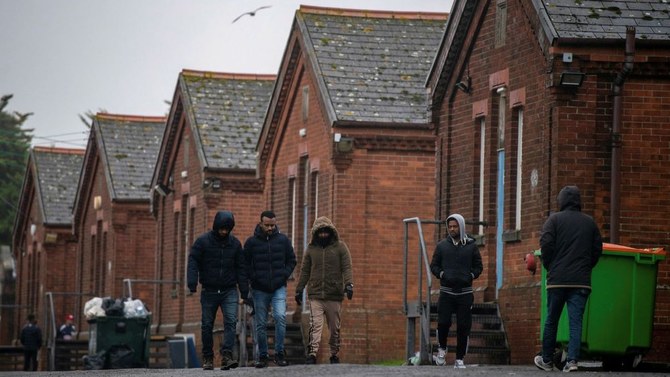
Asylum seekers in Napier Barracks, near Folkestone, in Kent, England. (Getty Images)
Short Url
Updated 25 January 2023
Follow

UK Home Office rules on asylum seekers branded ‘ludicrous’ by Labour MP

  • Tens of thousands unable to receive application outcomes while stuck in temporary shelters
  • Up to 45,000 have yet to find permanent accommodation, costing the UK millions

LONDON: The UK is unable to tell thousands of asylum seekers in temporary accommodation whether or not their applications have been approved or rejected because of rules branded “totally ludicrous” by a senior Labour MP.

A report by The Independent revealed UK Home Office rules prevent asylum seekers in hotels from receiving information on the outcome of their cases “until they have been moved from initial accommodation.”

The UK is facing a backlog in processing cases, with more than 140,000 people awaiting decisions. Home Secretary Suella Braverman has blamed delays on an increase in migrants crossing the English Channel illegally in small boats last year combined with “low productivity” in the civil service.

It has led to private landlords and companies being asked to provide shelter, with hotels and holiday parks repurposed to house people from as far afield as Syria and Afghanistan, with the two countries making up the largest asylum seeker cohorts.

Asylum seekers are meant to spend just a month in the shelters, but there are about 45,000 people who have yet to have been moved to more permanent locations.

Some have been waiting for well over a year for an outcome despite approval rates at nearly 98 percent for Afghans and Syrians, with asylum seekers left unable to work until their applications are approved.

They are forced to rely on the state for shelter and food, receiving additional support of as little as £8 ($9.85) a week, costing the UK taxpayer about £7 million every day.

Yvette Cooper, Labour’s shadow home secretary, told The Independent: “This is just increasing the costs to the taxpayer, too, as thousands of people are stuck in hotels, because the Home Office can’t get a grip.”

Dame Diana Johnson, chair of the House of Commons’ Home Affairs Select Committee, told the newspaper: “The government’s slow asylum processes have left some individuals waiting years for their claim to be decided. The result is an enormous backlog of asylum claims, a huge hotel bill for the public purse and people left in limbo — unable to move forward with their lives.

“The prime minister (Rishi Sunak) has publicly pledged to clear the asylum backlog by the end of this year. It is concerning to hear of yet another potential blockage in Home Office processes undermining this promise. We need urgent clarification from the government on this.”

Enver Solomon, CEO of the Refugee Council, told The Independent: “The Home Office’s failure to communicate its decisions on people’s asylum claims in a timely manner is deeply damaging to men, women and children who have lost everything.

“Refugees who are stuck in limbo in our asylum system have gone through extremely traumatic experiences and all they want is to feel safe and be able to integrate in the UK.”


EU, India successfully conclude major trade deal: New Delhi

Updated 3 sec ago
Follow

EU, India successfully conclude major trade deal: New Delhi

  • Indian government officials say the pact, which was two decades in the making, will be unveiled Tuesday
  • European Commission President Ursula von der Leyen and European Council president Antonio Costa appear as guests of honor at India’s Republic Day parade
NEW DELHI: India and the European Union have finalized a massive free trade deal, Indian government officials said on Monday, about two decades after negotiations were first launched.
Facing challenges from China and the United States, Brussels and New Delhi have sought closer ties, producing a pact that is to be unveiled in the Indian capital on Tuesday.
Feted Monday as guests of honor at India’s Republic Day parade, European Commission President Ursula von der Leyen and European Council president Antonio Costa are to meet Indian Prime Minister Narendra Modi for a summit.
“Official level negotiations are being concluded and both sides are all set to announce the successful conclusion” of talks at the Tuesday summit, Indian commerce secretary Rajesh Agrawal told AFP.
The EU has eyed India — the world’s most populous nation — as an important market for the future, while New Delhi sees the European bloc as an important source of much-needed technology and investment to rapidly upscale its infrastructure and create millions of new jobs.

’Mother of all deals’

Bilateral trade in goods reached 120 billion euros ($139 billion) in 2024, an increase of nearly 90 percent over the past decade, according to EU figures, with a further 60 billion euros ($69 billion) in trade in services.
India’s Commerce Minister Piyush Goyal has described the new pact as “the mother of all deals.”
“Final negotiations have been focused and fruitful, and we are now very optimistic that we will land this historic trade deal,” an EU official said Monday speaking on condition of anonymity.
Under the agreement, India is expected to ease market access for key European products, including cars and wine, in return for easier exports of textiles and pharmaceuticals, among other things.
“The EU stands to gain the highest level of access ever granted to a trade partner in the traditionally protected Indian market,” von der Leyen said on Sunday, adding that she expected exports to India to double.
“We will gain a significant competitive advantage in key industrial and agri-good sectors.”
Talks went down to the wire on Monday, focusing on a few sticking points, including the impact of the EU’s carbon border tax on steel, according to sources familiar with the discussions.
The accord comes as both Brussels and New Delhi have sought to open up new markets in the face of US tariffs and Chinese export controls.
India and the EU were also expected to conclude an accord to facilitate movement for seasonal workers, students, researchers and highly skilled professionals, and a security and defense pact.
“India and Europe have made a clear choice. The choice of strategic partnership, dialogue and openness,” von der Leyen wrote on social media. “We are showing a fractured world that another way is possible.”
New Delhi, which has relied on Moscow for key military hardware for decades, has tried to cut its dependence on Russia in recent years by diversifying imports and pushing its own domestic manufacturing base.
Europe is doing the same with regard to the United States.